


Japanese You Keep Seeing:「よろしくお願いします」を自己紹介の最後に言うのはなぜ?|Japanese Grammar (N5–N3)
(Raya standing up and bowing at a traditional welcome dinner, saying “Yoroshiku onegaishimasu” to Director Tanaka. An orange cat plays with a lantern nearby.) Welcome to “Japanese You Keep Seeing”! In...

Japanese You Keep Seeing: 初対面で聞く「はじめまして」って本当は何を言っている? |Japanese Grammar (N5–N3)
(Raya bowing and saying “Hajimemashite” to Director Tanaka in an elegant hotel lounge, with Joy, Ken, and a sleeping orange cat nearby) Welcome to “Japanese You Keep Seeing”! If you open...

Japanese You Keep Seeing: 日本人がよく言う「そうなんだ」ってどんな気持ち?|Japanese Grammar (N5–N3)
(Joy saying “Sou nanda!” with mild realization while taking reference photos with Ken and Raya in a botanical greenhouse. An orange cat sleeps nearby.) Welcome to “Japanese You Keep Seeing”! If you...

Japanese You Keep Seeing:「なるほど」はどんな時に使う?|Japanese Grammar (N5–N3)
(Joy having an “Aha!” moment saying “Naruhodo!” at a Kyoto matcha cafe with Ken, Raya, and a sleeping orange cat) Welcome to “Japanese You Keep Seeing”! When you watch anime or listen...

Japanese You Keep Seeing: 「ほんと?」をよく聞くけど、いつ使う?|Japanese Grammar (N5–N3)
(Joy looking thrilled and saying “Honto?” at a Japanese summer festival with Ken, Raya, and a cute orange cat) Welcome to “Japanese You Keep Seeing”! If you share a surprising story...

Japanese You Keep Seeing:日本人が会話でよく言う「まあ」って何?|Japanese Grammar (N5–N3)
(Alt Text: Ken saying “Maa maa” to calm a frustrated Joy at a Japanese Izakaya, with Raya smiling and an orange cat peeking from behind a menu) Welcome to “Japanese You...

Japanese You Keep Seeing:「どうぞ」は“Please”だけじゃない?よく聞く理由|Japanese Grammar (N5–N3)
(Ken offering Japanese sweets to Raya and Joy saying “Douzo” in a traditional tatami room, with an orange cat sleeping on a cushion) Welcome to “Japanese You Keep Seeing”! If you...

Japanese You Keep Seeing: 「あの…」は何の意味?日本人が話す前によく言う理由|Japanese Grammar (N5–N3)
(Joy hesitantly saying “Ano…” to politely interrupt Ken who is reading in a bookstore/cafe, with Raya browsing nearby and an orange cat sleeping) Welcome to “Japanese You Keep Seeing”! Have you...

Japanese You Keep Seeing:「えっ?」は失礼?日本人が驚いた時によく言う一言|Japanese Grammar (N5–N3)
(Joy looking shocked at a claw machine saying “Eh?”, with Raya and Ken at a Japanese arcade, and an orange cat sleeping nearby) Welcome to “Japanese You Keep Seeing”! In English-speaking...

Japanese You Keep Seeing:日本人がよく言う「そうそう」ってどういう意味|Japanese Grammar (N5–N3)
( Raya pointing at Joy’s phone, saying “Sou Sou!”, sitting with Joy and Ken in a cafe with a sleeping orange cat nearby) Welcome to “Japanese You Keep Seeing”! Welcome back...
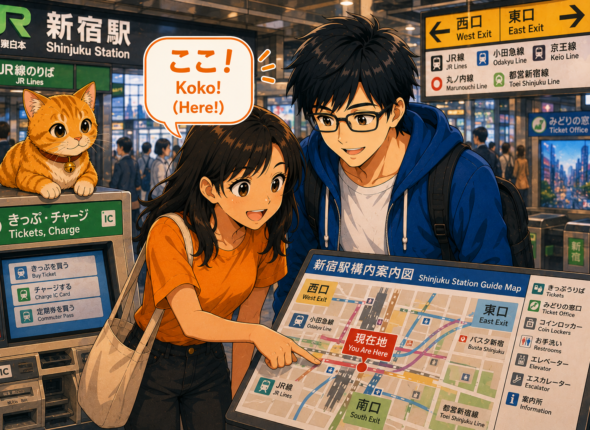
Japanese You Keep Seeing:「ここ」ってどこ?会話で何度も聞く基本の日本語|Japanese Grammar (N5–N3)
(Alt Text: Joy pointing at a station map saying “Koko!”, standing with Ken while a cute orange cat sits on a ticket machine) Welcome to “Japanese You Keep Seeing”! In this series,...

Japanese You Keep Seeing: 「これ」って何?日本語初心者が最初によく聞く言葉 |Japanese Grammar (N5–N3)
(Raya pointing at a souvenir saying “Kore!”, standing with Joy and Ken while a cute orange cat sits on the counter) Welcome to “Japanese You Keep Seeing”! Have you ever noticed that...
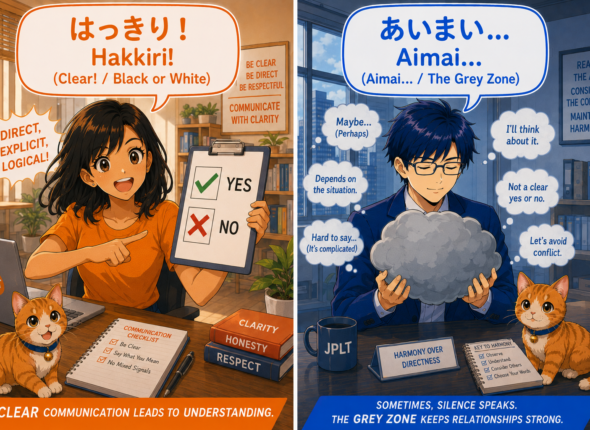
The Difference Between あいまい表現と明確表現、日本語と英語の違い の違い |Japanese Grammar (N5–N3)
(Joy holding a clear YES/NO clipboard [Black or White] vs. Ken holding a vague grey cloud [Aimai / The Grey Zone]) “This idea is bad. Let’s not do it.” -> 明確表現 (Meikaku...
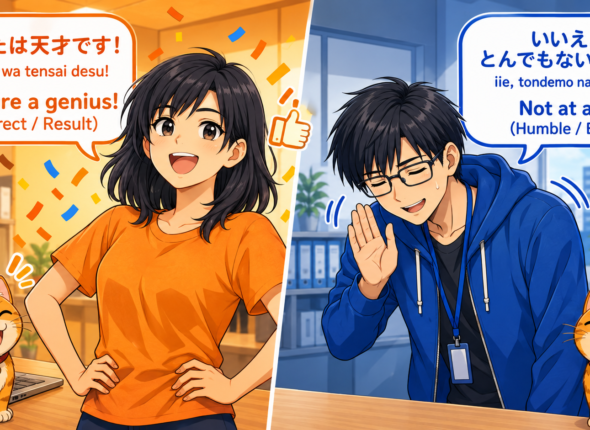
The Difference Between 直接褒める英語と控えめに褒める日本語の違い の違い |Japanese Grammar (N5–N3)
(Joy accepting praise proudly [Direct/English] vs. Ken humbly waving his hand to deflect praise [Kenson/Japanese]) “You are an absolute genius!” -> Direct Praise (Focus on Talent) “No, no, I still have much...
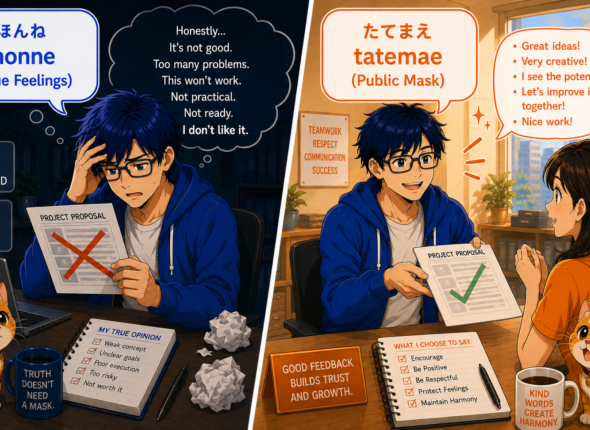
The Difference Between建前と本音の違いで失敗しない日本語 の違い |Japanese Grammar (N5–N3)
(Ken showing his raw negative feelings in a thought bubble [Honne] vs. Ken showing a polite, supportive smile in public [Tatemae]) “This design is terrible.” -> 本音 (Honne – True Feelings) “This...
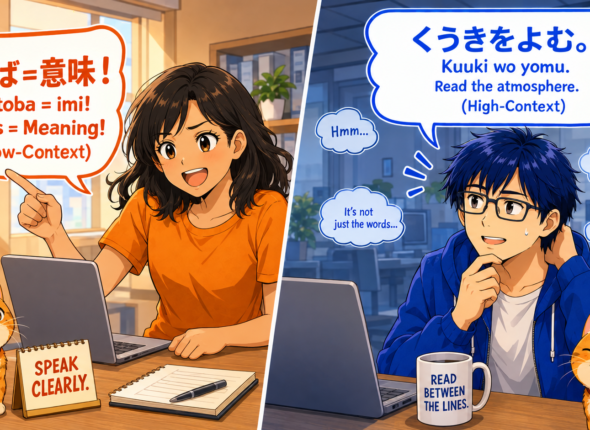
The Difference Between「空気を読む」と英語文化の違いの違い |Japanese Grammar (N5–N3)
(Joy relying purely on spoken words [Low-Context] vs. Ken observing the atmosphere and unspoken cues [High-Context]) “Say exactly what you mean.” -> Low-Context Culture (English) “Understand what is left unsaid.” -> High-Context...

The Difference Between 沈黙の意味が違う?日本語と英語の会話文化の違い |Japanese Grammar (N5–N3)
(oy panicking to fill the silence [Awkward / English] vs. Ken sitting calmly with closed eyes [Ma / Japanese]) “Nobody is talking… I have to say something!” -> Awkward Silence (Western Culture)...
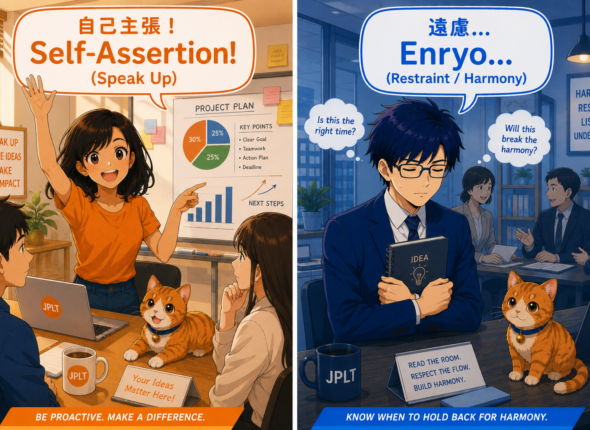
The Difference Between 自己主張の文化と遠慮の文化の違い の違い |Japanese Grammar (N5–N3)
(Joy confidently raising her hand to speak [Self-Assertion] vs. Ken hesitating and holding back to read the room [Enryo]) “I think we should do this!” -> 自己主張 (Jiko-shuchou / Self-Assertion) “I’ll hold...
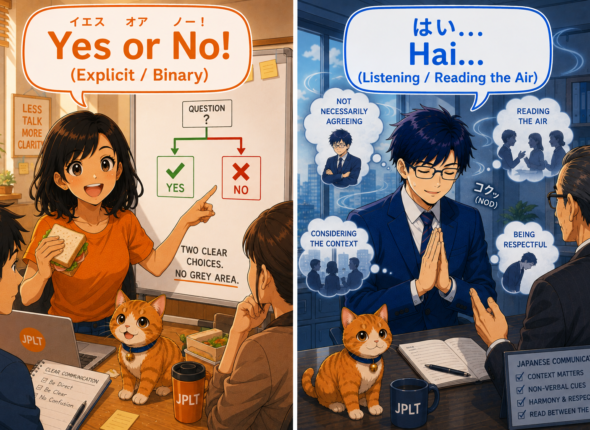
The Difference Between YES/NO重視の英語と空気重視の日本語の違い の違い |Japanese Grammar (N5–N3)
(Joy pointing to a clear Yes/No flowchart [Explicit] vs. Ken nodding while looking hesitant [Reading the Air / Aizuchi]) “Yes, I agree.” -> YES (Binary & Explicit) “Yes, I hear the words...
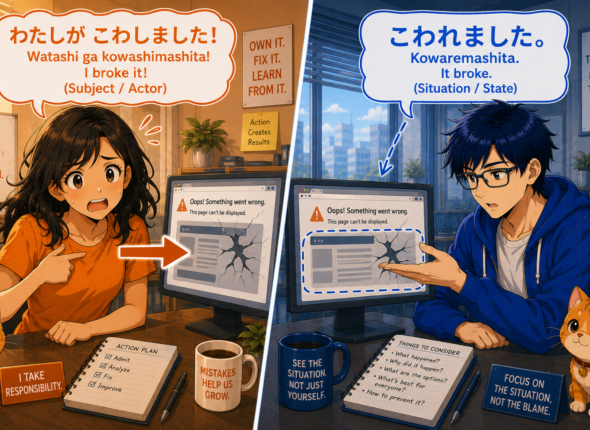
The Difference Between 主語中心の英語と状況中心の日本語の違い の違い |Japanese Grammar (N5–N3)
(Alt Text: Joy pointing to herself saying ‘I broke it’ [Subject-Centric] vs. Ken pointing to the screen saying ‘It broke’ [Situation-Centric]) “I dropped my phone.” -> 私が落としました (Subject-centric / English style) “My...