
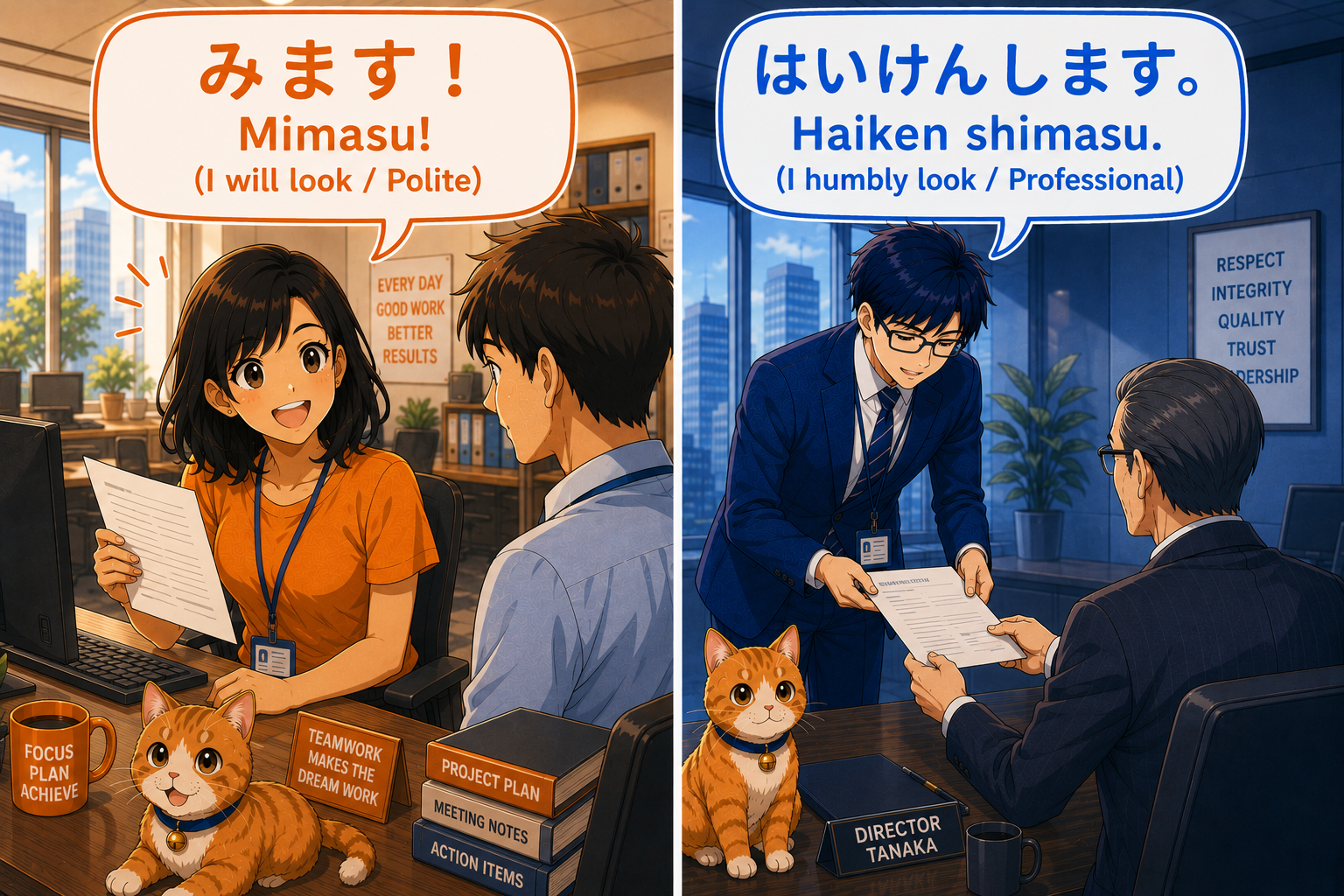
 (Joy looking at a document saying Mimasu [Polite] vs. Ken humbly looking at a client document saying Haiken shimasu [Humble])
“I will look at the document.” (To a coworker) -> 資料を見ます。 (Polite) “I will look at your email.” (To a client) -> メールを拝見します。 (Humble) As a Studio Season 1 student, you use 見ます (Mimasu) every day to mean “to see” or “to look.” But in Japanese business, whose document or email are you looking at? If you are looking at something created by or belonging to a superior or a client, you must use the Humble Language (Kenjougo) form: 拝見します (Haiken shimasu). Let’s see what happens when Director Tanaka asks Joy to review a client’s design.
🗣 Conversation Scene
Director Tanaka forwards an important email with design attachments from a VIP client to Joy.Tanaka
Joyさん、クライアントから送られてきた新しいデザイン資料を見ておいてください。
(Joy, please take a look at the new design materials sent by the client.)
Joy
はい、すぐに見ます!
(Yes, I will look [“Mimasu”] at them right away!)
[ Ken pulls Joy aside to help her upgrade her business vocabulary. ]
Ken
Joyさん、お客様や上司の資料を見る時は「見ます」ではなく「拝見します」を使うと、とてもプロフェッショナルですよ。
(Joy, when looking at materials from a client or boss, using “Haiken shimasu” instead of “Mimasu” makes you sound very professional.)
💡 Explanation
Standard Polite vs. Humble Language⚠️ The Golden Rule of Looking:
When talking about looking at a general item, 見ます (Mimasu) is polite. When looking at an item connected to someone of higher status (their email, their website, their document), you must lower your own status by using 拝見します (Haiken shimasu).
1. 見ます (Mimasu) = Polite (Teineigo) ☕
Target: Coworkers, internal documents, general objects. This is standard polite language. It is perfectly respectful for everyday office life when talking about general items or things created by your own team. However, because it lacks the “humble” factor, it sounds too casual when referring to something a VIP client took the time to send you.- [To a coworker] 昨日の会議のメモ、今から見ます。 (I’ll look at yesterday’s meeting notes now. *Standard Polite*)
2. 拝見します (Haiken shimasu) = Humble (Kenjougo) 👔
Target: Emails, websites, portfolios, or documents from bosses and clients. The kanji 拝 (hai) means “to worship” or “to bow respectfully.” 拝見 (haiken) literally means “to look at with deep respect.” You use this when you are consuming information provided by someone you respect. (Note: You will often see it as 拝見いたします (Haiken itashimasu) in formal emails for maximum politeness).- [To a client in an email] お送りいただいた資料を拝見いたしました。 (I have humbly looked at the materials you sent. *Professional/Humble*)
- [When viewing a partner’s website] 御社のウェブサイトを拝見しました。 (I humbly viewed your company’s website. *Standard Business*)
📊 Comparison Table
🚧 The Dangerous “Please Look” Trap
Because “Haiken shimasu” sounds so polite, beginners often use it to ask their boss to look at something: “Shachou, kono shiryoshu wo haiken shite kudasai.” This is a massive mistake! Humble language lowers the person doing the action. If you tell the boss to “haiken,” you are pushing the boss down to the floor! When asking a superior to look, you must use Respectful Language (Sonkeigo): ご覧になってください (Goran ni natte kudasai).🔥 Practice Quiz
Tap to check the answer!Keep practicing in Studio Season 1!