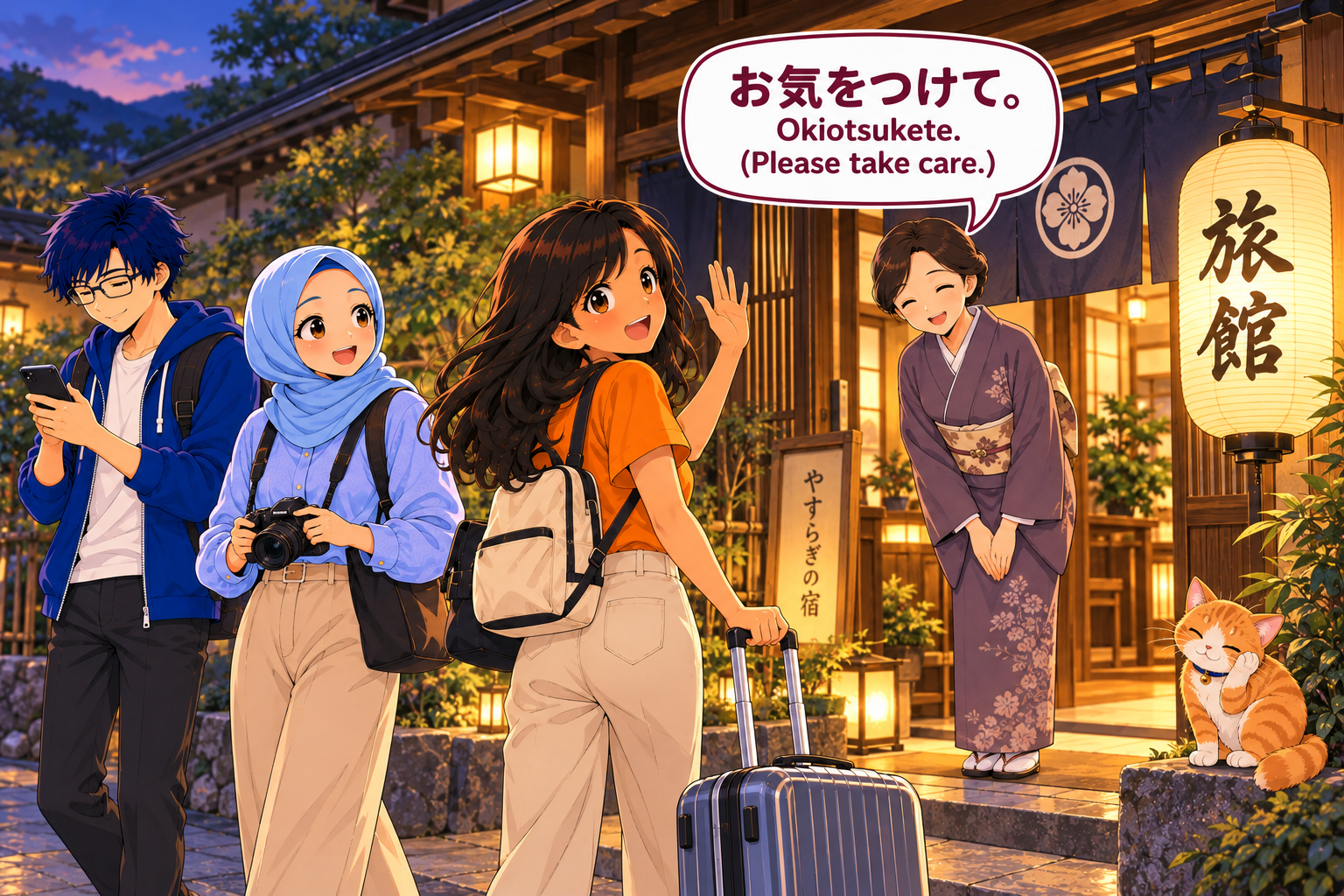
 (A Ryokan proprietress saying “Okiotsukete” to Joy, Ken, and Raya as they leave, with an orange cat grooming itself by a lantern)
Welcome to “Japanese You Keep Seeing”!
You are checking out of a hotel, leaving a restaurant on a rainy day, or saying goodbye to a friend after dinner. As you turn to leave, they call out: お気をつけて (Okiotsukete). If you look this up in a dictionary, it translates to “Be careful!” But don’t panic—they aren’t warning you about an imminent danger! This is actually one of the warmest and most caring ways to say goodbye in Japanese. Let’s explore the sentiment behind the phrase.
🗣 Conversation Scene
Joy, Ken, and Raya have just finished a wonderful weekend stay at a traditional Japanese Ryokan in Hakone. They are heading to the train station, and the Okami (proprietress) comes out to see them off.💡 Explanation: The Spirit of “Take Care”
To understand why this is a greeting and not just a warning, let’s look at the fascinating kanji used in the phrase.1. What does it literally mean? 🔍
The phrase comes from the expression 気をつける (Ki wo tsukeru). ✅ 気 (Ki): Spirit, mind, or energy. ✅ つける (Tsukeru): To attach or apply. Literally, it means “To attach your mind/attention to something.” When someone says お気をつけて (Okiotsukete), they are politely asking you to pay attention to your surroundings so that you can return home safely. It is the Japanese equivalent of “Take care” or “Get home safe.”2. Polite vs. Casual Form 👔
You can adjust this phrase depending on who you are talking to: ✅ お気をつけて (Okiotsukete) / お気をつけてください (Okiotsukete kudasai): Polite. Used by staff to customers, or when speaking to someone older/superiors. ✅ 気をつけてね (Kiotsukete ne): Casual. Used with friends, family, or your partner when they are heading home.3. How to Reply 🗣️
If a shop staff member says “Okiotsukete,” you do not need to say it back to them, because they are staying at the shop while you are leaving! Simply smile and say: ありがとうございます (Arigatou gozaimasu – Thank you). If you are parting ways with a friend and you are BOTH traveling home, you can say: 〇〇ちゃんも気をつけてね! ([Name]-chan mo kiotsukete ne! – You take care too!).💎 Pro Tip: Weather and Time
You will hear this phrase much more frequently if the conditions are difficult! If it is raining, snowing, or very late at night, a cashier at a convenience store or a taxi driver will almost always say “Okiotsukete” as you leave to show extra care for your safety.
🔥 Practice Quiz
Ready to master the Ko-So-A-Do system?
Want to dive deeper? Check out our official Beginner’s Grammar Book for more examples, detailed explanations, and practice exercises to perfect your Japanese pointing skills!
📖 Read more in the Grammar Book: これ/それ/あれ/どれ