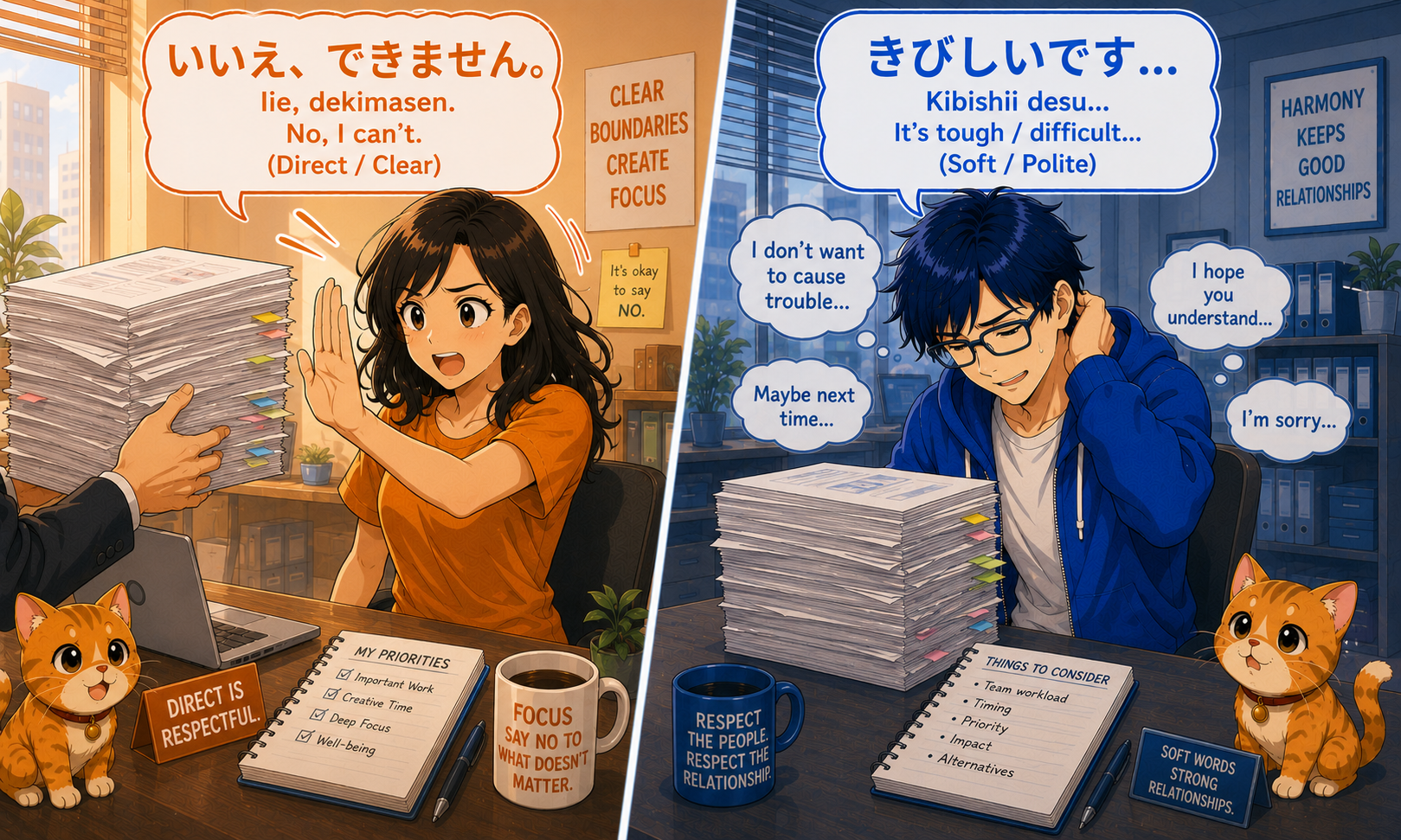
(Joy putting her hand up saying No, I can’t [Direct/English] vs. Ken rubbing his neck saying Kibishii desu [Soft/Japanese])
“No, I cannot do that.” -> できません (Dekimasen) (Too aggressive!)
“That is a little bit difficult.” -> ちょっと厳しいです (Chotto kibishii desu) (Professional & Soft)
In English, setting clear boundaries and saying “I can’t” is respected as honest and efficient communication. In Japanese business culture, shutting down a request with a flat “No” (Iie) or “I can’t” (Dekimasen) feels like slamming a door in someone’s face. To preserve harmony, Japanese professionals use the art of the Soft Refusal (やんわり断る – Yawanri kotowaru). Let’s see what happens when Director Tanaka asks Joy for a sudden, last-minute update.
🗣 Conversation Scene
It is 4:30 PM. Director Tanaka approaches Joy with an urgent request regarding the new upper-beginner course.
(Joy, regarding the student booking page for the upper-beginner course, can you update the design by tomorrow morning?)
(No, “Dekimasen” [I can’t]! I am busy making the SNS visuals right now.)
[ Tanaka looks shocked by her blunt rejection. Ken quickly steps in to translate her English directness into Japanese politeness. ]
(Joy! Saying “I can’t” to a boss is way too harsh! Let’s decline softly by saying “By tomorrow morning is a little tough / Kibishii desu”!)
💡 Explanation
Replacing the Brick Wall with a Soft Cushion
In Japanese business, you must never use words that completely destroy hope. できません (Dekimasen – I cannot) is a brick wall. Instead, use words like 難しい (Muzukashii – Difficult) or 厳しい (Kibishii – Severe/Tough), which act as a soft cushion.
1. できません (Dekimasen) = The Brick Wall 🧱
While grammatically correct, “Dekimasen” leaves no room for discussion. It sounds like you are refusing to even try. It can make you seem uncooperative or angry. The only time you should use a direct “No” or “I cannot” is if you are rejecting something illegal or completely outside your job description.
2. 難しいです / 厳しいです = The Soft Cushion ☁️
To safely reject a request, Japanese professionals use adjectives that describe the situation, rather than verbs that describe their lack of ability.
- 難しいです (Muzukashii desu – It is difficult)
This is the standard polite refusal. It implies “I want to do it, but the circumstances make it hard.” - 厳しいです (Kibishii desu – It is tough/severe)
This is extremely common in modern business when talking about deadlines or budgets. It means “The conditions are too tight.”
3. The Magic Buffer: ちょっと (Chotto) 🪄
To make the refusal even softer, always add ちょっと (Chotto – a little bit). In English, if something is impossible, saying it’s “a little difficult” sounds sarcastic. But in Japanese, “Chotto” acts as an emotional buffer, absorbing the shock of the rejection.
- [Rejecting a deadline] 明日までは、ちょっと厳しいです。
(By tomorrow is a little tough. *True meaning: I absolutely cannot do it by tomorrow*)
📊 The Refusal Matrix
💎 The Ultimate Structure
A perfect Japanese refusal has three parts: Apology + Soft Reason + Soft Refusal.
Example: “I am sorry (Sumimasen), but I have other tasks right now (Ima hoka no sagyou ga arumashite), so doing it today is a little tough (kyou chuu wa chotto kibishii desu).”
🔥 Practice Quiz
Tap to check the answer!