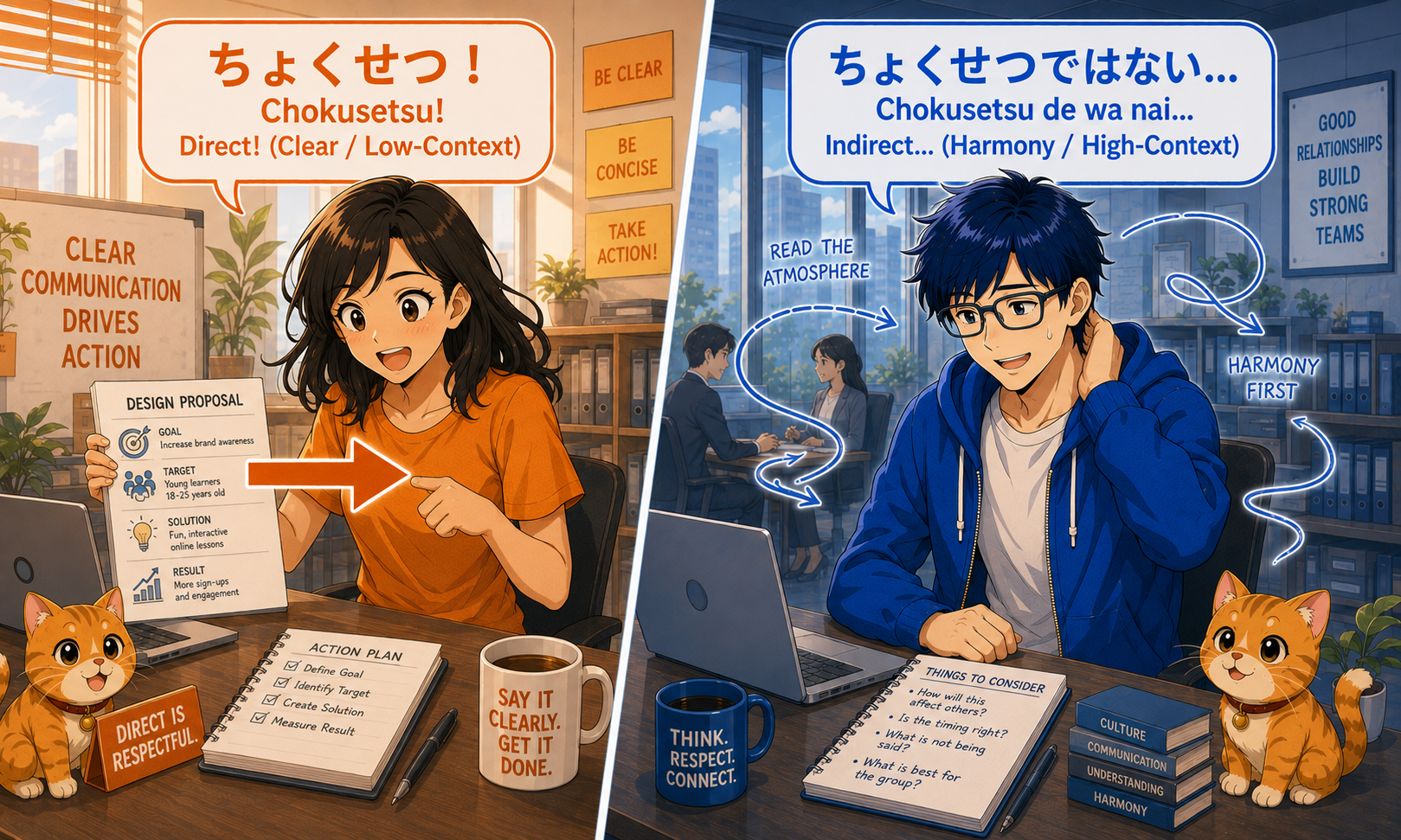
(Joy speaking directly with a straight arrow [Clear/English] vs. Ken smiling politely with a wavy arrow [Harmony/Japanese])
“Please change this color, I don’t like it.” -> Direct (Low-Context / English)
“This is very nice, but the color is a little bit…” -> Indirect (High-Context / Japanese)
One of the biggest culture shocks foreigners experience in Japan is the communication style. In English, being direct is considered polite because it saves time and avoids confusion. In Japanese, being direct is often seen as aggressive or rude. Japanese people use 遠回し (Toomawashi – Indirect expression) to protect harmony. Let’s see what happens when Joy submits a new visual communication design to Director Tanaka.
🗣 Conversation Scene
Joy has just finished creating the visual materials for tomorrow’s social media campaign and shows them to Director Tanaka.
(Director, the visual design for tomorrow’s SNS is finished! How is it?)
(Good work. The design is pretty. However, the text color is a little bit…)
(Thank you! I will upload it as is then!)
[ Tanaka panics. Ken quickly stops Joy. ]
(Joy, stop! In Japanese business, “a little bit…” means “NG (No Good / Redo it)”! Read the air!)
💡 Explanation
Clarity vs. Harmony (Low-Context vs. High-Context)
English is a Low-Context language: Politeness comes from being clear and not wasting people’s time. Japanese is a High-Context language: Politeness comes from preserving harmony (Wa – 和) and avoiding direct confrontation.
1. The English Way (Directness) 🎯
In English business culture, if a design needs changing, a good boss will say, “Change the text color, it’s hard to read.” This is considered helpful and efficient. In Japan, stating negative feedback this directly sounds like you are angry or attacking the creator’s personal ability.
2. The Japanese Way (Indirectness / Toomawashi) 🌫️
To avoid hurting feelings, Japanese people use 遠回し (Toomawashi – beating around the bush). Instead of saying “No,” they leave the sentence unfinished or use vague words, trusting that you will “read the air” (Kuuki wo yomu) and understand the true meaning.
- それはちょっと…… (Sore wa chotto…)
Literal: That is a little bit…
True Meaning: No / I disagree / Please change it. - 難しいかもしれません (Muzukashii kamoshiremasen)
Literal: It might be difficult.
True Meaning: It is impossible / We cannot do it.
📊 The Translation of “No”
💎 The “Sandwich” Technique
If you *must* give negative feedback in Japan, always use the Sandwich Technique.
1. Praise (The bread): “The layout is great.”
2. Indirect Critique (The meat): “But the font is *a little bit…*”
3. Soft landing (The bread): “What do you think?”
🔥 Practice Quiz
Tap to check the answer!