Skip to content
JPLT Online Japanese Language Training SchoolJPLT Online Japanese Language Training School
  • Courses
  • Plans
  • Get Started
    • What is JPLT Metaverse Campus
    • How to Enroll
  • JPLT LEARNING GYM
    • What is JPLT LEARNING GYM?
    • BootCamp
    • Studio
    • Season
    • Grammar Book
    • Optional Classes and AOTD
  • Schedule
  • Blog
  • About Us
    • What Is Dialog+ JPLT
    • Teachers
    • Company Profile
    • Contact Us
    • FAQs
  • Login
  • For Business
JPLT Online Japanese Language Training SchoolJPLT Online Japanese Language Training School
  • Courses
  • Plans
  • Get Started
    • What is JPLT Metaverse Campus
    • How to Enroll
  • JPLT LEARNING GYM
    • What is JPLT LEARNING GYM?
    • BootCamp
    • Studio
    • Season
    • Grammar Book
    • Optional Classes and AOTD
  • Schedule
  • Blog
  • About Us
    • What Is Dialog+ JPLT
    • Teachers
    • Company Profile
    • Contact Us
    • FAQs
  • Login
  • For Business
JPLT Blog

The Difference Between 「できます」と「可能です」のフォーマル度の違い の違い |Japanese Grammar (N5–N3)

  • 14 Jul, 2026
  • Com 0
「できます」と「可能です」のフォーマル度の違い
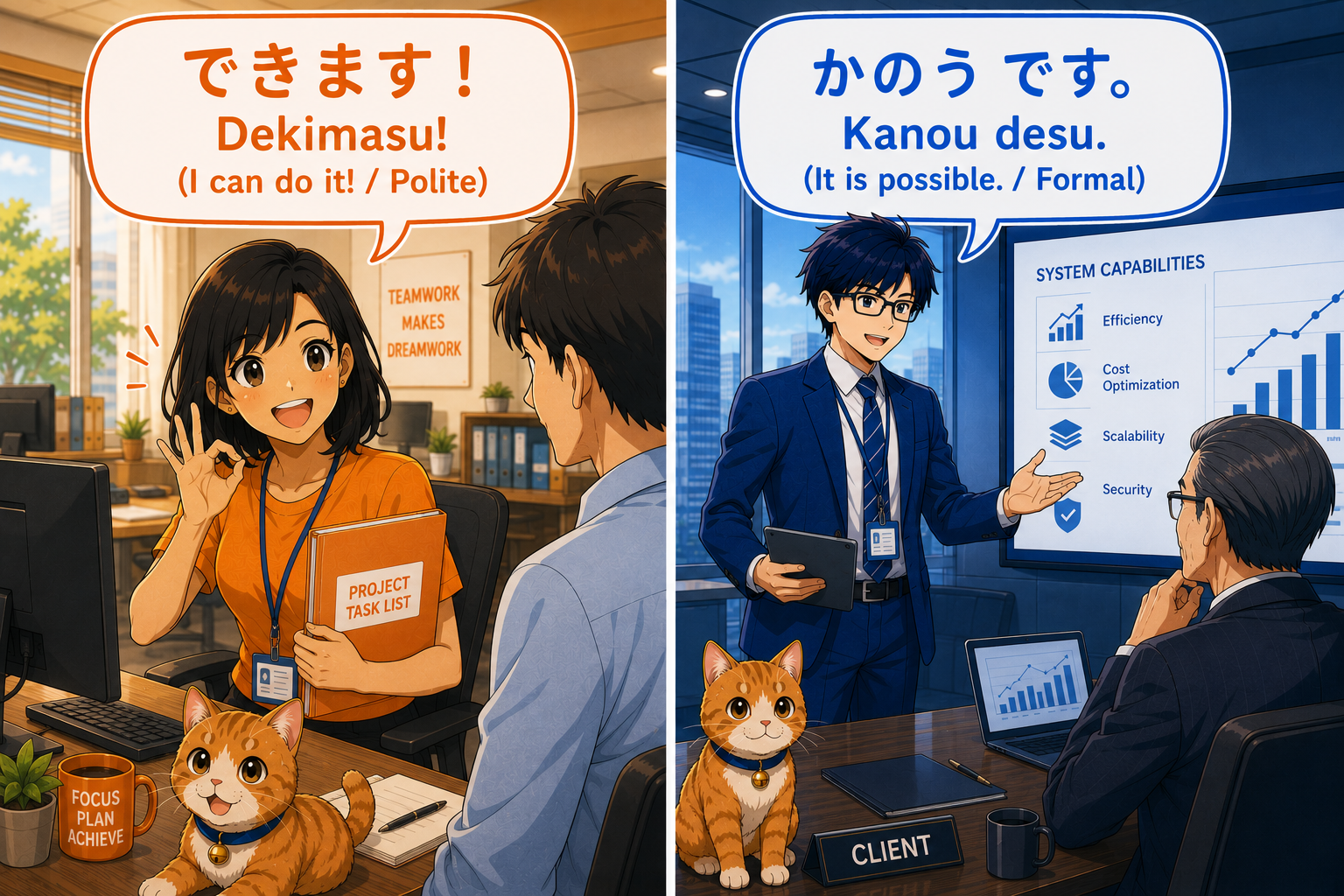
(Joy making an OK sign saying Dekimasu [Standard Polite] vs. Ken presenting professionally saying Kanou desu [Formal Business])

“I can change the schedule.” (Conversational) -> スケジュール変更できます。 (Standard Polite)
“It is possible to change the schedule.” (Professional) -> スケジュール変更可能です。 (Formal / Objective)
When you want to say “I can do it” or “It is possible,” the first word you learn is できます (Dekimasu). While perfectly polite for the office, Japanese business communication prefers words that sound objective and logical rather than personal. To sound like a true professional, especially in writing, you should upgrade to 可能です (Kanou desu). Let’s watch Joy draft an email to a client.

🗣 Conversation Scene

Director Tanaka asks Joy to reply to an important client regarding a website update.

Tanaka
Joyさん、クライアントに「金曜日までにデザインの変更ができる」とメールで伝えてください。
(Joy, please email the client and tell them we can change the design by Friday.)
Joy
はい!ええと、「金曜日までに変更できます」……送信!
(Yes! Um, “We can change it by Friday [henkou dekimasu]”… Send!)

[ Ken reviews the sent email and gives Joy some advice. ]

Ken
Joyさん、間違いではないですが、お客様への公式なメールでは「変更可能です」と書いた方が、より客観的で信頼されるビジネス文章になりますよ。
(Joy, it’s not wrong, but in an official email to a client, writing “henkou kanou desu” makes it a more objective and trustworthy business sentence.)

💡 Explanation

Conversational Ability vs. Objective Fact

⚠️ The Golden Rule of Capability:
できます (Dekimasu) sounds slightly subjective and conversational (“I/We have the ability to do it”). 可能です (Kanou desu) sounds objective and formal (“Under the current conditions, it is a possible fact”).

1. できます (Dekimasu) = Can do / Able to 🗣️

Level: Standard Polite (Spoken Japanese)
“Dekimasu” is fantastic for spoken, everyday office communication. When talking face-to-face with your boss or coworkers, it shows a positive, proactive attitude. However, because it is an everyday word, it can sound a bit too casual or “soft” when used in formal business emails or contracts.

  • [To a boss in the hallway] はい、今日中に終わらせることができます。
    (Yes, I can finish it by today. *Spoken/Proactive*)
  • [To a coworker] Excelの操作、できますか?
    (Can you operate Excel? *Checking personal ability*)

2. 可能です (Kanou desu) = It is possible 💼

Level: Formal Business (Written/Objective Japanese)
“Kanou desu” is a Chinese-origin word (Kango), which naturally makes it sound smarter, stricter, and more formal. In business, removing personal feelings makes a statement sound more reliable. You use this when confirming schedules, system limits, and official company policies to clients.

  • [In a client email] 納期の変更は可能です。
    (It is possible to change the delivery date. *Professional Fact*)
  • [Presenting to a VIP] このシステムで、データの自動化が可能です。
    (With this system, data automation is possible. *Objective capability*)

📊 Comparison Table

Word Tone & Nuance Best Situation
〜できます
(~dekimasu)
Conversational / Subjective. Shows personal ability or proactive energy. Spoken conversation, talking to team members.
〜可能です
(~kanou desu)
Formal / Objective. Stating a capability as a solid fact. Business emails, proposals, strict client communication.

🚧 The Opposite: “Dekimasen” vs “Fukanou desu”

The same rule applies when saying “I cannot.” Saying できません (Dekimasen) to a client sounds very direct and slightly emotional (“I won’t do it / I can’t”). Saying 不可能です (Fukanou desu – It is impossible) or 対応いたしかねます (Taiou itashikanemasu) sounds like an objective company rule, which softens the blow and sounds much more polite.

🔥 Practice Quiz

Tap to check the answer!

Q1. You are writing an official email to a VIP client confirming that you can schedule a meeting on Monday.
A. Getsuyoubi ni meetingu dekimasu.
B. Getsuyoubi no meetingu wa kanou desu.
Answer: B (Kanou desu)
For an official email to a VIP client, you should use the objective, formal “Kanou desu.”
Q2. A coworker asks you if you know how to use Photoshop. You want to say “Yes, I can.”
A. Hai, dekimasu!
B. Hai, kanou desu!
Answer: A (Dekimasu!)
When talking about a personal skill in a conversational setting with a coworker, “Dekimasu” is the most natural choice. Saying “Photoshop is possible” sounds like you are a robot!
Keep practicing with JPLT!


Related posts:

[Must-Read Guide] Recommended Japanese Study Methods for Foreigners Challenges of Learning Japanese: 10 Solutions & Key Points Understanding Gakusei ja nai~n desu and Gakusei ja nai desu Tanoshimi vs Tanoshisa: Understanding their Differences
Share on:
【使い分け】「確認します」と「確認いたします」の敬語の違い の違い [日本語学習]
【使い分け】「できます」と「可能です」のフォーマル度の違い の違い [日本語学習]
JPLT Malaysia

Japanese Learning Resources:

Tips for Learning Japanese Learn Japanese with Mastery Tips Japanese Grammar Book Japanese Learning Hacks Japanese Learning FAQ (日本語) Japanese Learning FAQ (English)

Connect with us!

Inquire Now!
Send us a message to know the latest class schedules. Lessons are conducted in English and Taglish (Tagalog-English).
Please enable JavaScript in your browser to complete this form.
Name *
Loading

Latest Post

Thumb
【使い分け】「できます」と「可能です」のフォーマル度の違い の違い [日本語学習]
14 Jul, 2026
Thumb
The Difference Between 「できます」と「可能です」のフォーマル度の違い の違い |Japanese Grammar
14 Jul, 2026
Thumb
【使い分け】「確認します」と「確認いたします」の敬語の違い の違い [日本語学習]
14 Jul, 2026

Categories

  • Courses (13)
  • Grammar Book (108)
  • JAPANESE LEARNING FAQ (23)
  • Japanese Learning Hacks (9)
  • Japanese Learning TIPS (181)
  • JPLT Blog (213)
  • JPLT NEWS (12)
  • List of media productions (5)
  • にほんごをまなぶTips (176)
  • 日本語学習ハック (9)
JPLT_logo (2)

JPLT (Japanese language training) online school by Dialogplus 

Icon-facebook Icon-instagram Youtube

株式会社ダイアログプラス(Dialog+ Co., Ltd.) 
神奈川県横浜市都筑区南山田二丁目1番1-206号 
Address: 2-1-1-206 Minamiyamada, Tsuzuki-ku, Yokohama Japan 
Website: https://www.dialogplus.co.jp/ 

Dialog+ Philippines
Philippine Address: Unit 7 2/F, Seung Lee Building, Lot 1 Greenwoods Park Rizal Highway, CBD Area, Subic Bay Freeport Zone, Philippines
Website: https://dialogplus.ph/
Email: info@jplt-dialogplus.com

  • Specified Commercial Transaction Law
  • Privacy Policy
  • Terms & Condition
  • Refund Policy
  • JPLT Calendar
  • Admin
JPLT Online Japanese Language Training SchoolJPLT Online Japanese Language Training School