
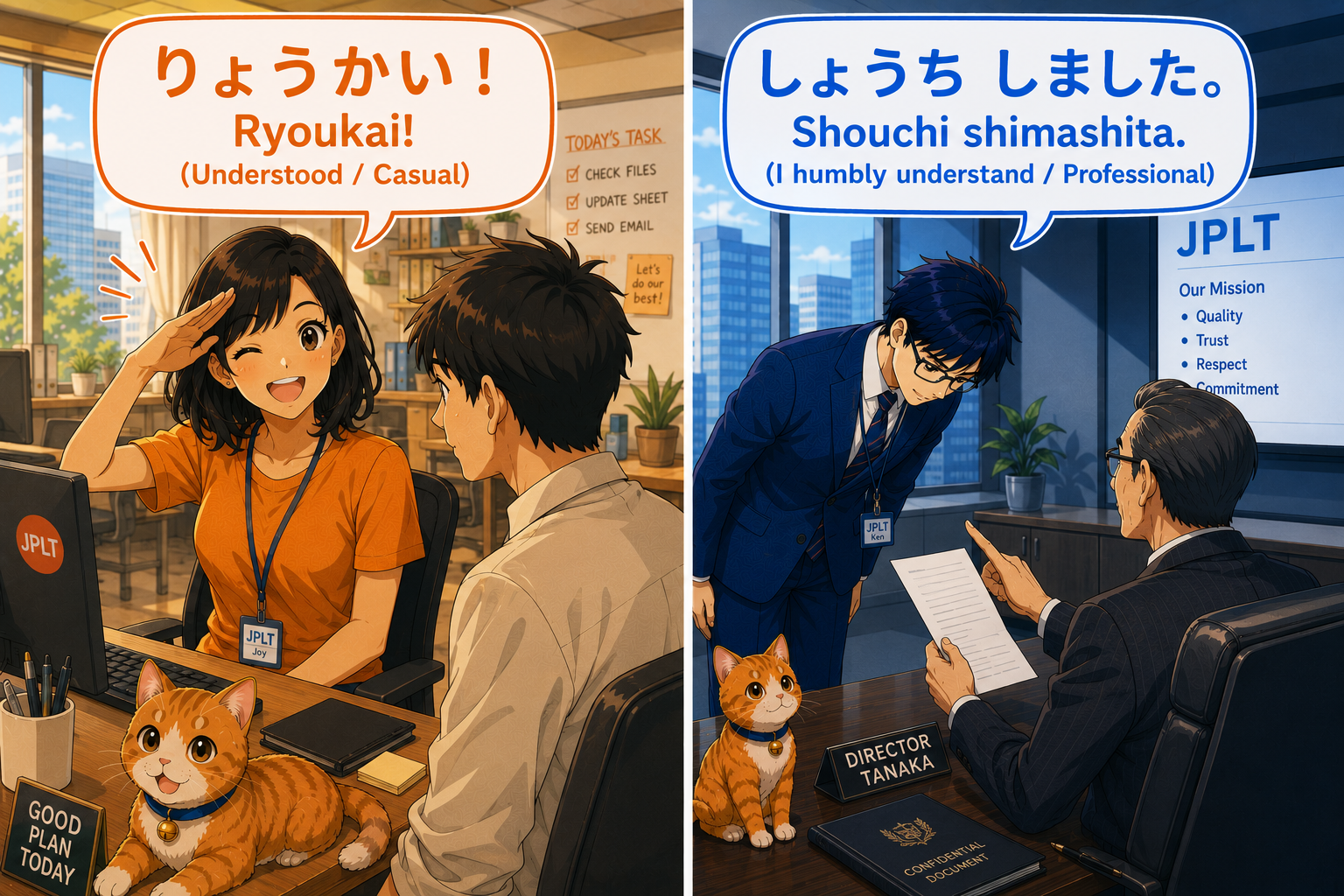
 (Joy saluting and saying Ryoukai to a coworker [Casual] vs. Ken humbly bowing and saying Shouchi shimashita to a boss [Humble])
“Got it!” (To a coworker) -> 了解!(Ryoukai!) (Casual / Top-Down) “I understand completely.” (To a boss) -> 承知しました。(Shouchi shimashita.) (Humble / Bottom-Up) When someone gives you an instruction in a Japanese office, you need to say “I understand.” Many beginners use 了解 (Ryoukai) because it sounds professional. However, “Ryoukai” has a hidden “top-down” nuance! Using it with a superior is a major etiquette violation. To survive in business, you must master the Humble Language (Kenjougo) alternative: 承知しました (Shouchi shimashita). Let’s see what happens when Director Tanaka asks Joy to create some new visual assets.
🗣 Conversation Scene
Director Tanaka is giving Joy a task regarding the company’s social media communication designs.Tanaka
Joyさん、来週のキャンペーン用に、新しいSNSのバナー画像を3つ作成しておいてください。
(Joy, please create three new SNS banner images for next week’s campaign.)
Joy
はい、了解しました! すぐにデザインに取り掛かります。
(Yes, “Ryoukai shimashita” [Understood]! I will start working on the designs immediately.)
[ Ken pulls Joy aside to correct her business etiquette. ]
Ken
Joyさん、目上の人に「了解」は上から目線になってしまいます!「承知しました」と言わなければいけませんよ。
(Joy, using “Ryoukai” with a superior sounds like you are looking down on them! You must say “Shouchi shimashita”.)
💡 Explanation
The Direction of Approval⚠️ The Golden Rule of Understanding:
了解 (Ryoukai) means “I approve” and goes DOWN the hierarchy. 承知しました (Shouchi shimashita) means “I humbly accept” and goes UP the hierarchy.
1. 了解 / 了解しました (Ryoukai) = Got it / Roger 🫡
Target: Coworkers, friends, junior staff. “Ryoukai” originally comes from military and police jargon (similar to “Roger that”). It carries a nuance of “comprehending and granting approval.” Because it implies you have the authority to approve something, using it with a boss sounds incredibly arrogant. Adding shimashita makes it polite (Teineigo), but it does not change the arrogant top-down meaning!- [To a close coworker on chat] 了解!あとで送るね。 (Roger! I’ll send it later. *Casual/Friendly*)
- [Boss to a subordinate] 報告、了解しました。 (I acknowledge your report. *Top-Down Polite*)
2. 承知しました (Shouchi shimashita) = I humbly understand 👔
Target: Bosses, clients, customers, formal emails. The kanji 承 (shou) means “to humbly receive or hear.” Therefore, “Shouchi shimashita” means “I lower myself to receive your instruction.” This is the absolute golden standard for the Japanese workplace. If you use this, you will never offend anyone.- [To a boss giving a task] はい、承知しました。 (Yes, I humbly understand. *Professional/Humble*)
- [In a business email to a client] 日程変更の件、承知いたしました。 (I have humbly understood the matter of the schedule change. *Extremely Formal*)
📊 Comparison Table
💎 The Ultimate Form: Kashikomarimashita
If “Shouchi shimashita” is the gold standard for office life, かしこまりました (Kashikomarimashita) is the platinum standard for customer service. It means “I have received your order and will execute it perfectly.” You use this if you work in B2C (restaurants, hotels) or when responding to a very high-level VIP client request.🔥 Practice Quiz
Tap to check the answer!Keep practicing in Studio Season 1!