

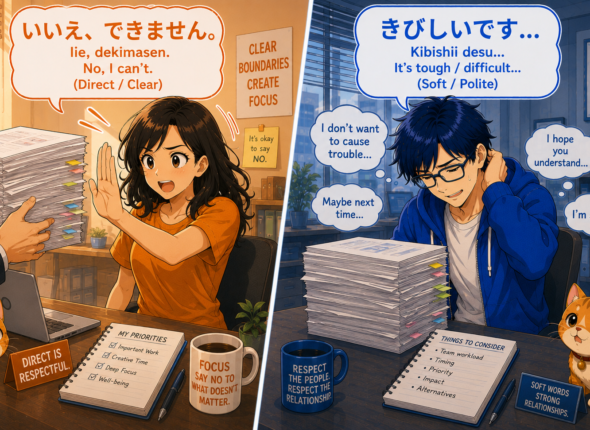
The Difference Betweenはっきり断る英語とやわらかく断る日本語の違いの違い |Japanese Grammar (N5–N3)
(Joy putting her hand up saying No, I can’t [Direct/English] vs. Ken rubbing his neck saying Kibishii desu [Soft/Japanese]) “No, I cannot do that.” -> できません (Dekimasen) (Too aggressive!) “That is a...
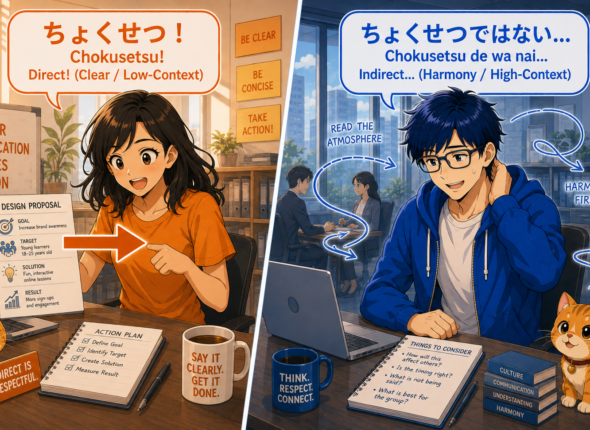
The Difference Between 直接言う英語と遠回しに言う日本語の違い の違い |Japanese Grammar (N5–N3)
(Joy speaking directly with a straight arrow [Clear/English] vs. Ken smiling politely with a wavy arrow [Harmony/Japanese]) “Please change this color, I don’t like it.” -> Direct (Low-Context / English) “This is...
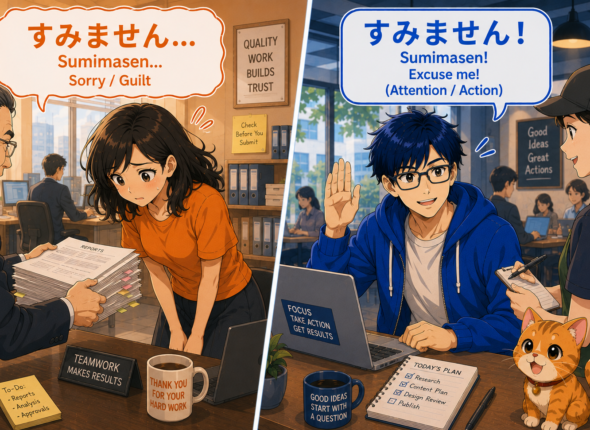
The Difference Between「すみません」と “Excuse me” の正しい使い分け の違い |Japanese Grammar (N5–N3)
(Joy looking guilty saying Sumimasen [Apology focus] vs. Ken raising his hand politely saying Excuse me [Attention focus]) “Excuse me, waiter!” -> すみません (Sumimasen) “I’m sorry I bumped into you.” -> すみません...
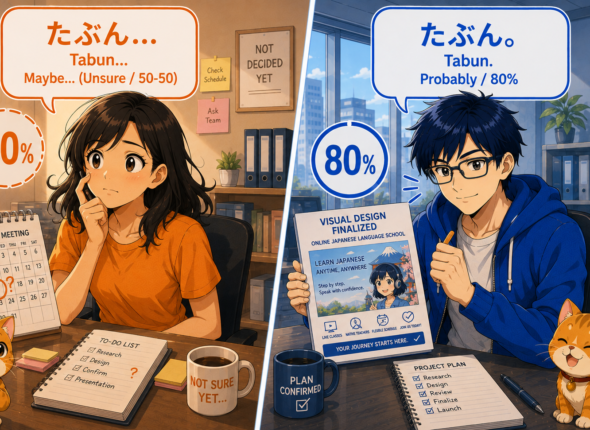
The Difference Between 「たぶん」と “Maybe” の確信度の違い の違い |Japanese Grammar (N5–N3)
(Joy looking unsure with a 50% sign [Maybe] vs. Ken looking confident with an 80% sign [Tabun]) “There’s a 50/50 chance.” -> かもしれません (Kamoshiremasen) / Maybe “I am 80% to 90% sure.”...
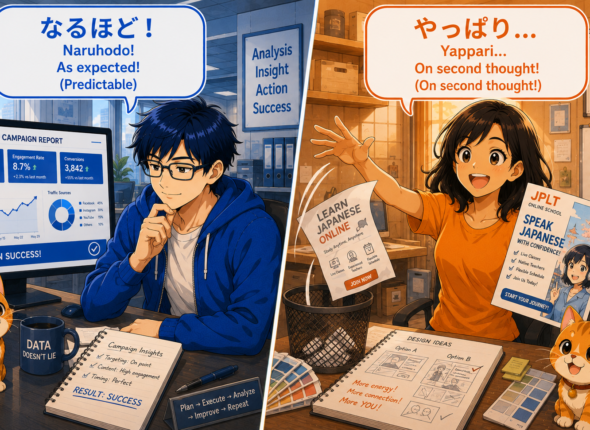
The Difference Between 「やっぱり」と “As expected” の使い方の違い の違い |Japanese Grammar (N5–N3)
(Ken nodding at a predictable outcome [As expected] vs. Joy changing her mind between two visual designs [Yappari / On second thought]) “I knew the campaign would be successful.” -> やっぱり...
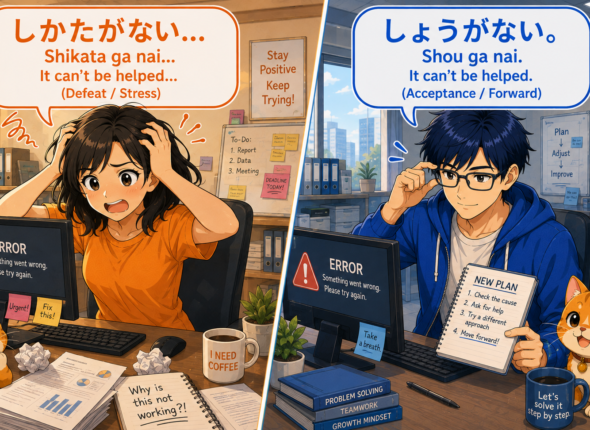
The Difference Between 「しょうがない」と “It can’t be helped” の感覚 の違い |Japanese Grammar (N5–N3)
(Joy stressing over a computer error [Defeat] vs. Ken calmly making a new plan saying Shou ga nai [Acceptance]) “We lost. I give up.” -> It can’t be helped (Western view: Defeat...
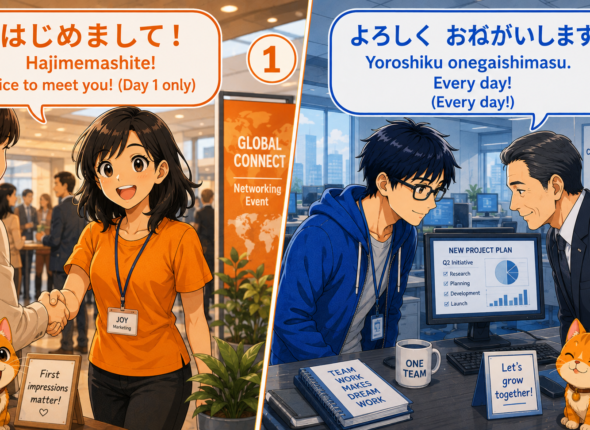
The Difference Between 「よろしくお願いします」と “Nice to meet you” のズレの違い |Japanese Grammar (N5–N3)
(Joy shaking hands saying Nice to meet you [Day 1] vs. Ken and his boss starting a project saying Yoroshiku onegaishimasu [Every day]) “First time meeting you.” -> はじめまして (Hajimemashite) (Day 1...
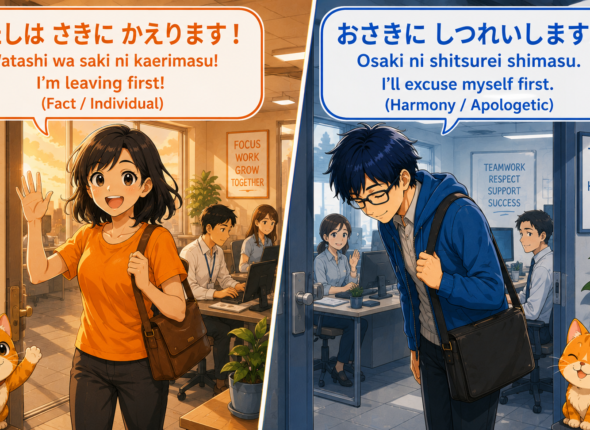
The Difference Between 「先に失礼します」と “I’m leaving first” の違い の違い |Japanese Grammar (N5–N3)
(Joy waving goodbye cheerfully [Stating a Fact] vs. Ken bowing apologetically saying Osaki ni shitsurei shimasu [Team Harmony]) “My shift is over, I’m going home.” -> お先に帰ります (I am leaving first) (Individualistic...
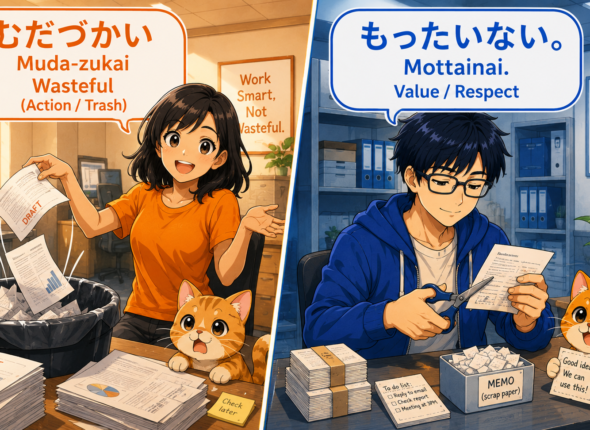
The Difference Between 「もったいない」と “Wasteful” の違い の違い |Japanese Grammar (N5–N3)
(Joy throwing away paper [Wasteful Action] vs. Ken making scrap memo pads out of misprints [Mottainai Respect]) “Throwing this away is bad.” -> Wasteful (Focus on the negative action) “This object still...
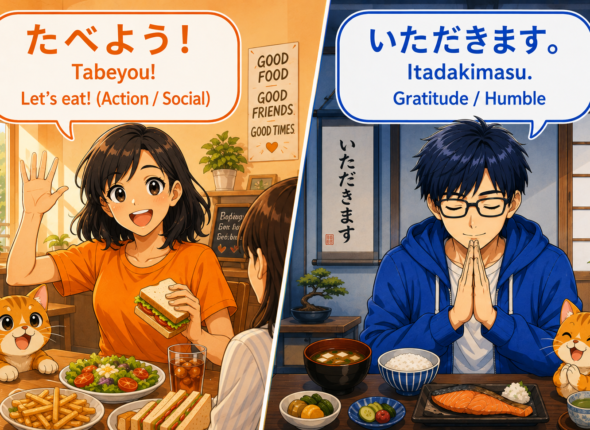
The Difference Between 「いただきます」と “Let’s eat” の本当の意味 の違い |Japanese Grammar (N5–N3)
(Joy cheerfully saying Let’s eat [Social Action] vs. Ken pressing his hands together saying Itadakimasu [Humble Gratitude]) “Okay everyone, time to eat!” -> Let’s eat / 食べましょう (Tabemashou) (Social Action) “Thank you...

The Difference Between 「頑張って」と “Good luck” のニュアンスの違いの違い |Japanese Grammar (N5–N3)
(Joy crossing fingers for Good Luck [Chance] vs. Ken making a determined fist pump for Ganbatte [Effort]) “I hope things go well for you!” -> Good luck (Relies on chance/fortune) “Push yourself...

The Difference Betweenの違い |Japanese Grammar (N5–N3)
(Joy causing confusion with Daijoubu [Ambiguous] vs. Ken being clear with Kekkou desu [Professional]) “Are you hurt?” -> 大丈夫です (I’m fine) “Do you need a bag?” -> 大丈夫です (No thank you) “Can...
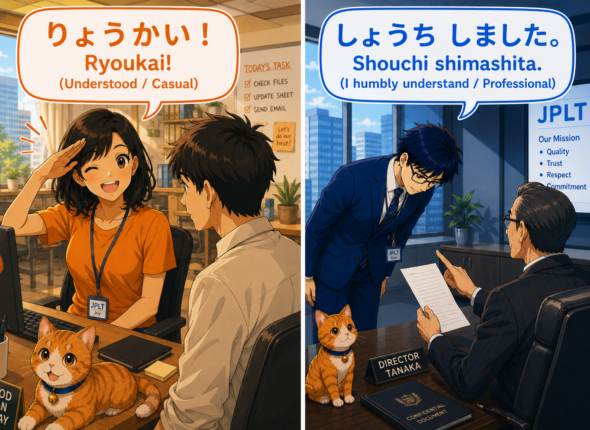
The Difference Between 「了解」と「承知しました」の敬語の違い の違い |Japanese Grammar (N5–N3)
(Joy saluting and saying Ryoukai to a coworker [Casual] vs. Ken humbly bowing and saying Shouchi shimashita to a boss [Humble]) “Got it!” (To a coworker) -> 了解!(Ryoukai!) (Casual / Top-Down) “I...
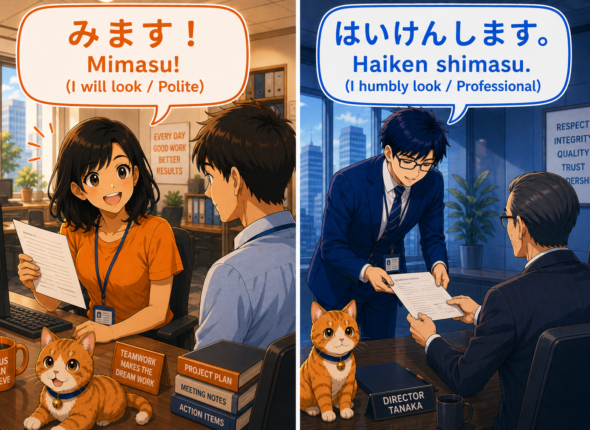
The Difference Between「見ます」と「拝見します」の正しい使い分けの違い |Japanese Grammar (N5–N3)
(Joy looking at a document saying Mimasu [Polite] vs. Ken humbly looking at a client document saying Haiken shimasu [Humble]) “I will look at the document.” (To a coworker) -> 資料を見ます。...
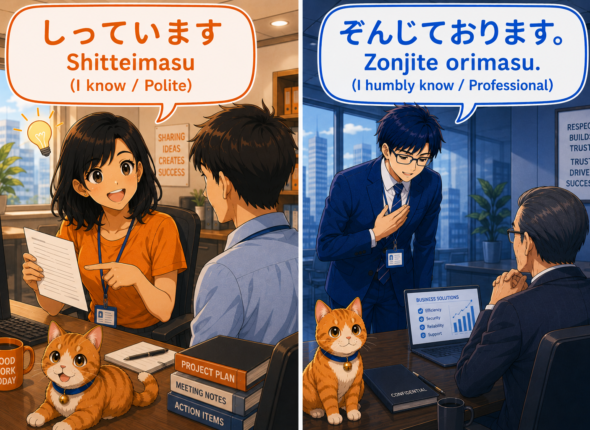
The Difference Between 「知っています」と「存じております 」の敬語の違いの違い |Japanese Grammar (N5–N3)
(Joy confidently saying Shitteimasu to a coworker [Polite] vs. Ken humbly saying Zonjite orimasu to a boss [Humble]) “I know the meeting time.” (To a coworker) -> 知っています。 (Polite) “I know the...
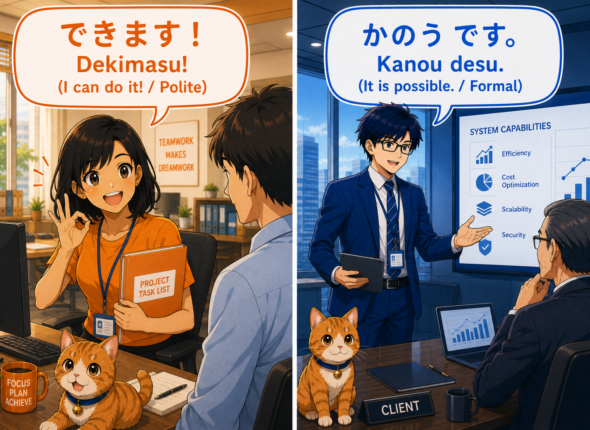
The Difference Between 「できます」と「可能です」のフォーマル度の違い の違い |Japanese Grammar (N5–N3)
(Joy making an OK sign saying Dekimasu [Standard Polite] vs. Ken presenting professionally saying Kanou desu [Formal Business]) “I can change the schedule.” (Conversational) -> スケジュール変更できます。 (Standard Polite) “It is possible to...
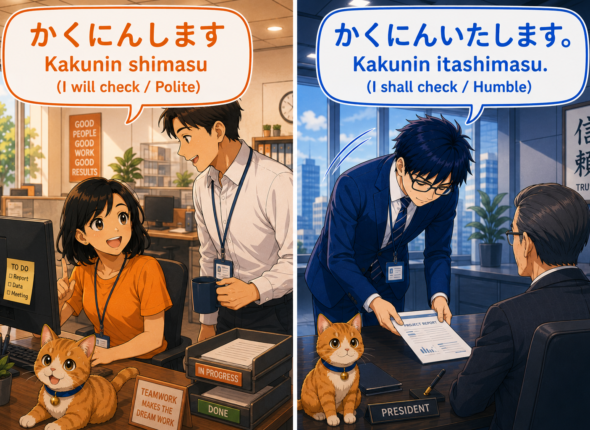
The Difference Between 「確認します」と「確認いたします」の敬語の違い の違い |Japanese Grammar (N5–N3)
(Joy checking a file for a coworker saying Kakunin shimasu [Polite] vs. Ken humbly checking for a client saying Kakunin itashimasu [Humble]) “I’ll check the schedule.” (To a coworker) -> スケジュールを確認します。...
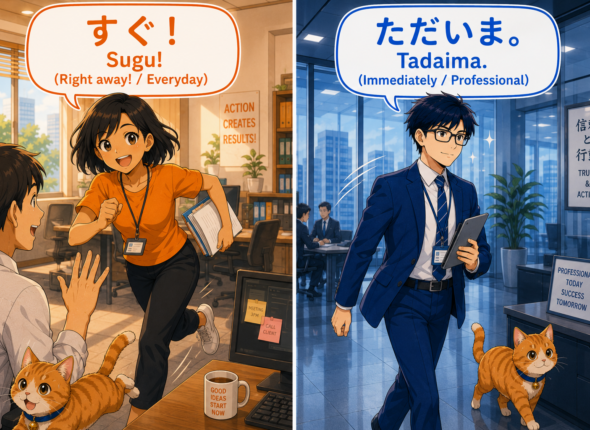
The Difference Between 「すぐ」と「ただいま」の会社での使い分け の違い |Japanese Grammar (N5–N3)
(Joy jogging energetically saying Sugu [Casual] vs. Ken walking elegantly saying Tadaima [Professional]) “I’ll go right away!” (To a coworker) -> すぐ行きます! (Standard Polite) “I will be right there.” (To a boss/client)...
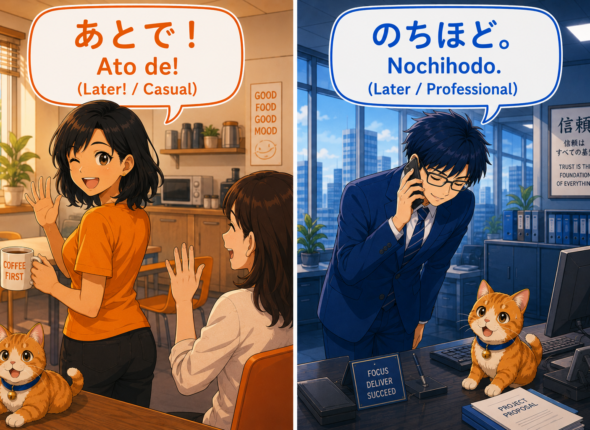
The Difference Between 「あとで」と「後ほど」のビジネス表現の違い の違い |Japanese Grammar (N5–N3)
(Joy waving casually saying Ato de [Casual] vs. Ken bowing on the phone saying Nochihodo [Professional]) “I’ll send it later.” (To a friend) -> あとで送ります。 (Casual / Daily Life) “I will send...
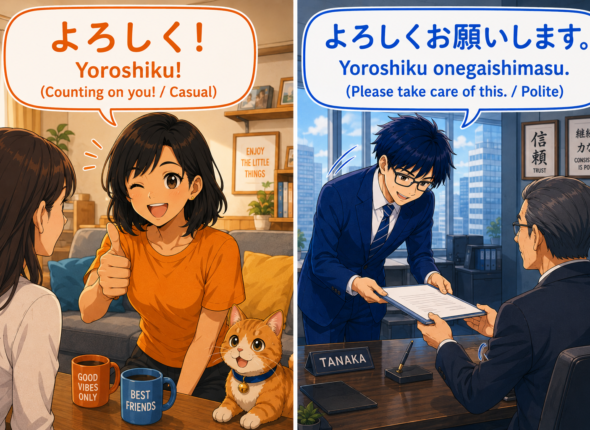
The Difference Between 「よろしく」と「よろしくお願いします」の丁寧さ の違い |Japanese Grammar (N5–N3)
(Joy giving a thumbs up saying Yoroshiku [Casual] vs. Ken bowing and saying Yoroshiku onegaishimasu [Polite]) “Counting on you!” (To a friend) -> よろしく! (Yoroshiku!) (Casual) “Please take care of this.”...