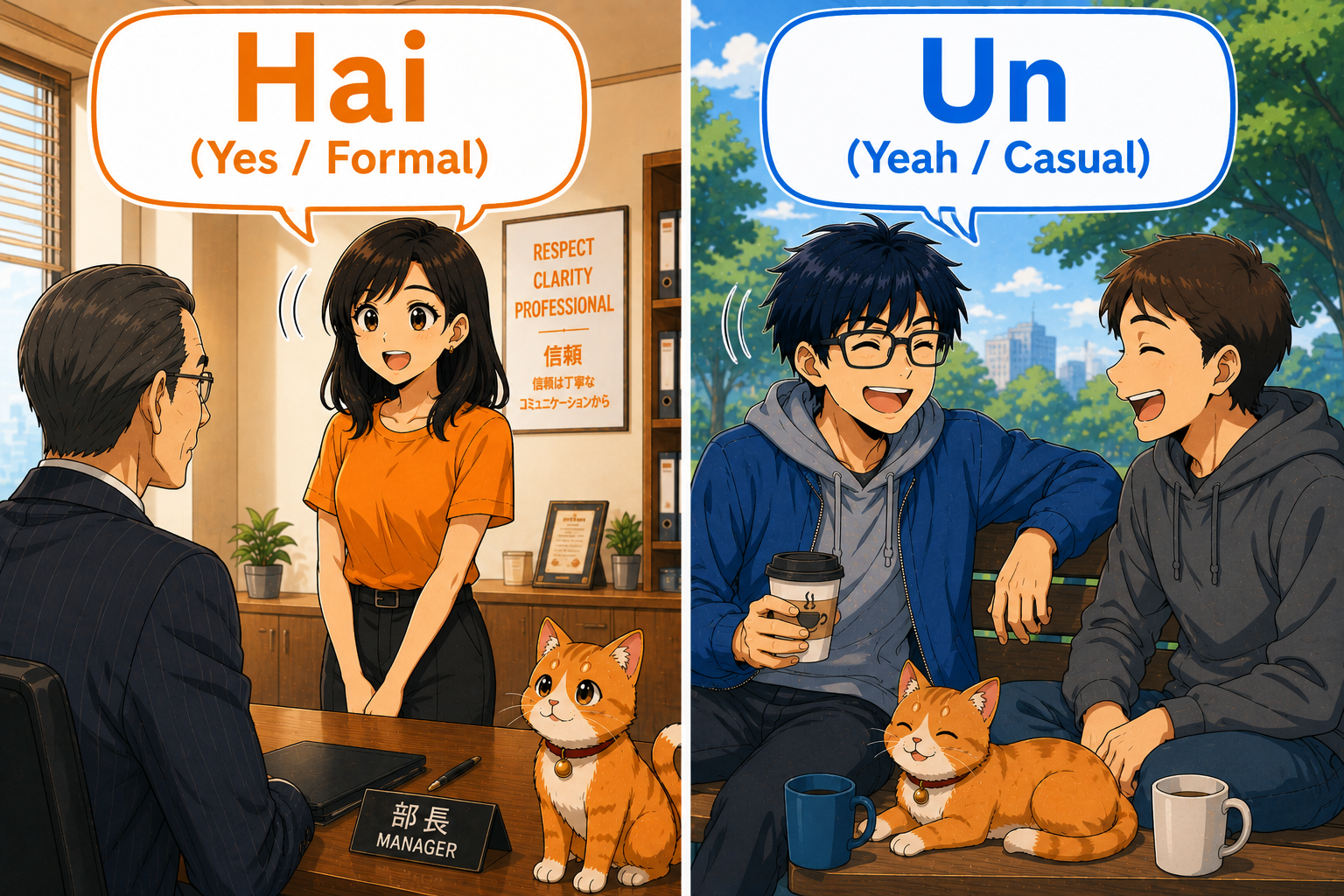
 (Joy standing straight and saying Hai to a boss [Formal] vs. Ken relaxing and saying Un to a friend [Casual])
“Did you understand?” -> Hai, wakarimashita. (Formal) “Did you understand?” -> Un, wakatta. (Casual) In English, we can comfortably say “Yes” or “Yeah” depending on our mood. In Japanese, however, your choice between はい (Hai) and うん (Un) has nothing to do with your mood—it is entirely based on who you are talking to. Mixing them up can make you sound incredibly rude, or awkwardly distant. Let’s look at what happens when Joy accidentally uses the wrong word at work.
🗣 Conversation Scene
Joy is listening to instructions from her older manager, Tanaka-san.Tanaka
Joyさん、このデータを明日までにエクセルに入力しておいてください。
(Joy, please enter this data into Excel by tomorrow.)
Joy
うん、わかりました!
(“Un” [Yeah], I understood!)
[ Tanaka-san looks slightly annoyed. Ken quickly whispers to Joy. ]
Ken
Joyさん!会社で上司に「うん」は絶対にダメです!すごく失礼ですよ。「はい」と言ってください。
(Joy! You absolutely cannot say “Un” to a boss at work! It is very rude. Please say “Hai”.)
💡 Explanation
Social Distance vs. Intimacy⚠️ The Golden Rule of Yes:
If you must use polite Japanese (Desu/Masu) with someone, you must use “Hai.” If you are allowed to use casual Japanese (Short Form) with someone, you can use “Un.”
1. はい (Hai) = Formal Yes 👔
Target Audience: Superiors, Strangers, Customers, Teachers. “Hai” creates a respectful, polite boundary between you and the listener. It acknowledges that there is a professional or social distance. In business, it shows that you are an alert, responsible adult.- [To a boss] はい、すぐやります。 (Yes, I will do it immediately.)
- [To a store clerk] はい、お願いします。 (Yes, please. *Maintaining polite distance*)
2. うん (Un) = Casual Yeah 👟
Target Audience: Close friends, Family, Juniors (younger people). “Un” removes the social boundary. It shows intimacy, warmth, and closeness. It is often accompanied by a relaxed nod. You only use “Un” with people who are inside your “inner circle.”- [To your mom] うん、美味しかったよ。 (Yeah, it was delicious.)
- [To a best friend] うん、一緒に行こう! (Yeah, let’s go together!)
📊 Comparison Table
🚧 The “Childish” Trap
Because children naturally say “Un” to their parents, using “Un” with an older person or a boss in Japan makes you sound exactly like a 5-year-old child! It strips away all your professional credibility. Even if your boss is friendly and smiles a lot, you must protect your professional image by answering with a crisp “Hai.”🔥 Practice Quiz
Tap to check the answer!Keep practicing with JPLT!