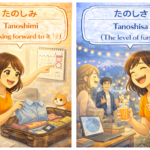
 (Joy receiving a gift and saying Arigatou sincerely [Sincere] vs. Ken grabbing coffee and saying Doumo casually [Light])
“Thank you so much for the gift!” -> ありがとう! (Arigatou!) (Sincere) “Thanks.” (Grabbing your receipt) -> どうも。 (Doumo.) (Light) Many beginners learn that どうも (Doumo) is a handy, short way to say “Thank you.” While it is very convenient, “Doumo” carries a very light weight of gratitude. If someone goes out of their way to help you and you respond with a quick “Doumo,” it can actually hurt their feelings! Let’s watch Ken make a big mistake after Joy helps him out.
🗣 Conversation Scene
Ken’s computer broke, and Joy spent three hours fixing it for him.Joy
ケンさん、パソコン直りましたよ!ウイルスを取り除きました。
(Ken, your computer is fixed! I removed the virus.)
Ken
あ、どうも。
(Ah, “Doumo.” [Thanks.] *Taking the laptop back casually*)
Joy
えっ!?「どうも」だけ!?3時間もかかったのに!
(Eh!? Just “Doumo”!? It took me three hours!)
💡 Explanation
The Weight of Japanese Gratitude⚠️ The Golden Rule of Gratitude:
Use ありがとう (Arigatou) when someone invests time, money, or effort into you. Use どうも (Doumo) for quick, transaction-level interactions where no real effort was spent.
1. ありがとう (Arigatou) = Sincere “Thank You” 🎁
Focus: Acknowledging Effort. “Arigatou” carries emotional weight. You use it when someone gives you a gift, helps you with a problem, or treats you to a meal. It tells the other person, “I recognize that you did something special for me.” (Note: To make it formal for bosses/strangers, just add gozaimasu).- [Friend buys you lunch] ごちそうさま!ありがとう! (Thanks for the meal! Thank you! *Sincere appreciation*)
- [Someone helps you move] 手伝ってくれてありがとう。 (Thank you for helping me. *Acknowledging their hard work*)
2. どうも (Doumo) = Light “Thanks” / “Cheers” ☕
Focus: Quick Acknowledgement. “Doumo” is extremely light. It is almost like a physical nod turned into a word. You use it for expected, minor actions where no deep emotional connection is needed. It is heavily used in customer service interactions from the customer’s side.- [Clerk hands you a plastic bag] あ、どうも。 (Ah, thanks. *Quick transaction*)
- [Someone holds the elevator door open] どうも。 (Cheers / Thanks. *Brief interaction*)
📊 Comparison Table
🚧 The “Ungrateful” Trap
If someone does you a huge favor—like picking you up from the airport, lending you money, or fixing your computer—and you say “Doumo,” it sounds incredibly dismissive. It implies: “Your three hours of hard work has the same value to me as a cashier handing me a receipt.” Always use Arigatou (gozaimasu) when real effort is involved!🔥 Practice Quiz
Tap to check the answer!Keep practicing with JPLT!