Skip to content
JPLT Online Japanese Language Training SchoolJPLT Online Japanese Language Training School
  • Courses
  • Plans
  • Get Started
    • What is JPLT Metaverse Campus
    • How to Enroll
  • JPLT LEARNING GYM
    • What is JPLT LEARNING GYM?
    • BootCamp
    • Studio
    • Season
    • Grammar Book
    • Optional Classes and AOTD
  • Schedule
  • Blog
  • About Us
    • What Is Dialog+ JPLT
    • Teachers
    • Company Profile
    • Contact Us
    • FAQs
  • Login
  • For Business
JPLT Online Japanese Language Training SchoolJPLT Online Japanese Language Training School
  • Courses
  • Plans
  • Get Started
    • What is JPLT Metaverse Campus
    • How to Enroll
  • JPLT LEARNING GYM
    • What is JPLT LEARNING GYM?
    • BootCamp
    • Studio
    • Season
    • Grammar Book
    • Optional Classes and AOTD
  • Schedule
  • Blog
  • About Us
    • What Is Dialog+ JPLT
    • Teachers
    • Company Profile
    • Contact Us
    • FAQs
  • Login
  • For Business
JPLT Blog

The Difference Between 「分かりました」と「かしこまりました」の使い分け の違い |Japanese Grammar (N5–N3)

  • 12 Jul, 2026
  • Com 0
「分かりました」と「かしこまりました」の使い分け
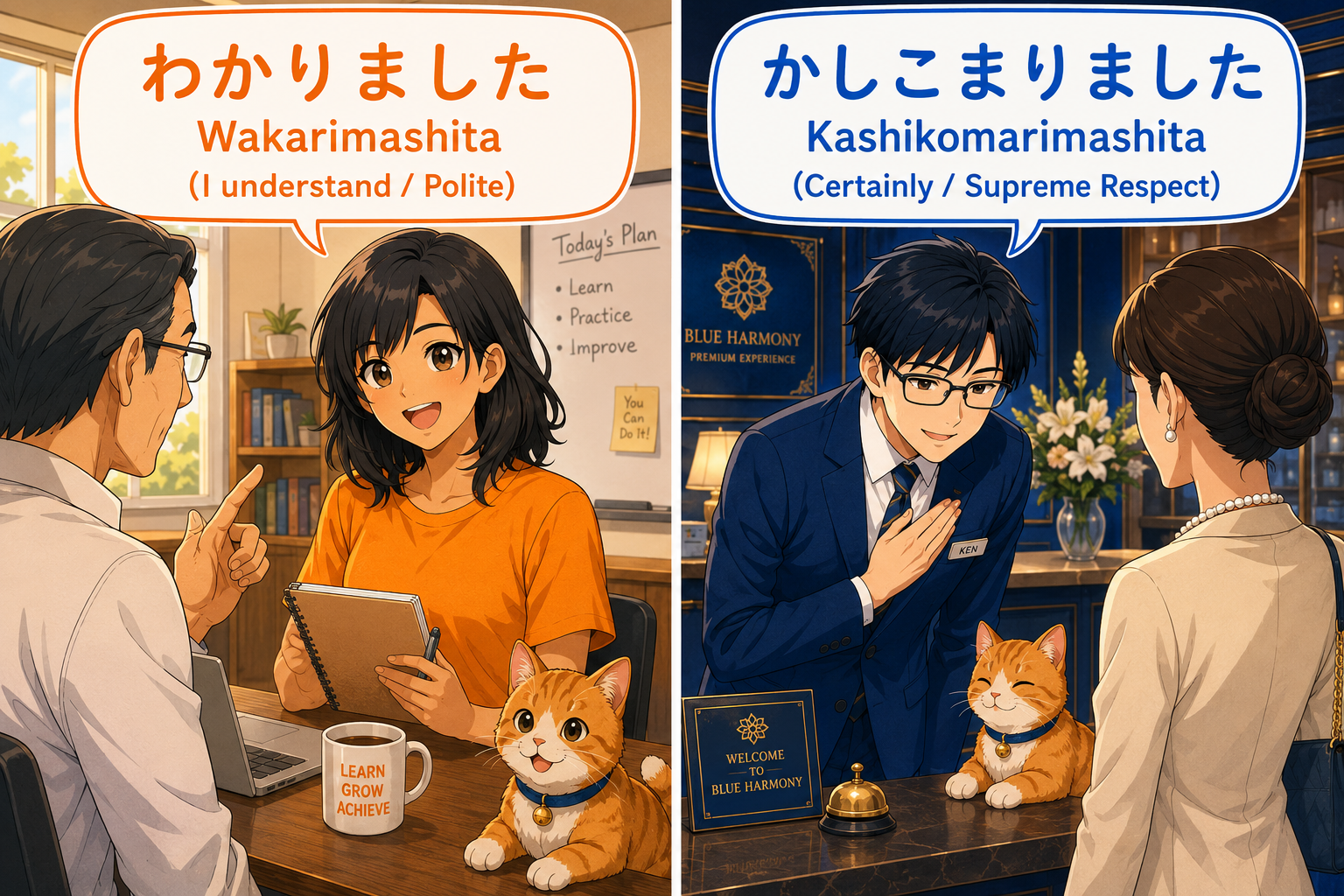
(Joy nodding warmly saying Wakarimashita [Standard Polite] vs. Ken bowing deeply saying Kashikomarimashita [Highest Respect])

“I understand the lesson.” -> 分かりました (Wakarimashita) (Standard Polite)
“I will prepare your room immediately, sir.” -> かしこまりました (Kashikomarimashita) (Ultimate Hospitality)
If you work in Japan, you will quickly realize that “Wakarimashita” is not enough when dealing with customers or VIPs. To show true Japanese hospitality (Omotenashi), you must upgrade your language. Let’s see what happens when Joy receives an important instruction from her boss.

🗣 Conversation Scene

Director Tanaka is giving Joy instructions regarding a very important VIP client visiting the school.

Tanaka
Joyさん、明日VIPのお客様がいらっしゃるので、第一会議室を準備しておいてください。
(Joy, a VIP client is coming tomorrow, so please prepare Meeting Room 1.)
Joy
はい、分かりました!
(Yes, “Wakarimashita!” [I understand!])

[ After Tanaka leaves, Ken gives Joy a professional tip. ]

Ken
Joyさん、「分かりました」も丁寧ですが、VIPのお客様に関する指示や、お客様への直接の返事には「かしこまりました」を使うと、最高のおもてなしになりますよ。
(Joy, “Wakarimashita” is polite, but for instructions about VIPs or replying directly to customers, using “Kashikomarimashita” shows the highest level of Omotenashi [hospitality].)

💡 Explanation

Standard Politeness vs. Humble Service

⚠️ The Golden Rule of Understanding:
Use 分かりました (Wakarimashita) for everyday conversations and general understanding. Use かしこまりました (Kashikomarimashita) when you are in a position of service (taking orders, serving clients, or receiving strict commands).

1. 分かりました (Wakarimashita) = I understand ☕

Level: Standard Polite (Teineigo)
This is the safest, most common way to say “I understand.” It is perfectly polite for normal daily life, speaking with senior colleagues, or talking to a teacher. However, because it lacks the “humble” aspect of customer service, it is not used by waiters or hotel staff.

  • [To a teacher] 先生、その文法、分かりました。
    (Teacher, I understood that grammar. *Polite and natural*)
  • [To a senior coworker] はい、分かりました。やっておきます。
    (Yes, understood. I’ll do it. *Standard office use*)

2. かしこまりました (Kashikomarimashita) = Certainly / Right away 🛎️

Level: Humble/Highest Respect (Kenjougo)
This word literally comes from the verb meaning “to obey respectfully.” It means, “I have heard your request, and I will execute it with the utmost respect.” This is the absolute golden standard for anyone working in a restaurant, hotel, or B2C (Business to Consumer) customer service.

  • [Customer orders coffee] かしこまりました。少々お待ちください。
    (Certainly. Please wait a moment. *Perfect Omotenashi*)
  • [Boss gives a critical order] かしこまりました。ただちに対応いたします。
    (Understood completely. I will handle it immediately. *High professional respect*)

📊 Comparison Table

Phrase Nuance Who to use it with
分かりました
(Wakarimashita)
Standard Polite. Shows basic comprehension. Teachers, senior coworkers, daily life.
かしこまりました
(Kashikomarimashita)
Ultimate Respect. Shows you are ready to serve. Customers, clients, VIPs, or very strict boss orders.

🚧 The “Butler” Trap

Because “Kashikomarimashita” is so polite, using it with your friends or family sounds like a joke! If your friend says, “Let’s get pizza,” and you reply “Kashikomarimashita,” you sound like their personal butler. Save this beautiful word strictly for professional customer service and formal business.

🔥 Practice Quiz

Tap to check the answer!

Q1. You are working part-time at a cafe. A customer orders a matcha latte. What do you say?
A. Wakarimashita.
B. Kashikomarimashita.
Answer: B (Kashikomarimashita)
In a service industry setting dealing directly with a customer, this is the only correct answer.
Q2. Your Japanese teacher explains a difficult grammar rule to you. You finally understand it. What do you say?
A. Wakarimashita!
B. Kashikomarimashita!
Answer: A (Wakarimashita!)
You are expressing comprehension, not taking an order. “Wakarimashita” is perfectly polite and natural here.
Keep practicing with JPLT!


Related posts:

[Must-Read Guide] Recommended Japanese Study Methods for Foreigners Challenges of Learning Japanese: 10 Solutions & Key Points Understanding Gakusei ja nai~n desu and Gakusei ja nai desu Tanoshimi vs Tanoshisa: Understanding their Differences
Share on:
【使い分け】「ありがとう」と「どうも」の軽さの違い の違い [日本語学習]
JPLT Malaysia

Japanese Learning Resources:

Tips for Learning Japanese Learn Japanese with Mastery Tips Japanese Grammar Book Japanese Learning Hacks Japanese Learning FAQ (日本語) Japanese Learning FAQ (English)

Connect with us!

Inquire Now!
Send us a message to know the latest class schedules. Lessons are conducted in English and Taglish (Tagalog-English).
Please enable JavaScript in your browser to complete this form.
Name *
Loading

Latest Post

Thumb
The Difference Between 「分かりました」と「かしこまりました」の使い分け の違い |Japanese Grammar
12 Jul, 2026
Thumb
【使い分け】「ありがとう」と「どうも」の軽さの違い の違い [日本語学習]
09 Jul, 2026
Thumb
The Difference Between 「ありがとう」と「どうも」の軽さの違い の違い |Japanese Grammar
09 Jul, 2026

Categories

  • Courses (13)
  • Grammar Book (108)
  • JAPANESE LEARNING FAQ (23)
  • Japanese Learning Hacks (9)
  • Japanese Learning TIPS (175)
  • JPLT Blog (201)
  • JPLT NEWS (12)
  • List of media productions (5)
  • にほんごをまなぶTips (170)
  • 日本語学習ハック (9)
JPLT_logo (2)

JPLT (Japanese language training) online school by Dialogplus 

Icon-facebook Icon-instagram Youtube

株式会社ダイアログプラス(Dialog+ Co., Ltd.) 
神奈川県横浜市都筑区南山田二丁目1番1-206号 
Address: 2-1-1-206 Minamiyamada, Tsuzuki-ku, Yokohama Japan 
Website: https://www.dialogplus.co.jp/ 

Dialog+ Philippines
Philippine Address: Unit 7 2/F, Seung Lee Building, Lot 1 Greenwoods Park Rizal Highway, CBD Area, Subic Bay Freeport Zone, Philippines
Website: https://dialogplus.ph/
Email: info@jplt-dialogplus.com

  • Specified Commercial Transaction Law
  • Privacy Policy
  • Terms & Condition
  • Refund Policy
  • JPLT Calendar
  • Admin
JPLT Online Japanese Language Training SchoolJPLT Online Japanese Language Training School