Skip to content
JPLT Online Japanese Language Training SchoolJPLT Online Japanese Language Training School
  • Courses
  • Plans
  • Get Started
    • What is JPLT Metaverse Campus
    • How to Enroll
  • JPLT LEARNING GYM
    • What is JPLT LEARNING GYM?
    • BootCamp
    • Studio
    • Season
    • Grammar Book
    • Optional Classes and AOTD
  • Schedule
  • Blog
  • About Us
    • What Is Dialog+ JPLT
    • Teachers
    • Company Profile
    • Contact Us
    • FAQs
  • Login
  • For Business
JPLT Online Japanese Language Training SchoolJPLT Online Japanese Language Training School
  • Courses
  • Plans
  • Get Started
    • What is JPLT Metaverse Campus
    • How to Enroll
  • JPLT LEARNING GYM
    • What is JPLT LEARNING GYM?
    • BootCamp
    • Studio
    • Season
    • Grammar Book
    • Optional Classes and AOTD
  • Schedule
  • Blog
  • About Us
    • What Is Dialog+ JPLT
    • Teachers
    • Company Profile
    • Contact Us
    • FAQs
  • Login
  • For Business
JPLT Blog

The Difference Between 「よろしくお願いします」と “Nice to meet you” のズレの違い |Japanese Grammar (N5–N3)

  • 02 Aug, 2026
  • Com 0
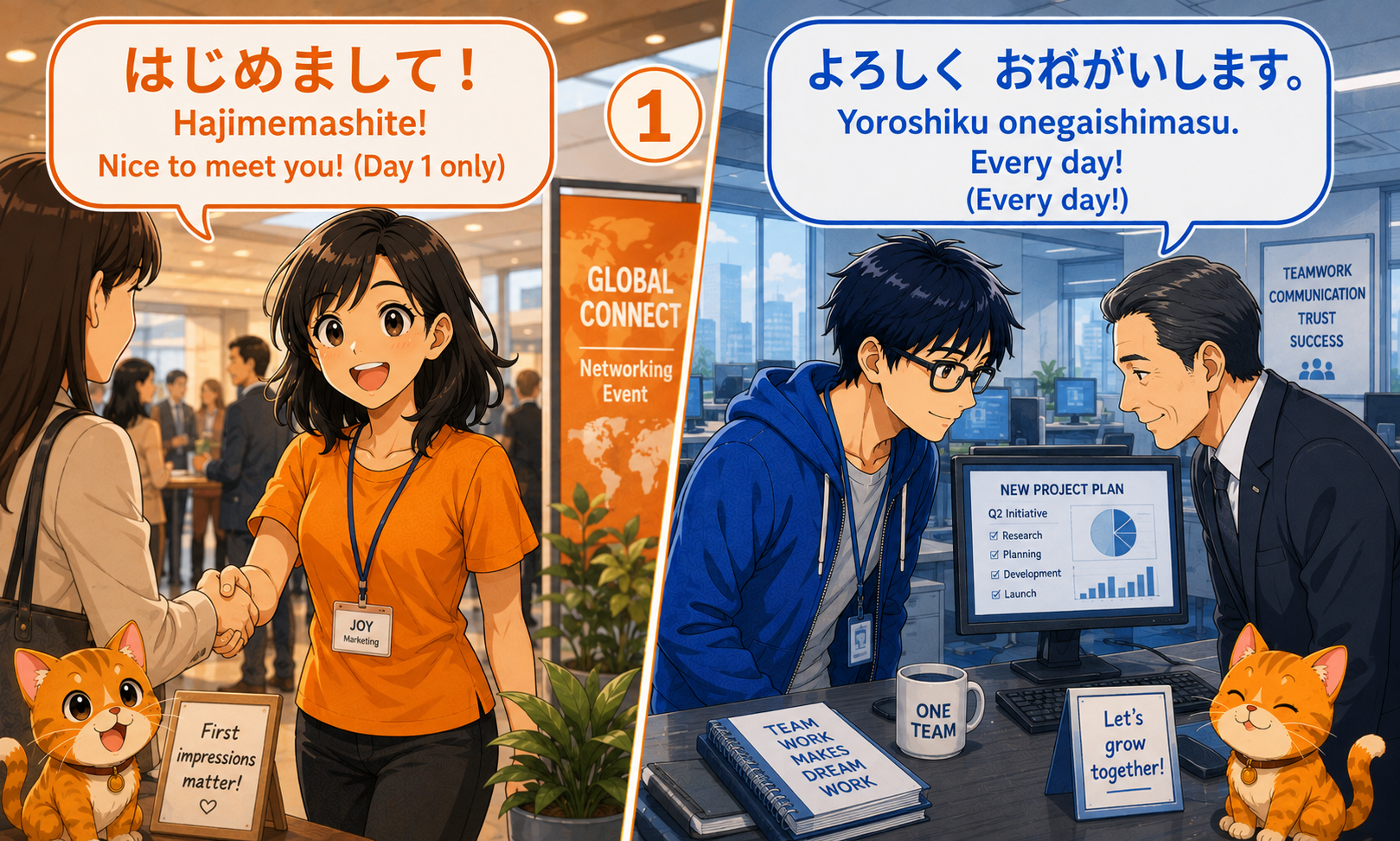
「よろしくお願いします」と “Nice to meet you” のズレ(Joy shaking hands saying Nice to meet you [Day 1] vs. Ken and his boss starting a project saying Yoroshiku onegaishimasu [Every day])

“First time meeting you.” -> はじめまして (Hajimemashite) (Day 1 Only)
“Let’s work well together.” -> よろしくお願いします (Yoroshiku onegaishimasu) (Every Single Day)
If you check an English-Japanese dictionary, よろしくお願いします (Yoroshiku onegaishimasu) is often translated as “Nice to meet you.” Because of this, many beginners use it once on their first day of work and then never say it again! This is a massive cultural trap. In Japanese business, this phrase is the glue that holds teams together. Let’s see what happens when Director Tanaka starts a new design project with Joy.

🗣 Conversation Scene

Joy and Director Tanaka have known each other for months. Today, they are kicking off a new social media campaign.

Tanaka
Joyさん、今日から新しいSNSキャンペーンのデザイン制作が始まります。よろしくお願いします。
(Joy, today we start creating the designs for the new SNS campaign. “Yoroshiku onegaishimasu”.)
Joy
え?ディレクター、「Nice to meet you」ですか?私たち、もうずっと一緒に働いていますよ?
(Eh? Director, “Nice to meet you”? But we have been working together for a long time?)

[ Tanaka is confused by her English translation. Ken jumps in to explain the magic word. ]

Ken
Joyさん!「よろしくお願いします」は「Nice to meet you」だけじゃありません!新しい仕事を一緒に始める時の「一緒に頑張りましょう」という合図なんですよ!
(Joy! “Yoroshiku onegaishimasu” doesn’t just mean “Nice to meet you”! It’s a signal meaning “Let’s do our best together” when starting a new task!)

💡 Explanation

The First Meeting vs. The Ongoing Relationship

⚠️ The Core Difference:
In English, “Nice to meet you” has an expiration date (you can only say it once). In Japanese, よろしくお願いします (Yoroshiku onegaishimasu) is a promise of good relations for the future. It never expires!

1. はじめまして (Hajimemashite) = Nice to meet you 🤝

Focus: Day 1 Only.
If you want the literal translation of “Nice to meet you / This is our first time meeting,” use はじめまして (Hajimemashite). You say this exactly one time in your entire life to a person. It is always the very first word out of your mouth when introducing yourself.

  • はじめまして、Joyです。
    (Nice to meet you, I am Joy. *Standard self-intro*)

2. よろしくお願いします (Yoroshiku onegaishimasu) = The Magic Word ✨

Focus: Please treat me well / I’m counting on you / Let’s do this.
“Yoroshiku” means “well/appropriately,” and “onegaishimasu” means “I humbly request.” So you are literally saying, “I humbly request that you treat me (or this task) well.” Because it is so versatile, you use it in almost every business scenario:

  • [At the end of a self-intro] はじめまして、Joyです。よろしくお願いします。
    (Nice to meet you… Please treat me well in the future.)
  • [When kicking off a new project] 今日から新しいプロジェクトですね。よろしくお願いします!
    (New project starts today. Let’s do our best together!)
  • [At the end of every business email] 引き続き、よろしくお願いいたします。
    (I look forward to our continued good relationship / Best regards.)

📊 Comparison Table

Phrase True Meaning When to use it
はじめまして
(Hajimemashite)
“This is the first time we are opening a relationship.” Only once. The first word of a self-introduction.
よろしくお願いします
(Yoroshiku onegaishimasu)
“Please treat me/this task well.” or “I’m counting on you.” Every day! Starting projects, handing off tasks, ending emails.

💎 The “Asking a Favor” Trap

In English, if you ask someone to do a task, you say “Thank you” in advance. In Japanese, saying “Arigatou gozaimasu” before they actually do the work feels strange! Instead, you hand them the task and say: 「このタスク、よろしくお願いします」 (I’m counting on you for this task). You only say “Thank you” after they finish it!

🔥 Practice Quiz

Tap to check the answer!

Q1. You are meeting a new client for the very first time. How do you introduce yourself?
A. Hajimemashite, Joy desu. Yoroshiku onegaishimasu.
B. Yoroshiku onegaishimasu, Joy desu. Hajimemashite.
Answer: A
“Hajimemashite” opens the introduction, and “Yoroshiku” is the promise to work well together at the end.
Q2. You are handing a document to a coworker you’ve known for a year and asking them to double-check it. What do you say?
A. Hajimemashite!
B. Yoroshiku onegaishimasu!
Answer: B (Yoroshiku onegaishimasu!)
You already know them, so no “Hajimemashite.” Here, Yoroshiku means “I’m counting on you to check this.”


Related posts:

[Must-Read Guide] Recommended Japanese Study Methods for Foreigners Challenges of Learning Japanese: 10 Solutions & Key Points Understanding Gakusei ja nai~n desu and Gakusei ja nai desu Tanoshimi vs Tanoshisa: Understanding their Differences
Share on:
【使い分け】「よろしくお願いします」と “Nice to meet you” のズレの違い [日本語学習]
JPLT Malaysia

Japanese Learning Resources:

Tips for Learning Japanese Learn Japanese with Mastery Tips Japanese Grammar Book Japanese Learning Hacks Japanese Learning FAQ (日本語) Japanese Learning FAQ (English)

Connect with us!

Inquire Now!
Send us a message to know the latest class schedules. Lessons are conducted in English and Taglish (Tagalog-English).
Please enable JavaScript in your browser to complete this form.
Name *
Loading

Latest Post

Thumb
The Difference Between 「よろしくお願いします」と “Nice to meet
02 Aug, 2026
Thumb
【使い分け】「よろしくお願いします」と “Nice to meet you” のズレの違い [日本語学習]
02 Aug, 2026
Thumb
【使い分け】「先に失礼します」と “I’m leaving first” の違い の違い [日本語学習]
02 Aug, 2026

Categories

  • Courses (13)
  • Grammar Book (108)
  • JAPANESE LEARNING FAQ (23)
  • Japanese Learning Hacks (9)
  • Japanese Learning TIPS (190)
  • JPLT Blog (232)
  • JPLT NEWS (12)
  • List of media productions (5)
  • にほんごをまなぶTips (186)
  • 日本語学習ハック (9)
JPLT_logo (2)

JPLT (Japanese language training) online school by Dialogplus 

Icon-facebook Icon-instagram Youtube

株式会社ダイアログプラス(Dialog+ Co., Ltd.) 
神奈川県横浜市都筑区南山田二丁目1番1-206号 
Address: 2-1-1-206 Minamiyamada, Tsuzuki-ku, Yokohama Japan 
Website: https://www.dialogplus.co.jp/ 

Dialog+ Philippines
Philippine Address: Unit 7 2/F, Seung Lee Building, Lot 1 Greenwoods Park Rizal Highway, CBD Area, Subic Bay Freeport Zone, Philippines
Website: https://dialogplus.ph/
Email: info@jplt-dialogplus.com

  • Specified Commercial Transaction Law
  • Privacy Policy
  • Terms & Condition
  • Refund Policy
  • JPLT Calendar
  • Admin
JPLT Online Japanese Language Training SchoolJPLT Online Japanese Language Training School