Skip to content
JPLT Online Japanese Language Training SchoolJPLT Online Japanese Language Training School
  • Courses
  • Plans
  • Get Started
    • What is JPLT Metaverse Campus
    • How to Enroll
  • JPLT LEARNING GYM
    • What is JPLT LEARNING GYM?
    • BootCamp
    • Studio
    • Season
    • Grammar Book
    • Optional Classes and AOTD
  • Schedule
  • Blog
  • About Us
    • What Is Dialog+ JPLT
    • Teachers
    • Company Profile
    • Contact Us
    • FAQs
  • Login
  • For Business
JPLT Online Japanese Language Training SchoolJPLT Online Japanese Language Training School
  • Courses
  • Plans
  • Get Started
    • What is JPLT Metaverse Campus
    • How to Enroll
  • JPLT LEARNING GYM
    • What is JPLT LEARNING GYM?
    • BootCamp
    • Studio
    • Season
    • Grammar Book
    • Optional Classes and AOTD
  • Schedule
  • Blog
  • About Us
    • What Is Dialog+ JPLT
    • Teachers
    • Company Profile
    • Contact Us
    • FAQs
  • Login
  • For Business
JPLT Blog

The Difference Between 「よろしく」と「よろしくお願いします」の丁寧さ の違い |Japanese Grammar (N5–N3)

  • 13 Jul, 2026
  • Com 0


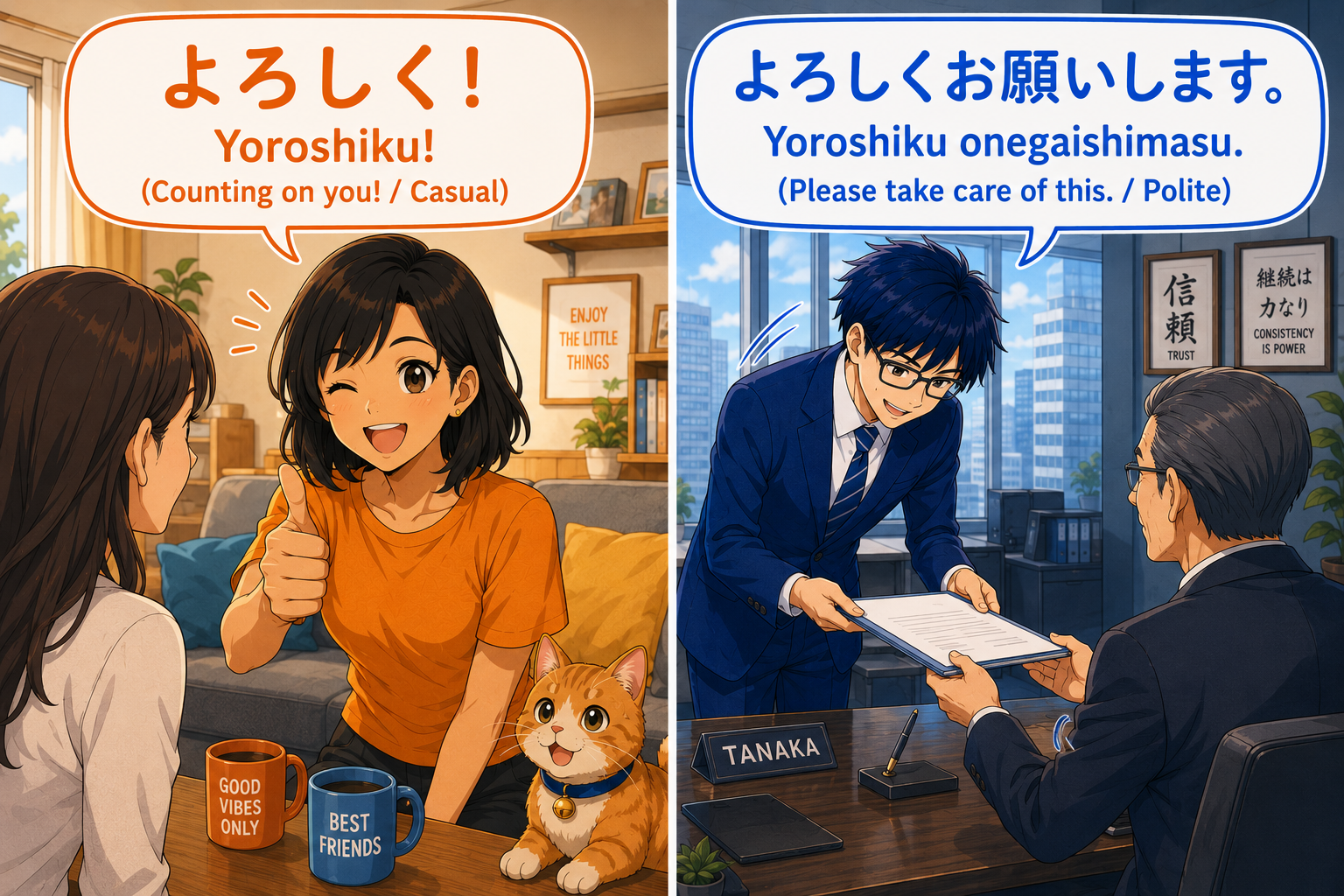
「よろしく」と「よろしくお願いします」の丁寧さ(Joy giving a thumbs up saying Yoroshiku [Casual] vs. Ken bowing and saying Yoroshiku onegaishimasu [Polite])

“Counting on you!” (To a friend) -> よろしく! (Yoroshiku!) (Casual)
“Please take care of this.” (To a boss) -> よろしくお願いします。(Yoroshiku onegaishimasu.) (Polite)
よろしくお願いします (Yoroshiku onegaishimasu) is a magic phrase in Japanese. It means “Please treat me well,” “I look forward to working with you,” or “Please take care of this favor.” However, many learners try to save time by shortening it to just よろしく (Yoroshiku). In the business world, dropping that polite ending is a massive mistake! Let’s watch what happens when Joy asks Director Tanaka for a favor.

🗣 Conversation Scene

Joy needs Director Tanaka to sign an important document before he leaves for a meeting.

Joy
ディレクター、この書類にサインをお願いします。じゃあ、よろしく!
(Director, please sign this document. Well then, “Yoroshiku!” [Counting on you!])
Tanaka
……「よろしく」? Joyさん、私はあなたの友達ではありませんよ。
(…”Yoroshiku”? Joy, I am not your friend. *Frowns*)

[ Ken quickly pulls Joy aside to explain the rule. ]

Ken
Joyさん!会社で上司に「よろしく」だけ言うのはすごく失礼です!「よろしくお願いします」と最後まで言わなければいけません!
(Joy! Saying just “Yoroshiku” to a boss at the company is very rude! You must say it to the end: “Yoroshiku onegaishimasu”!)

💡 Explanation

The Weight of a Request

⚠️ The Golden Rule of Yoroshiku:
よろしく (Yoroshiku) removes the polite distance, making it a casual demand. よろしくお願いします (Yoroshiku onegaishimasu) builds a polite wall, making it a respectful request.

1. よろしく (Yoroshiku) = Casual / Friendly 🏠

Target: Close friends, family, or subordinates.
“Yoroshiku” is the short form. Because it drops the verb “onegaishimasu” (I humbly request), it sounds very light and close. It is perfectly natural when asking a friend for a small favor or introducing yourself at a casual party. However, using it downwards (to someone younger) can sound slightly bossy.

  • [To a best friend] 明日、8時に駅ね。よろしく!
    (Tomorrow, 8 AM at the station. Counting on you! *Friendly*)
  • [Self-intro at a college club] ケンです。よろしく!
    (I’m Ken. Nice to meet you! *Casual*)

2. よろしくお願いします (Yoroshiku onegaishimasu) = Polite / Professional 🏢

Target: Bosses, coworkers, strangers, clients.
Adding お願いします (onegaishimasu) creates a polite, professional boundary. It shows that you respect the other person’s time and effort. This is the absolute standard for business emails, workplace requests, and formal self-introductions.

  • [Handing a task to a coworker] このデータ、確認をよろしくお願いします。
    (Please check this data. I’m counting on you. *Professional*)
  • [First day at a new job] ジョイです。よろしくお願いします。
    (I am Joy. I look forward to working with you. *Polite*)

📊 Comparison Table

Phrase Politeness Level Who to use it with
よろしく
(Yoroshiku)
Casual (Short Form). Zero social walls. Family, close friends, subordinates.
よろしくお願いします
(Yoroshiku onegaishimasu)
Polite (Long Form). Respectful and professional. Coworkers, bosses, clients, strangers.

🚧 The “Arrogant Demand” Trap

When you ask someone to do a task, they are the one doing you a favor. If you hand a file to a manager and say “Yoroshiku!”, you are effectively saying, “Do this for me, buddy.” It sounds incredibly arrogant and bossy. In the workplace, always add the humble “onegaishimasu” to show you appreciate their help.

🔥 Practice Quiz

Tap to check the answer!

Q1. You send an email to a coworker in another department asking them to send you a report. How do you end the email?
A. Yoroshiku!
B. Yoroshiku onegaishimasu.
Answer: B (Yoroshiku onegaishimasu)
This is a professional business email. You must use the polite form to maintain proper boundaries and respect.
Q2. You ask your best friend to save a seat for you at the movie theater because you are running 5 minutes late.
A. Gomen! Seki totte oite! Yoroshiku!
B. Gomen! Seki totte oite! Yoroshiku onegaishimasu.
Answer: A (Yoroshiku!)
With your best friend, using “Yoroshiku onegaishimasu” would sound strangely stiff and robotic. “Yoroshiku!” is perfect here.
Keep practicing with JPLT!

Related posts:

[Must-Read Guide] Recommended Japanese Study Methods for Foreigners Challenges of Learning Japanese: 10 Solutions & Key Points Understanding Gakusei ja nai~n desu and Gakusei ja nai desu Tanoshimi vs Tanoshisa: Understanding their Differences
Share on:
The Difference Between 「お疲れさま」と「ご苦労さま」の立場の違い の違い |Japanese Grammar (N5–N3)
【使い分け】 「よろしく」と「よろしくお願いします」の丁寧さ の違い [日本語学習]
JPLT Malaysia

Japanese Learning Resources:

Tips for Learning Japanese Learn Japanese with Mastery Tips Japanese Grammar Book Japanese Learning Hacks Japanese Learning FAQ (日本語) Japanese Learning FAQ (English)

Connect with us!

Inquire Now!
Send us a message to know the latest class schedules. Lessons are conducted in English and Taglish (Tagalog-English).
Please enable JavaScript in your browser to complete this form.
Name *
Loading

Latest Post

Thumb
【使い分け】「あとで」と「後ほど」のビジネス表現の違い の違い [日本語学習]
13 Jul, 2026
Thumb
The Difference Between 「あとで」と「後ほど」のビジネス表現の違い の違い |Japanese Grammar
13 Jul, 2026
Thumb
【使い分け】 「よろしく」と「よろしくお願いします」の丁寧さ の違い [日本語学習]
13 Jul, 2026

Categories

  • Courses (13)
  • Grammar Book (108)
  • JAPANESE LEARNING FAQ (23)
  • Japanese Learning Hacks (9)
  • Japanese Learning TIPS (178)
  • JPLT Blog (207)
  • JPLT NEWS (12)
  • List of media productions (5)
  • にほんごをまなぶTips (173)
  • 日本語学習ハック (9)
JPLT_logo (2)

JPLT (Japanese language training) online school by Dialogplus 

Icon-facebook Icon-instagram Youtube

株式会社ダイアログプラス(Dialog+ Co., Ltd.) 
神奈川県横浜市都筑区南山田二丁目1番1-206号 
Address: 2-1-1-206 Minamiyamada, Tsuzuki-ku, Yokohama Japan 
Website: https://www.dialogplus.co.jp/ 

Dialog+ Philippines
Philippine Address: Unit 7 2/F, Seung Lee Building, Lot 1 Greenwoods Park Rizal Highway, CBD Area, Subic Bay Freeport Zone, Philippines
Website: https://dialogplus.ph/
Email: info@jplt-dialogplus.com

  • Specified Commercial Transaction Law
  • Privacy Policy
  • Terms & Condition
  • Refund Policy
  • JPLT Calendar
  • Admin
JPLT Online Japanese Language Training SchoolJPLT Online Japanese Language Training School