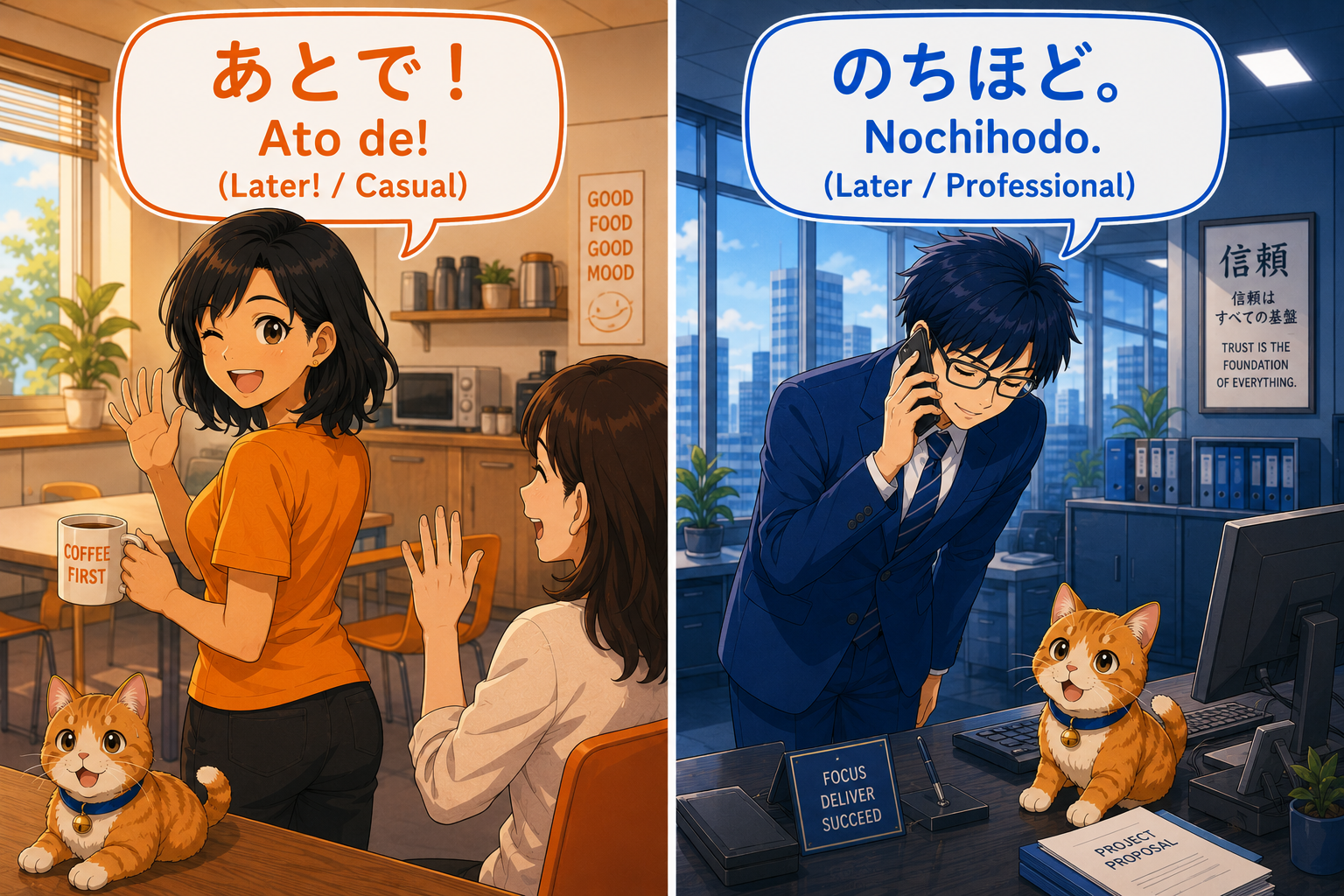
 (Joy waving casually saying Ato de [Casual] vs. Ken bowing on the phone saying Nochihodo [Professional])
“I’ll send it later.” (To a friend) -> あとで送ります。 (Casual / Daily Life) “I will send it later.” (To a client) -> 後ほどお送りいたします。 (Professional / Business) In everyday Japanese, あとで (Ato de) is the standard word for “later.” But in the Japanese business world, words get upgraded to show respect. If you use “Ato de” with a strict boss or an important client, it sounds like you lack professional manners. To survive in a Japanese office, you must learn the “Business Upgrade”: 後ほど (Nochihodo). Let’s see what happens when Joy talks to Director Tanaka about a file.
🗣 Conversation Scene
Director Tanaka asks Joy if she has finished preparing the presentation data.Tanaka
Joyさん、明日のプレゼン資料はできましたか?
(Joy, is the presentation data for tomorrow ready?)
Joy
まだです!あとでメールしますね。
(Not yet! I’ll email it to you “ato de” [later].)
[ Ken overhears this and quickly gives Joy some business advice. ]
Ken
Joyさん、ビジネスの場で「あとで」は少しカジュアルすぎます。上司やお客様には「後ほど」を使いましょう!
(Joy, “ato de” is a bit too casual for business. Let’s use “Nochihodo” for bosses and clients!)
💡 Explanation
Everyday Talk vs. Business Terminology⚠️ The Golden Rule of Timing Words:
あとで (Ato de) is an everyday word (casual distance). 後ほど (Nochihodo) is a formal business word (professional distance).
1. あとで (Ato de) = Later (Everyday / Casual) 👟
Target: Friends, family, close colleagues. “Ato de” is the standard spoken word for “later.” Even if you attach formal verbs to the end of the sentence (like *Ato de kimasu*), the word “Ato de” itself still carries a casual, conversational feeling. In a strict office environment, using this with superiors can make you sound inexperienced.- [To a close coworker] あとでランチ行こう! (Let’s go to lunch later! *Friendly*)
- [To a friend] 詳細はあとで送るね。 (I’ll send the details later. *Casual*)
2. 後ほど (Nochihodo) = Later (Professional / Formal) 🏢
Target: Bosses, clients, business emails, public announcements. “Nochihodo” is the upgraded, professional version of “Ato de.” It shows deep respect and a high level of business etiquette. *Note:* “Nochihodo” usually implies a relatively short amount of time (usually later *the same day*). It is often paired with humble verbs (Kenjougo) to create perfectly polite business Japanese.- [To a boss] 後ほど、メールでお送りいたします。 (I will send it by email later. *Professional & Polite*)
- [On a business call] 担当者から後ほどご連絡いたします。 (The person in charge will contact you later. *Standard Business*)
📊 Comparison Table
🚧 The “Time Limit” Trap
Be careful! 後ほど (Nochihodo) implies “later *today*.” If you tell a client “Nochihodo renraku shimasu” and you don’t contact them until the *next* day, they will be very angry because they were waiting for it today. If you need to contact them tomorrow or next week, use 後日 (Gojitsu – at a later date) instead.🔥 Practice Quiz
Tap to check the answer!Keep practicing with JPLT!