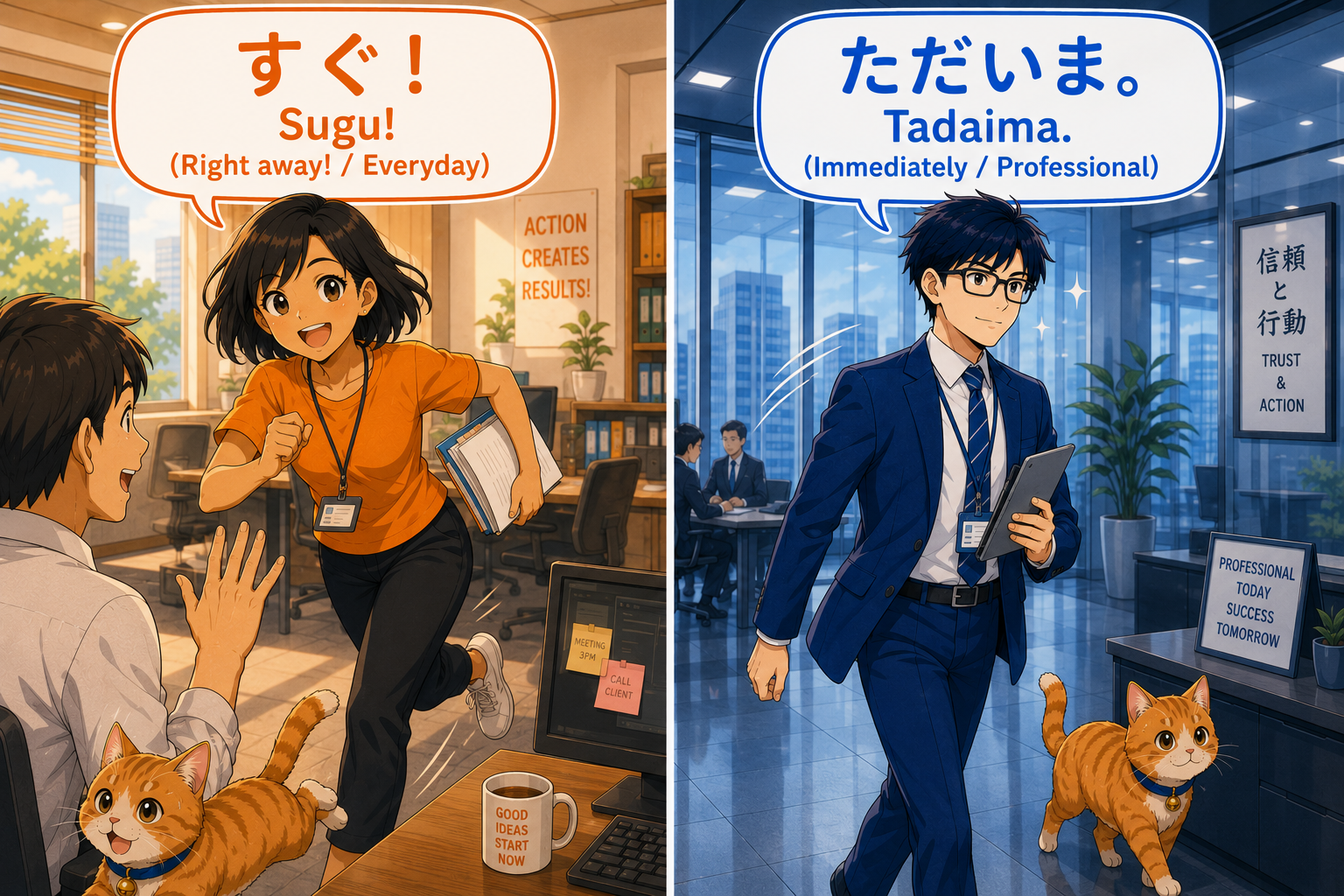
 (Joy jogging energetically saying Sugu [Casual] vs. Ken walking elegantly saying Tadaima [Professional])
“I’ll go right away!” (To a coworker) -> すぐ行きます! (Standard Polite) “I will be right there.” (To a boss/client) -> ただいま参ります。 (Professional / Elegant) When someone calls your name, you want to show that you will respond quickly. In daily life, すぐ (Sugu) is the perfect word. But in a Japanese business setting, “Sugu” can sound a little bit raw or childish. To show true professional polish, you need to use ただいま (Tadaima). Let’s see what happens when Joy is called by her manager.
🗣 Conversation Scene
Director Tanaka needs Joy’s help with a document and calls her from across the room.Tanaka
Joyさん、ちょっとここに来てくれますか?
(Joy, could you come here for a second?)
Joy
はい、すぐ行きます!
(Yes, I’ll go “sugu” [right away]!)
[ Ken whispers to Joy to help her sound more professional. ]
Ken
Joyさん、上司には「すぐ行きます」よりも、「ただいま参ります」の方が、大人っぽくてプロフェッショナルに聞こえますよ!
(Joy, to a boss, saying “Tadaima mairimasu” sounds much more mature and professional than “Sugu ikimasu”!)
💡 Explanation
Everyday Urgency vs. Business Elegance⚠️ The Golden Rule of Immediacy:
すぐ (Sugu) focuses on the speed of the action (casual/standard). ただいま (Tadaima) focuses on the present moment and adds an elegant, professional wall of respect.
1. すぐ (Sugu) = Right away / Soon 👟
Target: Coworkers, daily life, friends. “Sugu” is perfectly fine for everyday situations and working with people of the same rank. However, because it is an everyday word, using it with a high-level boss or an important client makes you sound a bit like a student responding to a teacher. It lacks corporate polish.- [To a coworker] すぐやります! (I’ll do it right away! *Energetic but standard*)
- [On a casual team chat] すぐ送ります。 (I’ll send it soon. *Standard office use*)
2. ただいま (Tadaima) = Immediately / Currently 🏢
Target: Bosses, clients, customers, VIPs. Written with the kanji 只今, it literally means “right now.” When used for future actions (“I will go right now”), it sounds incredibly elegant and respectful. It is almost always paired with Humble Language (Kenjougo). It is also heavily used in customer service (e.g., “Tadaima kakunin itashimasu” – I am checking right now).- [When called by a boss] ただいま参ります。 (I will be right there. *Highest respect*)
- [To a client waiting] ただいまお持ちいたします。 (I will bring it immediately. *Professional service*)
📊 Comparison Table
🚧 The “I’m Home” Trap
You probably learned that ただいま (Tadaima) is what you say when you arrive home (“I’m home!”). Because of this, beginners sometimes walk back into their office after a meeting and happily shout, “Tadaima!” Do not do this! Your office is not your house. When returning to the office, you should say 戻りました (Modorimashita – I have returned).🔥 Practice Quiz
Tap to check the answer!Keep practicing with JPLT!