
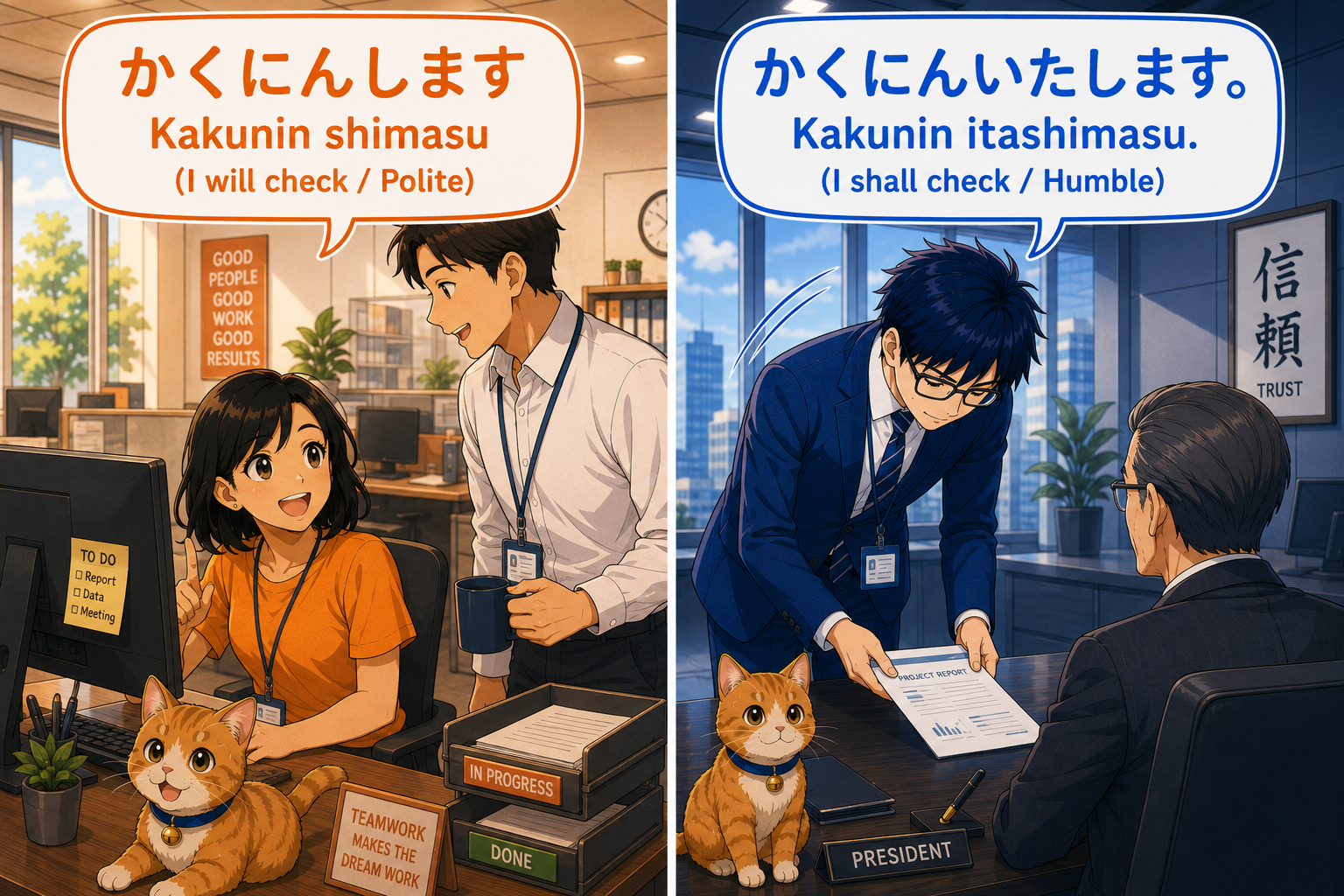
 (Joy checking a file for a coworker saying Kakunin shimasu [Polite] vs. Ken humbly checking for a client saying Kakunin itashimasu [Humble])
“I’ll check the schedule.” (To a coworker) -> スケジュールを確認します。 (Polite) “I will check the contract.” (To a client) -> 契約書を確認いたします。 (Humble) In Japanese business, the word “check” or “confirm” (確認 – Kakunin) is used dozens of times a day. As a beginner, you learn to add します (shimasu) to make it polite. However, when dealing with VIPs, clients, or strict bosses, standard politeness is not enough. You must use Humble Language. Let’s see what happens when Joy talks to Director Tanaka about an important document.
🗣 Conversation Scene
Director Tanaka asks Joy to review an important contract from a partner company.Tanaka
Joyさん、この契約書に間違いがないか見ておいてください。
(Joy, please take a look at this contract to see if there are any mistakes.)
Joy
はい、すぐに確認します!
(Yes, I will check it immediately [“Kakunin shimasu”]!)
[ Ken pulls Joy aside to help her upgrade her business Japanese. ]
Ken
Joyさん、上司やお客様には「確認します」ではなく、「確認いたします」を使うと、謙虚でとても美しいビジネス日本語になりますよ。
(Joy, to a boss or client, using “Kakunin itashimasu” instead of “Kakunin shimasu” makes your business Japanese humble and very beautiful.)
💡 Explanation
Standard Polite vs. Humble Language⚠️ The Golden Rule of Doing Actions:
When talking about your own actions, 〜します (~shimasu) is neutral and polite. Changing it to 〜いたします (~itashimasu) actively lowers your status to elevate the listener, which is required for high-level respect.
1. 確認します (Kakunin shimasu) = Polite (Teineigo) ☕
Target: Coworkers, standard office situations, junior staff. This is standard polite language. It is perfectly respectful for everyday office life when talking to team members or people of similar rank. However, because it doesn’t lower your status, it feels a bit too “equal” when talking to a major client or a high-ranking director.- [To a coworker] 会議室の予約、私が確認します。 (I will check the meeting room reservation. *Standard Polite*)
2. 確認いたします (Kakunin itashimasu) = Humble (Kenjougo) 👔
Target: Bosses, clients, customers, formal emails. “Itashimasu” is the humble form of “shimasu.” By using it, you are grammatically lowering yourself to put the listener on a pedestal. This is the absolute standard for business emails, answering the phone, and serving clients.- [To a client on the phone] 在庫があるか、すぐに確認いたします。 (I shall check immediately if we have it in stock. *Professional/Humble*)
- [In an email to a boss] 添付ファイルを確認いたしました。 (I have humbly checked the attached file. *Formal*)
📊 Comparison Table
🚧 The “Itashimasu” Rule
Remember that humble language (Kenjougo) is only used for your own actions (or your team’s actions). You can say “Watashi ga kakunin itashimasu” (I will check). But you must never use it for the boss’s actions! If you say “Shachou ga kakunin itashimasu” (The CEO will check), you are grammatically lowering the CEO into the dirt. (To talk about the boss’s actions, you must use Sonkeigo – Respectful language).🔥 Practice Quiz
Tap to check the answer!Keep practicing with JPLT!