Skip to content
JPLT Online Japanese Language Training SchoolJPLT Online Japanese Language Training School
  • Courses
  • Plans
  • Get Started
    • What is JPLT Metaverse Campus
    • How to Enroll
  • JPLT LEARNING GYM
    • What is JPLT LEARNING GYM?
    • BootCamp
    • Studio
    • Season
    • Grammar Book
    • Optional Classes and AOTD
  • Schedule
  • Blog
  • About Us
    • What Is Dialog+ JPLT
    • Teachers
    • Company Profile
    • Contact Us
    • FAQs
  • Login
  • For Business
JPLT Online Japanese Language Training SchoolJPLT Online Japanese Language Training School
  • Courses
  • Plans
  • Get Started
    • What is JPLT Metaverse Campus
    • How to Enroll
  • JPLT LEARNING GYM
    • What is JPLT LEARNING GYM?
    • BootCamp
    • Studio
    • Season
    • Grammar Book
    • Optional Classes and AOTD
  • Schedule
  • Blog
  • About Us
    • What Is Dialog+ JPLT
    • Teachers
    • Company Profile
    • Contact Us
    • FAQs
  • Login
  • For Business
Japanese Learning TIPS

The Difference Between 自己主張の文化と遠慮の文化の違い の違い |Japanese Grammar (N5–N3)

  • 12 Aug, 2026
  • Com 0

自己主張の文化と遠慮の文化の違い
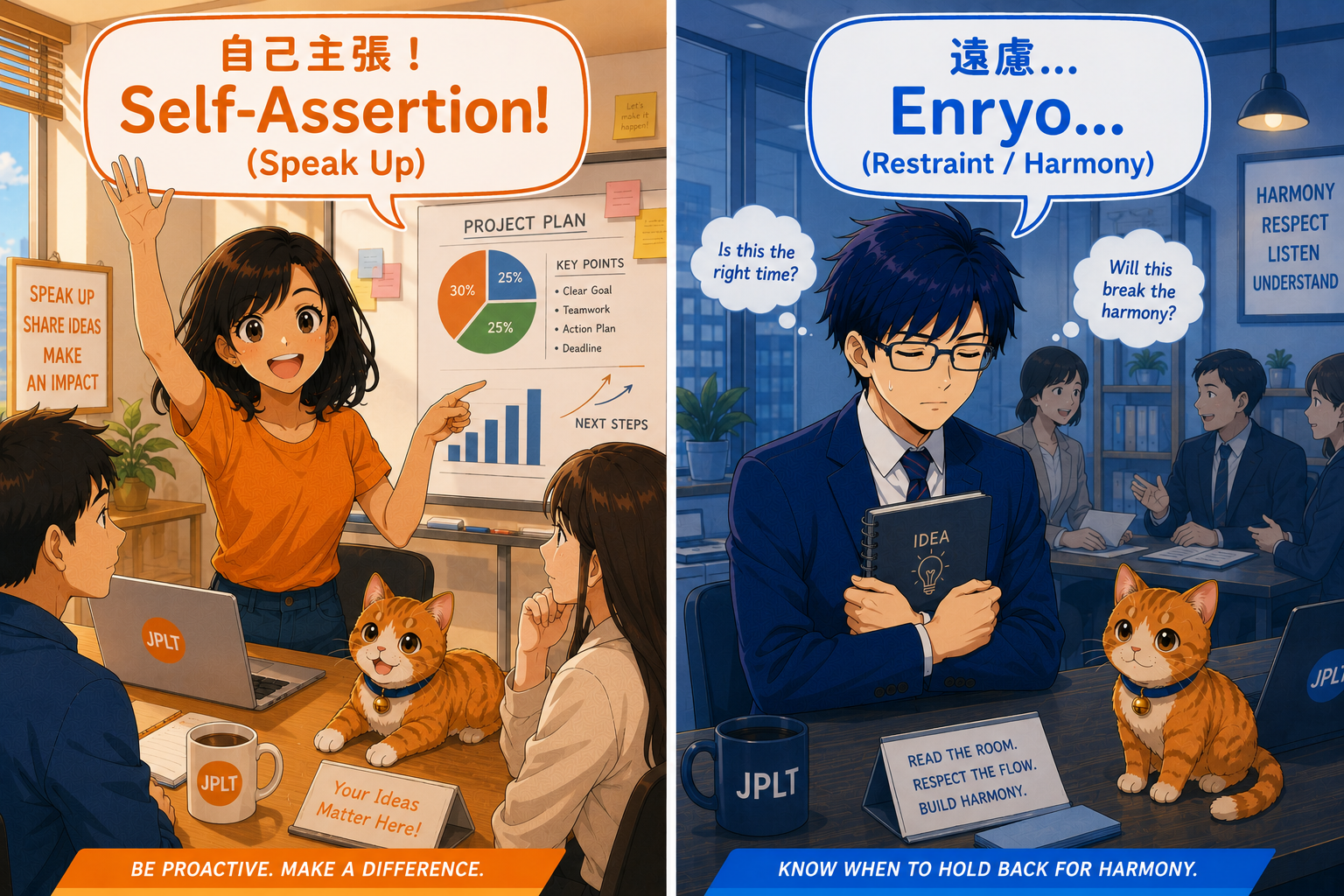
(Joy confidently raising her hand to speak [Self-Assertion] vs. Ken hesitating and holding back to read the room [Enryo])

“I think we should do this!” -> 自己主張 (Jiko-shuchou / Self-Assertion)
“I’ll hold back so I don’t disrupt the group.” -> 遠慮 (Enryo / Restraint)
In Western corporate culture, “the squeaky wheel gets the grease.” If you have a good idea, you are expected to speak up and assert yourself. In Japan, “the nail that sticks out gets hammered down.” The Japanese virtue of 遠慮 (Enryo) means holding back your ego to protect the team’s harmony. If you assert yourself too strongly, you will be labeled as selfish. Let’s see what happens when Joy proposes an operational classroom change to Director Tanaka.

🗣 Conversation Scene

Joy has noticed that the student numbers in the online upper-beginner classes are declining. She has an operational solution.
Joy
ディレクター!アッパービギナーの生徒数が減っているので、Room BをRoom Aに統合(merge)します!先生たちにも指示を出しておきますね!
(Director! The number of upper-beginner students is declining, so I will merge Room B into Room A! I will give the instructions to the teachers too!)
Tanaka
えっ!?ちょっと待ってください!相談もなしに、Joyさんが一人で決めたんですか!?
(Eh!? Please wait a minute! Did you decide this all by yourself without consulting anyone!?)

[ Tanaka is shocked by Joy’s aggressive self-assertion. Ken steps in to explain the cultural misstep. ]

Ken
Joyさん、アイデアは素晴らしいですが、「私がやります!」という強い自己主張は日本では傲慢(arrogant)に見えます。一歩引いて「〜するのはどうでしょうか?」と遠慮をもって提案しましょう。
(Joy, the idea is great, but strong “Self-Assertion” like “I will do it!” looks arrogant in Japan. Take a step back and propose it with “Enryo” [restraint] by asking, “What do you think about doing ~?”)

💡 Explanation

Individual Confidence vs. Group Restraint
⚠️ The Core Concept:
In English, Self-Assertion (自己主張 – Jiko-shuchou) proves competence and leadership. In Japanese, Restraint (遠慮 – Enryo) proves maturity and respect. A good Japanese employee guides the group to a conclusion rather than dictating it themselves.

1. 自己主張 (Jiko-shuchou) = Self-Assertion 🗣️

Declaring “I will merge the rooms!” is highly subject-centric. It focuses on the individual “I” taking control. In a Japanese company, no matter how brilliant your idea is, forcing it upon the group without prior consensus (Nemawashi) creates friction. It makes you look like a solo player who ignores the team’s harmony.

2. 遠慮 (Enryo) = The Art of Holding Back 🛑

Enryo literally means “to think from a distance.” It is the act of suppressing your ego so you do not burden or override others. This does *not* mean you cannot have good ideas! It means you must package your ideas softly.
Instead of a statement (“I will do X”), you use Enryo to turn your idea into a consultation (相談 – Soudan) or a gentle question.

  • [Self-Assertion ❌] Room BをRoom Aに統合します。
    (I am merging Room B into Room A. *Aggressive/Dictatorial*)
  • [Enryo ✅] Room Bを統合するのはいかがでしょうか?
    (How would you feel about merging Room B? *Polite/Consultative*)

3. Enryo in Daily Life (Refusing Offers) 🎁

Enryo is also the reason Japanese people often refuse gifts or offers the first time. If someone offers you the last piece of pizza, saying “Yes, I’ll take it!” (Self-assertion) is greedy. Saying “No thank you, please you have it” (Enryo) is expected. If they insist a second time, then you may accept it.

📊 Cultural Mindset Table

Concept Western Perspective Japanese Perspective
Self-Assertion
(自己主張)
Positive. Shows confidence, leadership, and taking initiative. Negative. Seen as selfish, arrogant, and disturbing the peace.
Enryo
(遠慮)
Negative. Seen as lacking confidence, weak, or indecisive. Positive. Shows maturity, empathy, and consideration for the group.

💎 The “Consultation” Hack

In Japan, the best way to get your idea approved is to pretend you haven’t made a final decision yet. Use phrases like 「ご相談なのですが…」 (Go-soudan na no desu ga… – I have a consultation…). It invites the boss to help you shape the idea, stroking their ego while getting exactly what you wanted.

🔥 Practice Quiz

Tap to check the answer!

Q1. You notice a flaw in the current student attendance tracking system and want to change it. How do you approach your Japanese boss?
A. “The current system is bad. I am changing the tracking system tomorrow.”
B. “I have a consultation. What do you think about updating the tracking system?”

Answer: B
Option A is pure Self-Assertion (aggressive). Option B uses Enryo, inviting the boss into the decision-making process.

Q2. A senior coworker buys a box of premium sweets and offers you one. What is the most culturally appropriate initial response?
A. “Wow, thank you! I’ll take the chocolate one!”
B. “Oh no, please, I couldn’t! (Enryo)”

Answer: B (Show Enryo first)
It is polite to show slight hesitation/Enryo before accepting a gift, showing that you don’t want to be a burden or greedy.


JPLT Online School

Learn Japanese with JPLT Online School

Want to study Japanese in a more guided and beginner-friendly way?
Feel free to contact us and we’ll help you find the right course for your level and goal.


We’re happy to help you start your Japanese learning journey with confidence.

Related posts:

[Must-Read Guide] Recommended Japanese Study Methods for Foreigners Challenges of Learning Japanese: 10 Solutions & Key Points Understanding Gakusei ja nai~n desu and Gakusei ja nai desu Tanoshimi vs Tanoshisa: Understanding their Differences
Share on:
GrammarBook: な-adjective + な のに (Even though [Na-adjective])
【使い分け】自己主張の文化と遠慮の文化の違い の違い [日本語学習]
JPLT Malaysia

Japanese Learning Resources:

Tips for Learning Japanese Learn Japanese with Mastery Tips Japanese Grammar Book Japanese Learning Hacks Japanese Learning FAQ (日本語) Japanese Learning FAQ (English)

Connect with us!

Inquire Now!
Send us a message to know the latest class schedules. Lessons are conducted in English and Taglish (Tagalog-English).
Please enable JavaScript in your browser to complete this form.
Name *
Loading

Latest Post

Thumb
【使い分け】自己主張の文化と遠慮の文化の違い の違い [日本語学習]
12 Aug, 2026
Thumb
The Difference Between 自己主張の文化と遠慮の文化の違い の違い |Japanese Grammar
12 Aug, 2026
Thumb
GrammarBook: な-adjective + な のに (Even though
12 Aug, 2026

Categories

  • Courses (13)
  • Grammar Book (125)
  • JAPANESE LEARNING FAQ (23)
  • Japanese Learning Hacks (9)
  • Japanese Learning TIPS (199)
  • JPLT Blog (250)
  • JPLT NEWS (12)
  • List of media productions (5)
  • にほんごをまなぶTips (195)
  • 日本語学習ハック (9)
JPLT_logo (2)

JPLT (Japanese language training) online school by Dialogplus 

Icon-facebook Icon-instagram Youtube

株式会社ダイアログプラス(Dialog+ Co., Ltd.) 
神奈川県横浜市都筑区南山田二丁目1番1-206号 
Address: 2-1-1-206 Minamiyamada, Tsuzuki-ku, Yokohama Japan 
Website: https://www.dialogplus.co.jp/ 

Dialog+ Philippines
Philippine Address: Unit 7 2/F, Seung Lee Building, Lot 1 Greenwoods Park Rizal Highway, CBD Area, Subic Bay Freeport Zone, Philippines
Website: https://dialogplus.ph/
Email: info@jplt-dialogplus.com

  • Specified Commercial Transaction Law
  • Privacy Policy
  • Terms & Condition
  • Refund Policy
  • JPLT Calendar
  • Admin
JPLT Online Japanese Language Training SchoolJPLT Online Japanese Language Training School