Skip to content
JPLT Online Japanese Language Training SchoolJPLT Online Japanese Language Training School
  • Courses
  • Plans
  • Get Started
    • What is JPLT Metaverse Campus
    • How to Enroll
  • JPLT LEARNING GYM
    • What is JPLT LEARNING GYM?
    • BootCamp
    • Studio
    • Season
    • Grammar Book
    • Optional Classes and AOTD
  • Schedule
  • Blog
  • About Us
    • What Is Dialog+ JPLT
    • Teachers
    • Company Profile
    • Contact Us
    • FAQs
  • Login
  • For Business
JPLT Online Japanese Language Training SchoolJPLT Online Japanese Language Training School
  • Courses
  • Plans
  • Get Started
    • What is JPLT Metaverse Campus
    • How to Enroll
  • JPLT LEARNING GYM
    • What is JPLT LEARNING GYM?
    • BootCamp
    • Studio
    • Season
    • Grammar Book
    • Optional Classes and AOTD
  • Schedule
  • Blog
  • About Us
    • What Is Dialog+ JPLT
    • Teachers
    • Company Profile
    • Contact Us
    • FAQs
  • Login
  • For Business
JPLT Blog

The Difference Between 「たぶん」と “Maybe” の確信度の違い の違い |Japanese Grammar (N5–N3)

  • 08 Aug, 2026
  • Com 0
「たぶん」と “Maybe” の確信度の違い
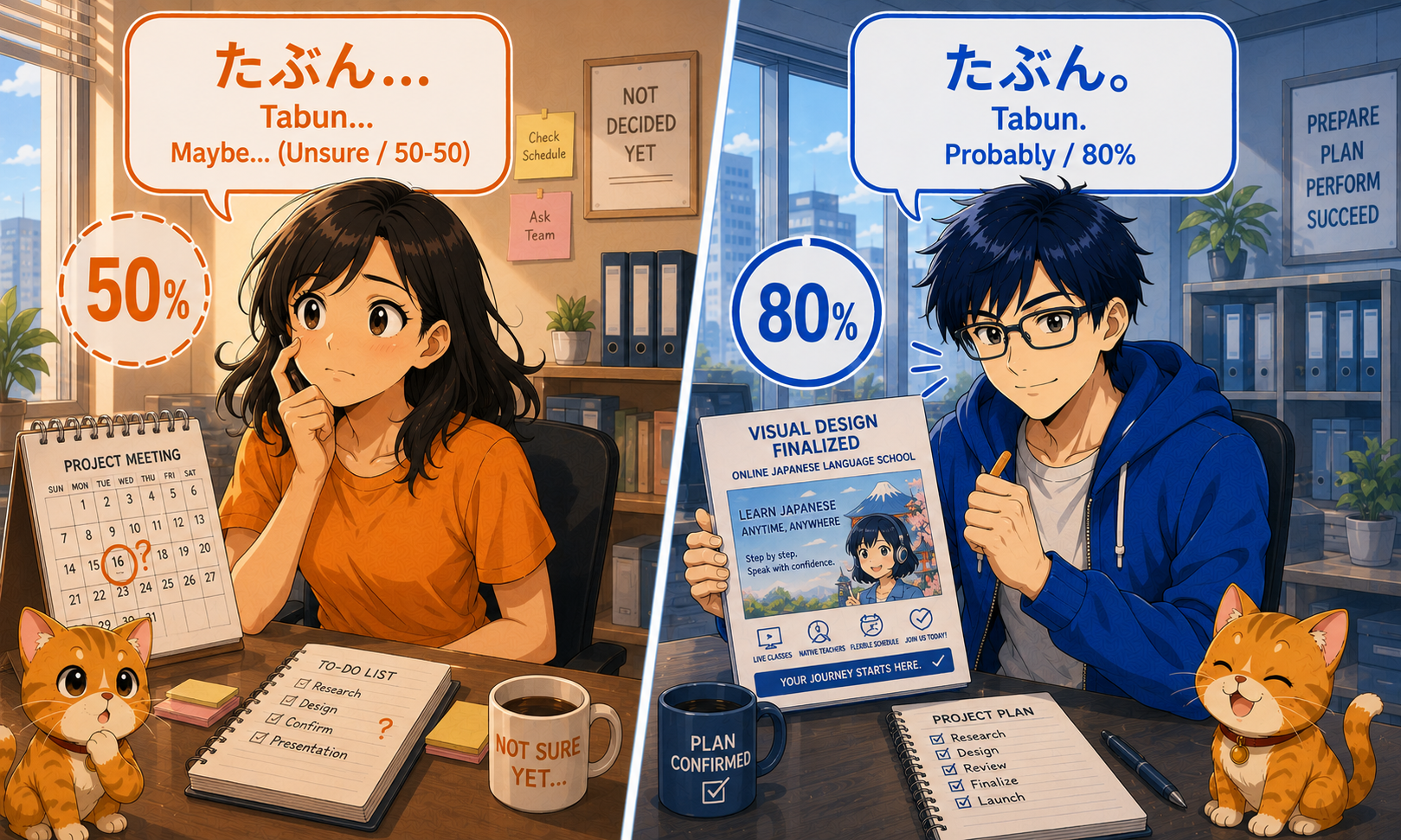
(Joy looking unsure with a 50% sign [Maybe] vs. Ken looking confident with an 80% sign [Tabun])

“There’s a 50/50 chance.” -> かもしれません (Kamoshiremasen) / Maybe
“I am 80% to 90% sure.” -> たぶん (Tabun) / Probably
If you look up “Maybe” in an English-Japanese dictionary, the first word you see is たぶん (Tabun). However, this translation causes massive communication breakdowns in the workplace! In English, “Maybe” means there is a 50% chance. But to a Japanese person, “Tabun” means there is an 80% or 90% chance. Let’s see what happens when Joy tries to use “Tabun” to talk about her visual design deadline.

🗣 Conversation Scene

Director Tanaka asks Joy if the new visual designs for Friday’s social media campaign will be finished in time.

Tanaka
Joyさん、金曜日のキャンペーンのビジュアルデザイン、明日の夕方までに間に合いますか?
(Joy, will the visual designs for Friday’s campaign be ready by tomorrow evening?)
Joy
うーん、たぶん間に合います!
(Hmm, “Tabun” [Joy thinks: 50% chance] it will be in time!)
Tanaka
そうですか、よかった!では、クライアントに「明日デザインをお見せできる」と確約のメールを出しておきますね。
(Is that so, great! Then I will send a confirmation email to the client that we can show them the designs tomorrow.)

[ Joy panics because she isn’t sure she can finish it. Ken pulls her aside. ]

Ken
Joyさん!日本語の「たぶん」は80%〜90%の確率(Probably)という意味ですよ!50%のつもりなら、「間に合わないかもしれません」と言わないと、後でトラブルになります!
(Joy! In Japanese, “Tabun” means an 80-90% probability [Probably]! If you meant 50%, you have to say “It might not be in time”, or it will cause trouble later!)

💡 Explanation

Probability and Politeness

⚠️ The Core Concept:
Japanese people use たぶん (Tabun) to soften their statements and sound polite, even when they are almost 100% sure. To express a true 50/50 “Maybe”, you must use 〜かもしれません (~kamoshiremasen).

1. たぶん (Tabun) = Probably / Most likely (80% – 90%) 📈

The kanji for Tabun is 多分. “多” means many/much, and “分” means part. Literally, it means “in large part.” When a Japanese person says “Tabun,” they usually already know the answer. They use it because stating an absolute fact (100%) sounds too aggressive, arrogant, or direct in Japanese culture.

  • あのレストラン、たぶん美味しいですよ。
    (That restaurant is probably delicious. *They are highly confident based on reviews*)
  • たぶん、彼が担当者です。
    (Most likely, he is the person in charge. *They are 95% sure*)

2. もしかしたら〜かもしれません (Moshikashitara ~kamoshiremasen) = Maybe / Perhaps (50%) ⚖️

If you truly do not know if you can meet a deadline, or if you are completely guessing, you must use 〜かもしれません (kamoshiremasen). It literally translates to “it cannot be known.” To make it even clearer, you can add もしかしたら (Moshikashitara – by any chance) to the beginning of the sentence.

  • もしかしたら、明日は雨かもしれません。
    (Maybe it will rain tomorrow. *50/50 chance*)
  • デザインの修正に、もっと時間がかかるかもしれません。
    (It might take more time to revise the designs. *Warning the boss of a 50% risk*)

📊 The Certainty Scale

Certainty Japanese Phrase English Equivalent
100% 絶対に〜です
(Zettai ni ~desu)
Absolutely / Definitely
80% – 90% たぶん〜です
(Tabun ~desu)
Probably / Most likely
30% – 50% 〜かもしれません
(~kamoshiremasen)
Maybe / Might / Perhaps

🔥 Practice Quiz

Tap to check the answer!

Q1. The boss asks if you can finish a task by 3:00 PM. You are only 50% sure you can do it. What do you say?
A. Tabun owarimasu.
B. Owarinai kamoshiremasen (It might not be finished).
Answer: B (Owarinai kamoshiremasen)
In business, if you say “Tabun,” the boss will assume it’s guaranteed. It is safer to use “kamoshiremasen” to manage expectations.
Q2. A coworker points to a jacket on a chair and asks “Is this Tanaka-san’s?” You saw Tanaka wearing it yesterday, so you are 95% sure. What do you say?
A. Tabun, Tanaka-san no desu.
B. Moshikashitara, Tanaka-san no kamoshiremasen.
Answer: A (Tabun, Tanaka-san no desu)
Since you are highly confident, “Tabun” is the perfect word to state the fact politely without sounding overly aggressive.


Related posts:

[Must-Read Guide] Recommended Japanese Study Methods for Foreigners Challenges of Learning Japanese: 10 Solutions & Key Points Understanding Gakusei ja nai~n desu and Gakusei ja nai desu Tanoshimi vs Tanoshisa: Understanding their Differences
Share on:
The Difference Between 「やっぱり」と “As expected” の使い方の違い の違い |Japanese Grammar (N5–N3)
【使い分け】「たぶん」と “Maybe” の確信度の違い の違い [日本語学習]
JPLT Malaysia

Japanese Learning Resources:

Tips for Learning Japanese Learn Japanese with Mastery Tips Japanese Grammar Book Japanese Learning Hacks Japanese Learning FAQ (日本語) Japanese Learning FAQ (English)

Connect with us!

Inquire Now!
Send us a message to know the latest class schedules. Lessons are conducted in English and Taglish (Tagalog-English).
Please enable JavaScript in your browser to complete this form.
Name *
Loading

Latest Post

Thumb
The Difference Between「すみません」と “Excuse me” の正しい使い分け の違い
08 Aug, 2026
Thumb
【使い分け】「すみません」と “Excuse me” の正しい使い分け の違い [日本語学習]
08 Aug, 2026
Thumb
【使い分け】「たぶん」と “Maybe” の確信度の違い の違い [日本語学習]
08 Aug, 2026

Categories

  • Courses (13)
  • Grammar Book (114)
  • JAPANESE LEARNING FAQ (23)
  • Japanese Learning Hacks (9)
  • Japanese Learning TIPS (194)
  • JPLT Blog (240)
  • JPLT NEWS (12)
  • List of media productions (5)
  • にほんごをまなぶTips (190)
  • 日本語学習ハック (9)
JPLT_logo (2)

JPLT (Japanese language training) online school by Dialogplus 

Icon-facebook Icon-instagram Youtube

株式会社ダイアログプラス(Dialog+ Co., Ltd.) 
神奈川県横浜市都筑区南山田二丁目1番1-206号 
Address: 2-1-1-206 Minamiyamada, Tsuzuki-ku, Yokohama Japan 
Website: https://www.dialogplus.co.jp/ 

Dialog+ Philippines
Philippine Address: Unit 7 2/F, Seung Lee Building, Lot 1 Greenwoods Park Rizal Highway, CBD Area, Subic Bay Freeport Zone, Philippines
Website: https://dialogplus.ph/
Email: info@jplt-dialogplus.com

  • Specified Commercial Transaction Law
  • Privacy Policy
  • Terms & Condition
  • Refund Policy
  • JPLT Calendar
  • Admin
JPLT Online Japanese Language Training SchoolJPLT Online Japanese Language Training School