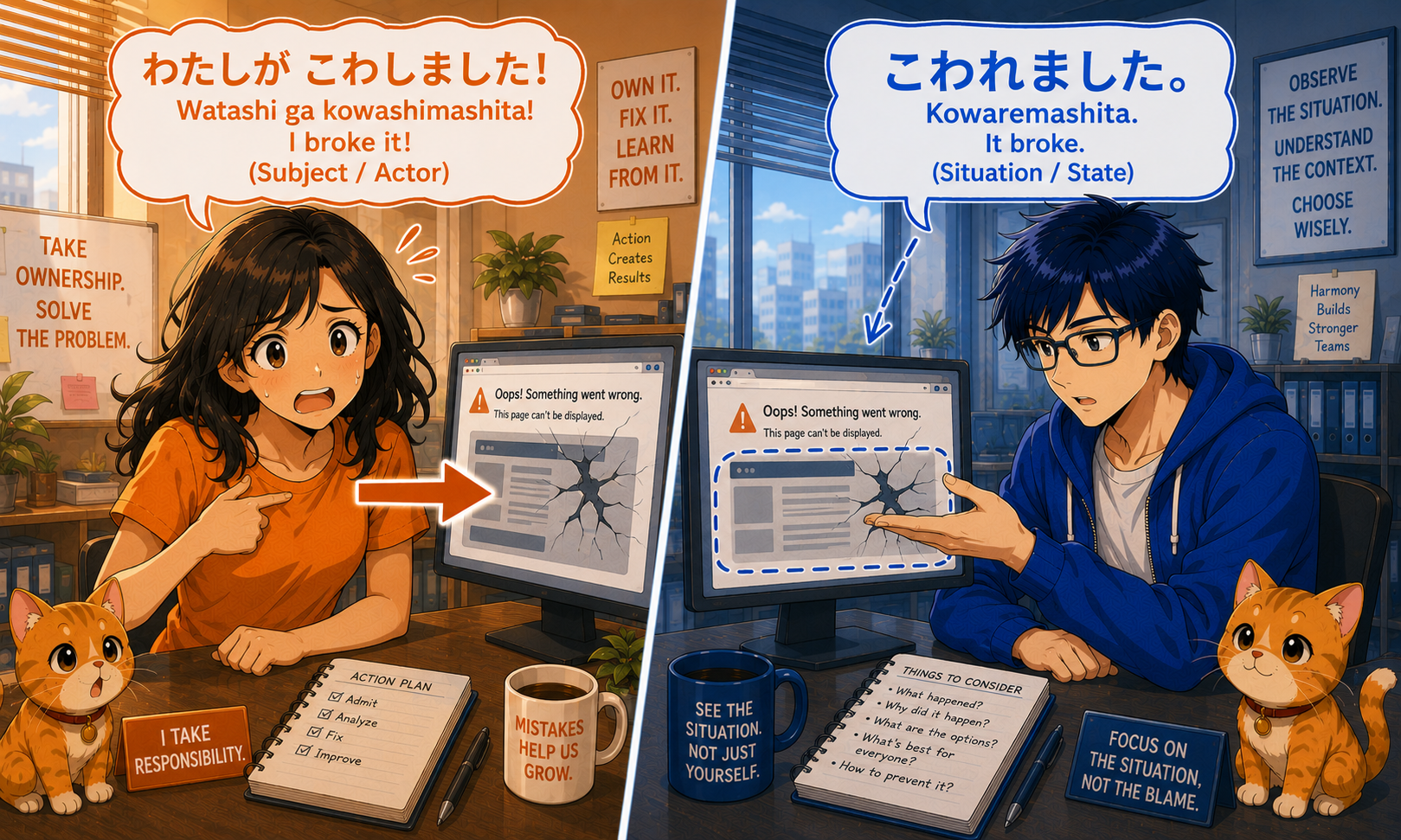
(Alt Text: Joy pointing to herself saying ‘I broke it’ [Subject-Centric] vs. Ken pointing to the screen saying ‘It broke’ [Situation-Centric])
“I dropped my phone.” -> 私が落としました (Subject-centric / English style)
“My phone fell.” -> 落ちてしまいました (Situation-centric / Japanese style)
English is a language obsessed with “Who did it?” Every sentence needs a subject (I, You, He, She). Japanese, however, is a language obsessed with “What happened?” The focus is on the environment, the situation, and the state of things. If you translate English directly into Japanese, you often sound too aggressive, defensive, or strangely dramatic! Let’s see what happens when Joy encounters a technical glitch while managing the school’s web pages.
🗣 Conversation Scene
Joy is updating the student booking page using Elementor. She makes a mistake with the code integration, and the layout gets messed up. She immediately reports it to Director Tanaka.
(Director, I’m sorry! *I* broke the Elementor layout!)
(Eh!? You broke it!? Did you do it on purpose!?)
[ Tanaka is shocked because Joy’s wording makes it sound like she intentionally smashed the website. Ken steps in. ]
(Joy, saying “I broke it” in Japanese sounds like a crime confession! In business, we report the situation by saying “The layout collapsed [by itself]”!)
💡 Explanation
The Actor vs. The Environment
English is Subject-centric (Who did what). Japanese is Situation-centric (What state is the environment in). By removing “I” and using Intransitive Verbs (Jidoushi), Japanese people describe accidents objectively without sounding intentionally destructive.
1. The English Way (Subject-Centric) 🎯
In English, saying “I dropped my coffee” or “I lost the file” is normal. It shows accountability. But if you literally translate this to Japanese (*Watashi ga kowashimashita* – I broke it), it strongly implies intent. It sounds like you took a hammer and actively decided to smash the server!
2. The Japanese Way (Situation-Centric) 🌫️
To sound natural in Japanese, you must describe the *scene*, not the *actor*. You do this using Intransitive Verbs (自動詞 – Jidoushi). These are verbs that happen “by themselves.”
Instead of saying “I lost the pen” (Transitive), you say “The pen went missing” (Intransitive). You still start the sentence with “Sumimasen” to apologize, but the description of the problem remains objective.
- [Reporting a lost file] すみません、データが消えてしまいました。
(Sorry, the data disappeared. *Natural & Objective*) - [Reporting a broken tool] パソコンが壊れてしまいました。
(The computer broke. *Removes the ‘I did it’ blame*)
3. The Magic Ending: 〜てしまいました (~te shimaimashita) 🪄
To show that the situation was an accident and you feel regret, always add 〜てしまいました (~te shimaimashita) to the end of the verb. This translates to “unfortunately happened” or “happened by accident.”
“Layout ga kuzurete shimaimashita” literally means: “The layout unfortunately collapsed on its own (and I feel bad about it).”
📊 Subject vs. Situation Table
🔥 Practice Quiz
Tap to check the answer!