Skip to content
JPLT Online Japanese Language Training SchoolJPLT Online Japanese Language Training School
  • Courses
  • Plans
  • Get Started
    • What is JPLT Metaverse Campus
    • How to Enroll
  • JPLT LEARNING GYM
    • What is JPLT LEARNING GYM?
    • BootCamp
    • Studio
    • Season
    • Grammar Book
    • Optional Classes and AOTD
  • Schedule
  • Blog
  • About Us
    • What Is Dialog+ JPLT
    • Teachers
    • Company Profile
    • Contact Us
    • FAQs
  • Login
  • For Business
JPLT Online Japanese Language Training SchoolJPLT Online Japanese Language Training School
  • Courses
  • Plans
  • Get Started
    • What is JPLT Metaverse Campus
    • How to Enroll
  • JPLT LEARNING GYM
    • What is JPLT LEARNING GYM?
    • BootCamp
    • Studio
    • Season
    • Grammar Book
    • Optional Classes and AOTD
  • Schedule
  • Blog
  • About Us
    • What Is Dialog+ JPLT
    • Teachers
    • Company Profile
    • Contact Us
    • FAQs
  • Login
  • For Business
JPLT Blog

The Difference Between 「先に失礼します」と “I’m leaving first” の違い の違い |Japanese Grammar (N5–N3)

  • 02 Aug, 2026
  • Com 0
「先に失礼します」と “I’m leaving first” の違い
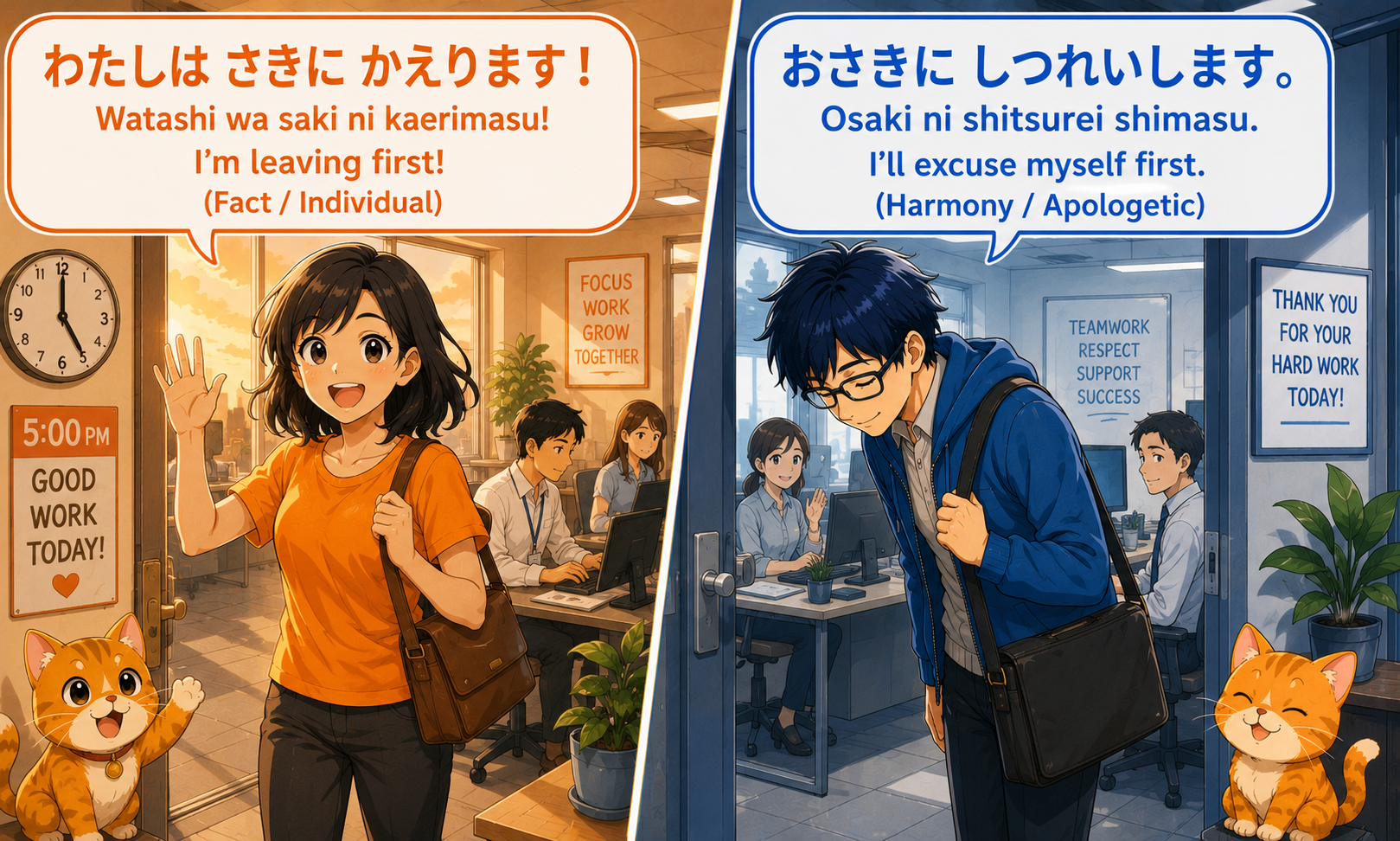
(Joy waving goodbye cheerfully [Stating a Fact] vs. Ken bowing apologetically saying Osaki ni shitsurei shimasu [Team Harmony])

“My shift is over, I’m going home.” -> お先に帰ります (I am leaving first) (Individualistic / Fact)
“Excuse me for leaving while you are still working.” -> お先に失礼します (Osaki ni shitsurei shimasu) (Team Harmony / Polite)
In many Western cultures, leaving the office when your shift ends is normal. You might say “Bye everyone, see you tomorrow!” But in Japan, the workplace is viewed as a single team. Leaving while your team members are still sweating over their keyboards requires a specific cultural acknowledgment. Let’s see what happens when Joy tries to leave the office at 5:00 PM on the dot.

🗣 Conversation Scene

It is exactly 5:00 PM. Joy’s shift is over, but Director Tanaka and Ken are still busy typing at their desks.

Joy
5時ですね!ディレクター、私はお先に帰ります! また明日!
(It’s 5 o’clock! Director, I am going home first! See you tomorrow!)
Tanaka
……え?ああ、はい。
(…Eh? Oh, yes.)

[ Tanaka looks a bit surprised by her bluntness. Ken quickly follows Joy to the hallway to give her some advice. ]

Ken
Joyさん、日本の職場で「帰ります」とだけ言うのは、少し自分勝手に聞こえます。残って働いている人への配慮として「お先に失礼します」と言いましょう。
(Joy, just saying “I’m going home” in a Japanese workplace sounds a bit selfish. As a consideration for those still working, let’s say “Osaki ni shitsurei shimasu”.)

💡 Explanation

Individual Facts vs. Team Consideration

⚠️ The Core Difference:
“I’m leaving first” simply states a fact about yourself. お先に失礼します (Osaki ni shitsurei shimasu) acknowledges the group by apologizing for the “rudeness” of resting while they are still working.

1. お先に帰ります (I am going home first) 🎒

Focus: My schedule, my reality.
While grammatically correct, telling your boss or coworkers “Saki ni kaerimasu” (I will go home first) can sound very blunt. It highlights that you are prioritizing your own schedule over the team’s workload. In Japanese business culture, where harmony (Wa – 和) is prioritized, stating a departure without showing empathy for the remaining workers is considered poor etiquette.

2. お先に失礼します (I commit the rudeness of leaving before you) 🏢

Focus: Empathy and Team Harmony.
Let’s break down this magic phrase:
* お先に (Osaki ni): Before you / Ahead of you.
* 失礼します (Shitsurei shimasu): I commit a rudeness / Excuse me.
You are not literally saying you are a bad person. You are demonstrating empathy. You are saying, “I recognize that you are still working hard, and I feel a little bad that I get to rest before you do. Excuse me for stepping out of the team formation.” This simple phrase completely removes any resentment from the coworkers left behind.

  • [To the whole office at 5 PM] お先に失礼します!
    (Excuse me for leaving before you. *Standard daily departure*)
  • [When leaving a meeting early] すみません、お先に失礼いたします。
    (I am sorry, but please excuse me for leaving early. *Humble form*)

📊 Comparison Table

Phrase Literal Meaning Impression in Japan
お先に帰ります
(Osaki ni kaerimasu)
“I am returning home before you.” Blunt, individualistic, can seem insensitive to the team.
お先に失礼します
(Osaki ni shitsurei shimasu)
“I commit the rudeness of leaving before you.” Polite, empathetic, prioritizing team harmony.

💎 How to Reply: The Golden Combo

When someone says “Osaki ni shitsurei shimasu” to you, you must never say “Sayonara” (Goodbye). The only correct response to someone leaving the office is acknowledging their hard work for the day: お疲れ様でした (Otsukaresama deshita – Thank you for your hard work).

🔥 Practice Quiz

Tap to check the answer!

Q1. You have a doctor’s appointment and need to leave the office 30 minutes early. Your coworkers are still working. What do you say?
A. Osaki ni shitsurei shimasu.
B. Osaki ni kaerimasu.
Answer: A (Osaki ni shitsurei shimasu)
Always apologize for the “rudeness” of leaving while others are working to maintain a good relationship with your team.
Q2. A coworker packs their bag, looks at you, and says “Osaki ni shitsurei shimasu.” How do you reply?
A. Sayonara!
B. Otsukaresama deshita!
Answer: B (Otsukaresama deshita!)
“Otsukaresama deshita” is the mandatory paired response to someone leaving the office.


Related posts:

[Must-Read Guide] Recommended Japanese Study Methods for Foreigners Challenges of Learning Japanese: 10 Solutions & Key Points Understanding Gakusei ja nai~n desu and Gakusei ja nai desu Tanoshimi vs Tanoshisa: Understanding their Differences
Share on:
【使い分け】「もったいない」と “Wasteful” の違い の違い [日本語学習]
【使い分け】「先に失礼します」と “I’m leaving first” の違い の違い [日本語学習]
JPLT Malaysia

Japanese Learning Resources:

Tips for Learning Japanese Learn Japanese with Mastery Tips Japanese Grammar Book Japanese Learning Hacks Japanese Learning FAQ (日本語) Japanese Learning FAQ (English)

Connect with us!

Inquire Now!
Send us a message to know the latest class schedules. Lessons are conducted in English and Taglish (Tagalog-English).
Please enable JavaScript in your browser to complete this form.
Name *
Loading

Latest Post

Thumb
The Difference Between 「よろしくお願いします」と “Nice to meet
02 Aug, 2026
Thumb
【使い分け】「よろしくお願いします」と “Nice to meet you” のズレの違い [日本語学習]
02 Aug, 2026
Thumb
【使い分け】「先に失礼します」と “I’m leaving first” の違い の違い [日本語学習]
02 Aug, 2026

Categories

  • Courses (13)
  • Grammar Book (108)
  • JAPANESE LEARNING FAQ (23)
  • Japanese Learning Hacks (9)
  • Japanese Learning TIPS (190)
  • JPLT Blog (232)
  • JPLT NEWS (12)
  • List of media productions (5)
  • にほんごをまなぶTips (186)
  • 日本語学習ハック (9)
JPLT_logo (2)

JPLT (Japanese language training) online school by Dialogplus 

Icon-facebook Icon-instagram Youtube

株式会社ダイアログプラス(Dialog+ Co., Ltd.) 
神奈川県横浜市都筑区南山田二丁目1番1-206号 
Address: 2-1-1-206 Minamiyamada, Tsuzuki-ku, Yokohama Japan 
Website: https://www.dialogplus.co.jp/ 

Dialog+ Philippines
Philippine Address: Unit 7 2/F, Seung Lee Building, Lot 1 Greenwoods Park Rizal Highway, CBD Area, Subic Bay Freeport Zone, Philippines
Website: https://dialogplus.ph/
Email: info@jplt-dialogplus.com

  • Specified Commercial Transaction Law
  • Privacy Policy
  • Terms & Condition
  • Refund Policy
  • JPLT Calendar
  • Admin
JPLT Online Japanese Language Training SchoolJPLT Online Japanese Language Training School