Skip to content
JPLT Online Japanese Language Training SchoolJPLT Online Japanese Language Training School
  • Courses
  • Plans
  • Get Started
    • What is JPLT Metaverse Campus
    • How to Enroll
  • JPLT LEARNING GYM
    • What is JPLT LEARNING GYM?
    • BootCamp
    • Studio
    • Season
    • Grammar Book
    • Optional Classes and AOTD
  • Schedule
  • Blog
  • About Us
    • What Is Dialog+ JPLT
    • Teachers
    • Company Profile
    • Contact Us
    • FAQs
  • Login
  • For Business
JPLT Online Japanese Language Training SchoolJPLT Online Japanese Language Training School
  • Courses
  • Plans
  • Get Started
    • What is JPLT Metaverse Campus
    • How to Enroll
  • JPLT LEARNING GYM
    • What is JPLT LEARNING GYM?
    • BootCamp
    • Studio
    • Season
    • Grammar Book
    • Optional Classes and AOTD
  • Schedule
  • Blog
  • About Us
    • What Is Dialog+ JPLT
    • Teachers
    • Company Profile
    • Contact Us
    • FAQs
  • Login
  • For Business
JPLT Blog

The Difference Between「すみません」と “Excuse me” の正しい使い分け の違い |Japanese Grammar (N5–N3)

  • 08 Aug, 2026
  • Com 0
「すみません」と “Excuse me” の正しい使い分け
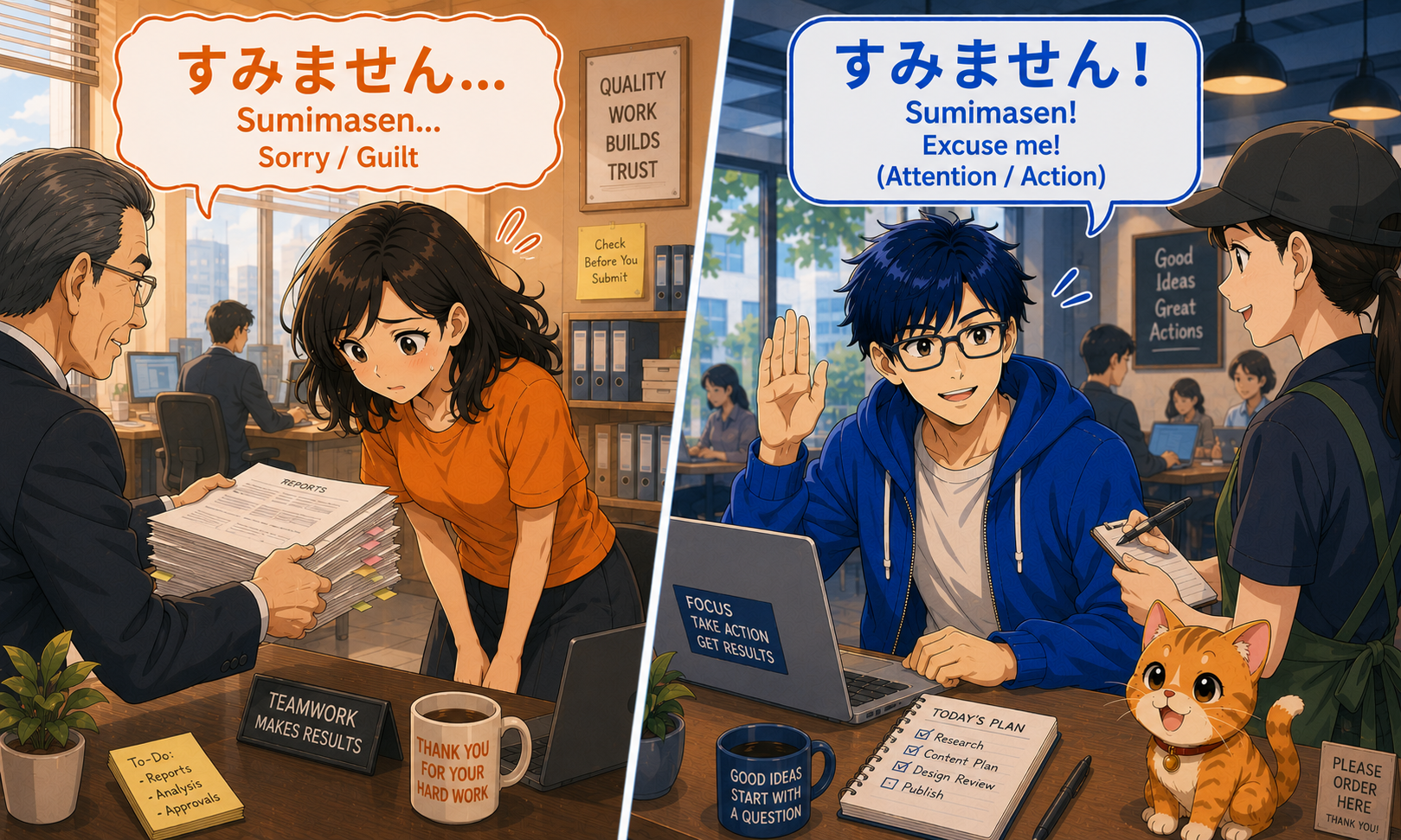
(Joy looking guilty saying Sumimasen [Apology focus] vs. Ken raising his hand politely saying Excuse me [Attention focus])

“Excuse me, waiter!” -> すみません (Sumimasen)
“I’m sorry I bumped into you.” -> すみません (Sumimasen)
“Thank you for picking up my pen.” -> すみません (Sumimasen)
すみません (Sumimasen) is the ultimate Swiss Army knife of the Japanese language. While textbooks translate it as “Excuse me,” it is also used for apologies and, surprisingly, for gratitude! However, if you rely on it too much, you will sound like you are constantly apologizing for your existence. Let’s see what happens when Director Tanaka helps Joy with a task.

🗣 Conversation Scene

Joy dropped a large stack of design documents on the floor. Director Tanaka stops to help her pick them up.

Tanaka
大丈夫ですか?手伝いますよ。はい、どうぞ。
(Are you okay? I’ll help you. Here you go.)
Joy
ああっ!ディレクター、すみません! 本当にすみません!
(Ahhh! Director, “Sumimasen!” [I’m so sorry!] Really, “Sumimasen!”)

[ Tanaka smiles and walks away. Ken gives Joy a helpful tip. ]

Ken
Joyさん、日本人は親切にされた時にも「すみません」を使いますが、「ありがとうございます」と言った方が、お互いにハッピーな気持ちになれますよ!
(Joy, Japanese people also use “Sumimasen” when someone is kind to them, but saying “Arigatou gozaimasu” [Thank you] makes both people feel much happier!)

💡 Explanation

The Three Faces of Sumimasen

⚠️ The Core Concept:
すみません (Sumimasen) is used whenever your actions interrupt another person’s space or time. This is why it works for getting attention, apologizing, and showing gratitude!

1. “Excuse me” (Calling Out) 🙋

When you need to get a waiter’s attention, or when you are trying to push through a crowded train, you are taking up someone’s time or space. “Sumimasen” is the perfect, polite tool for this.

  • [At a restaurant] すみません、注文をお願いします!
    (Excuse me, I’d like to order!)
  • [On a crowded train] すみません、降ります!
    (Excuse me, I’m getting off!)

2. “I’m sorry” (Light Apology) 🙏

If you accidentally bump into someone, or if you are a few minutes late, “Sumimasen” acts as a light apology. However, do not use it for massive business failures! If you make a huge mistake that costs the company money, “Sumimasen” sounds too casual. You must use 申し訳ございません (Moushiwake gozaimasen).

  • [Bumping shoulders in the hall] あ、すみません!
    (Ah, sorry!)

3. The “Sorry-Thank You” (Gratitude) 🎁

In Japanese culture, noticing the effort someone put into helping you is highly polite. When you drop your pen and someone picks it up, native speakers often say “Sumimasen” to mean: “I am sorry you had to use your energy to help me, and I appreciate it.”

The Trap: Because beginners hear Japanese people saying “Sumimasen” constantly, they forget to say “Arigatou” (Thank you). If you always say “Sumimasen,” your communication becomes very negative and guilty. Try to upgrade your “Sorry-Thank You” to a positive ありがとうございます (Arigatou gozaimasu) to brighten the office mood!

📊 Comparison Table

Situation Meaning Better Alternative?
Calling a waiter “Excuse me!” None. “Sumimasen” is perfect here.
Making a HUGE mistake “I am sorry.” 申し訳ございません
(Moushiwake gozaimasen)
Someone holds the elevator door for you “Sorry for the trouble (Thank you).” ありがとうございます
(Arigatou gozaimasu)

🔥 Practice Quiz

Tap to check the answer!

Q1. You are walking toward the office door. A coworker sees you and holds the door open so you can walk through. What is the most positive thing to say?
A. Sumimasen.
B. Arigatou gozaimasu.
Answer: B (Arigatou gozaimasu)
While native speakers might mumble “Sumimasen” out of habit, saying “Arigatou gozaimasu” is a brighter, more positive way to show appreciation!
Q2. You accidentally step on your boss’s shoe in the elevator. What do you say?
A. Sumimasen!
B. Arigatou gozaimasu!
Answer: A (Sumimasen!)
Please do not thank your boss for letting you step on their shoe! This is a situation that requires a light apology.


Related posts:

[Must-Read Guide] Recommended Japanese Study Methods for Foreigners Challenges of Learning Japanese: 10 Solutions & Key Points Understanding Gakusei ja nai~n desu and Gakusei ja nai desu Tanoshimi vs Tanoshisa: Understanding their Differences
Share on:
【使い分け】「すみません」と “Excuse me” の正しい使い分け の違い [日本語学習]
JPLT Malaysia

Japanese Learning Resources:

Tips for Learning Japanese Learn Japanese with Mastery Tips Japanese Grammar Book Japanese Learning Hacks Japanese Learning FAQ (日本語) Japanese Learning FAQ (English)

Connect with us!

Inquire Now!
Send us a message to know the latest class schedules. Lessons are conducted in English and Taglish (Tagalog-English).
Please enable JavaScript in your browser to complete this form.
Name *
Loading

Latest Post

Thumb
The Difference Between「すみません」と “Excuse me” の正しい使い分け の違い
08 Aug, 2026
Thumb
【使い分け】「すみません」と “Excuse me” の正しい使い分け の違い [日本語学習]
08 Aug, 2026
Thumb
【使い分け】「たぶん」と “Maybe” の確信度の違い の違い [日本語学習]
08 Aug, 2026

Categories

  • Courses (13)
  • Grammar Book (114)
  • JAPANESE LEARNING FAQ (23)
  • Japanese Learning Hacks (9)
  • Japanese Learning TIPS (194)
  • JPLT Blog (240)
  • JPLT NEWS (12)
  • List of media productions (5)
  • にほんごをまなぶTips (190)
  • 日本語学習ハック (9)
JPLT_logo (2)

JPLT (Japanese language training) online school by Dialogplus 

Icon-facebook Icon-instagram Youtube

株式会社ダイアログプラス(Dialog+ Co., Ltd.) 
神奈川県横浜市都筑区南山田二丁目1番1-206号 
Address: 2-1-1-206 Minamiyamada, Tsuzuki-ku, Yokohama Japan 
Website: https://www.dialogplus.co.jp/ 

Dialog+ Philippines
Philippine Address: Unit 7 2/F, Seung Lee Building, Lot 1 Greenwoods Park Rizal Highway, CBD Area, Subic Bay Freeport Zone, Philippines
Website: https://dialogplus.ph/
Email: info@jplt-dialogplus.com

  • Specified Commercial Transaction Law
  • Privacy Policy
  • Terms & Condition
  • Refund Policy
  • JPLT Calendar
  • Admin
JPLT Online Japanese Language Training SchoolJPLT Online Japanese Language Training School