

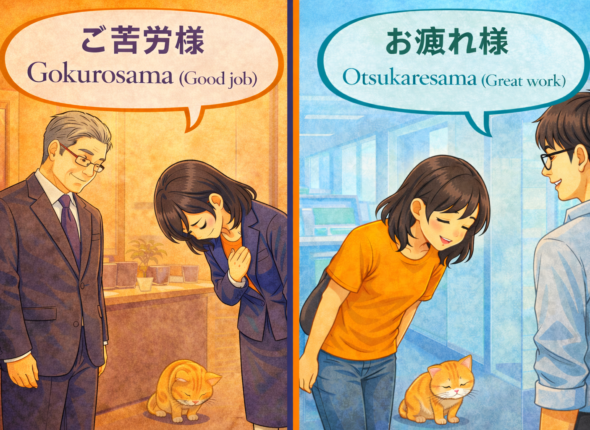
The Difference Between「ご苦労さま」と「お疲れさま」の違い|Japanese Grammar (N5–N3)
(Boss saying Gokurosama [Authority] vs. Joy saying Otsukaresama [Polite]) “Good work today!” In Japanese, how you say “Good job” depends on your rank. ご苦労さま (Gokurosama) is for subordinates. お疲れさま (Otsukaresama) is for...
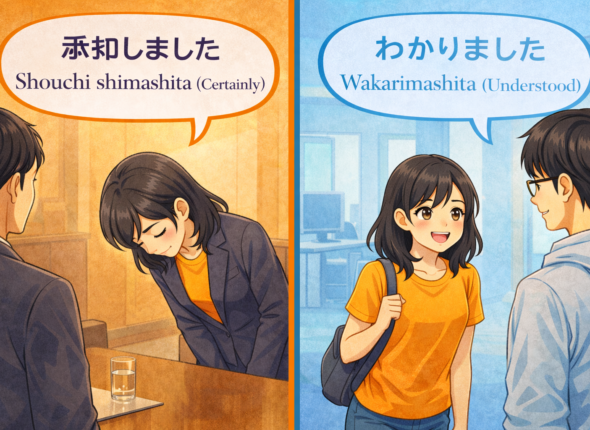
The Difference Between「承知しました」と「分かりました」の違い|Japanese Grammar (N5–N3)
(Joy bowing to boss [Shouchi shimashita] vs. Joy nodding to coworker [Wakarimashita]) “I understand.” In daily life, 分かりました (Wakarimashita) is perfect. But in business, saying this to a client might make you...
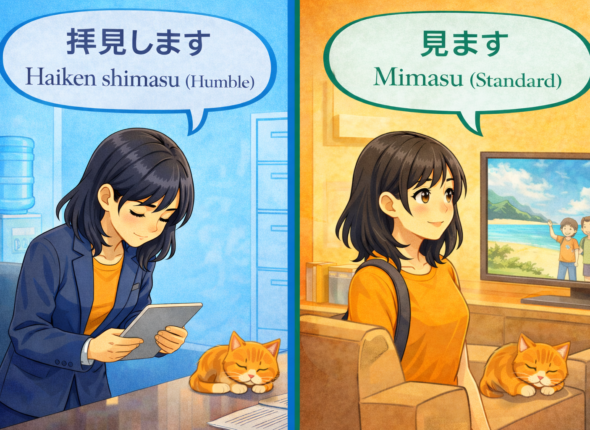
The Difference Between「拝見します」と「見ます」の違い|Japanese Grammar (N5–N3)
(Joy checking a document politely [Haiken] vs. Joy watching TV [Mimasu]) “I saw your email.” In Japanese business, you cannot just say “Mimashita.” You must say 拝見しました (Haiken shimashita). This implies “I...
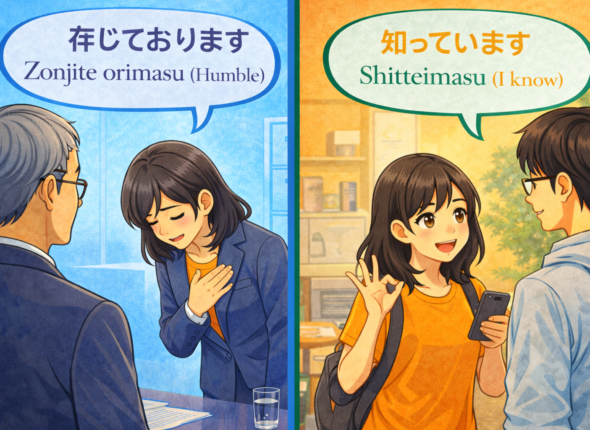
The Difference Between「存じます」と「知っています」の違い|Japanese Grammar (N5–N3)
(Joy using humble Keigo [Zonjimasu] vs. Joy using standard Japanese [Shitteimasu]) “I know about that.” In Japanese business, saying “Shitteimasu” to a client can sound childish or too direct. You need to...

The Difference Between「伺う」と「訪ねる」の違い|Japanese Grammar (N5–N3)
(Joy visiting a client [Ukagau] vs. Joy visiting a friend [Tazuneru]) “I will visit your office tomorrow.” If you say “Ashita, ofisu wo tazunemasu,” it sounds a bit like you are going...
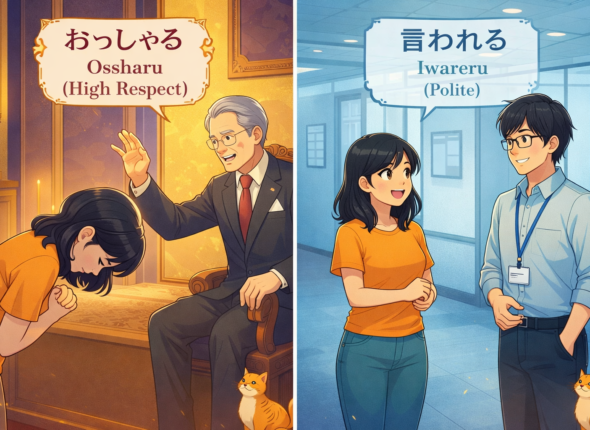
The Difference Between 「おっしゃる」と「言われる」の違い|Japanese Grammar (N5–N3)
(Joy listening to a VIP [Ossharu] vs. Joy listening to a senior [Iwareru]) “The President said…” In Japanese business, you cannot just say “Iimashita”. You must use Honorifics (Sonkeigo). There are two...
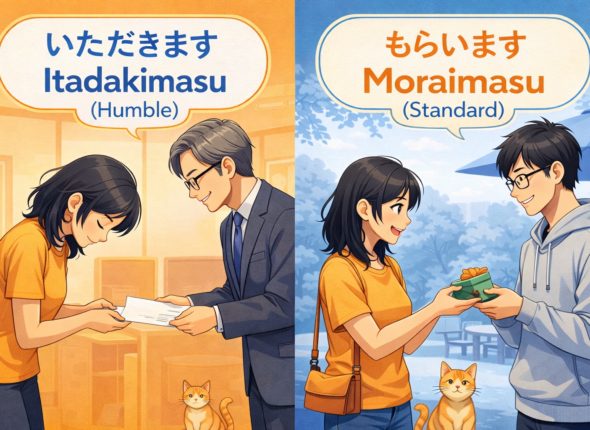
The Difference between「いただきます」と「もらいます」の違い|Japanese Grammar (N5–N3)
(Joy bowing to boss [Itadakimasu] vs. Joy getting gift from friend [Moraimasu]) “I received a gift from my friend.” vs. “I received a certificate from the President.” Both mean “Receive,” but the...

The Difference between「〜たほうがいい」と「〜べきだ」の違い|Japanese Grammar (N5–N3)
(Joy giving advice [Ta hou ga ii] vs. Joy enforcing rules [Beki da]) “You should go home.” In English, “should” is used for everything. In Japanese, we have 〜たほうがいい (Ta hou ga...
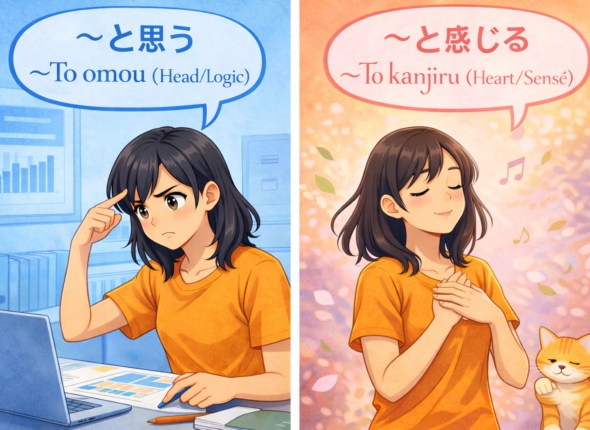
The Difference between「〜と思う」と「〜と感じる」の違い|Japanese Grammar (N5–N3)
(Joy thinking with logic [Omou] vs. Joy feeling with senses [Kanjiru]) “I think it’s expensive.” “I feel cold.” In Japanese, we separate thoughts from sensations. 〜と思う (To omou) is for the head....
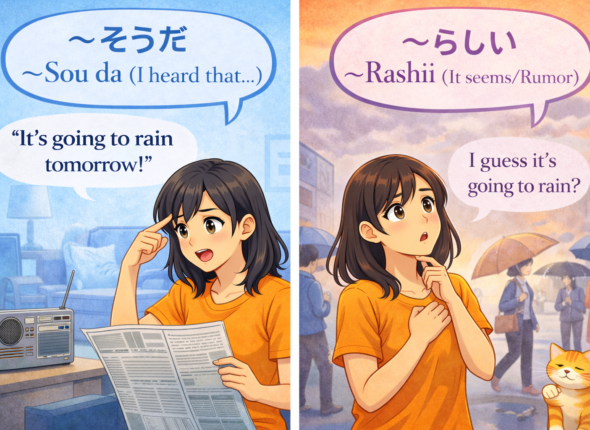
The Difference between「〜らしい」と「〜そうだ」の違い|Japanese Grammar (N5–N3)
(Joy quoting news [Sou da] vs. Joy guessing from a scene [Rashii]) “I heard it will rain.” 雨が 降る そうだ。 (Ame ga furu sou da) 雨が 降る らしい。 (Ame ga furu rashii)...
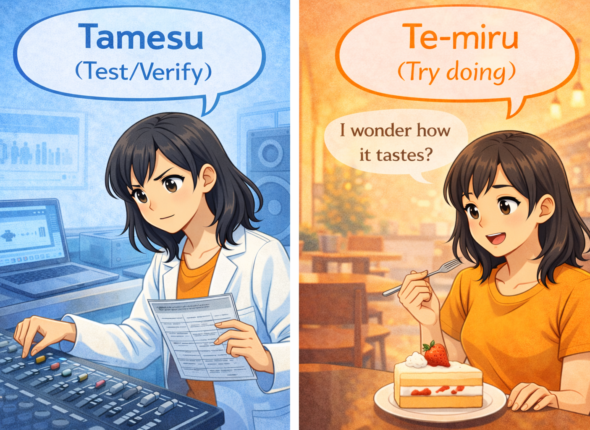
The Difference Between 「〜てみる」と「〜ためす」|Japanese Grammar (N5–N3)
(Joy testing equipment [Tamesu] vs. Joy trying a cake [Te-miru]) “I will test the machine.” (Kikai o tamesu) “I will try eating this cake.” (Keeki o tabete miru) Both mean “to try,”...

The Difference Between「〜やすい」と「〜にくい」の違い|Japanese Grammar (N5–N3)
(Joy reading an easy book [Yasui] vs. Joy struggling with a hard book [Nikui]) “This pen is easy to write with.” “This meat is hard to eat.” In Japanese, you can turn...
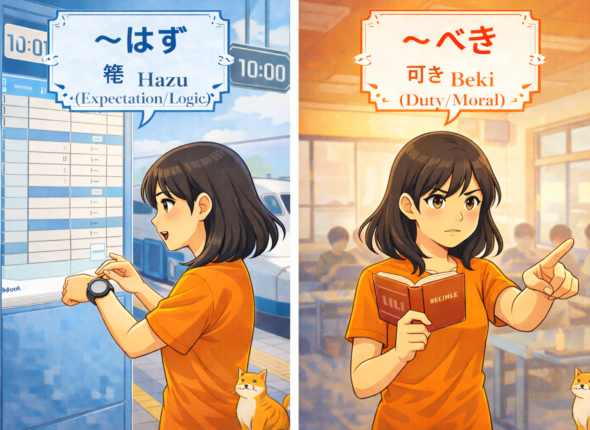
The Difference Between〜はず (hazu) vs 〜べき (beki)|Japanese Grammar (N5–N3)
(Joy calculating time [Hazu] vs. Joy enforcing rules [Beki]) “He should be at home now.” (Logic) “You should be kind to others.” (Morals) In English, “Should” covers both. In Japanese, 〜はず (Hazu)...
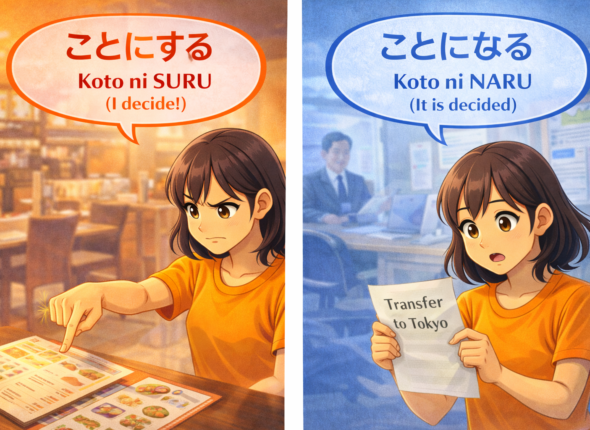
The Difference Between〜ことにする (koto ni suru) vs 〜ことになる (koto ni naru)|Japanese Grammar (N5–N3)
(Joy making a choice [Suru] vs. Joy accepting a rule [Naru]) “I decided to go.” (Iku koto ni shita) “It has been decided that I go.” (Iku koto ni natta) Both express...
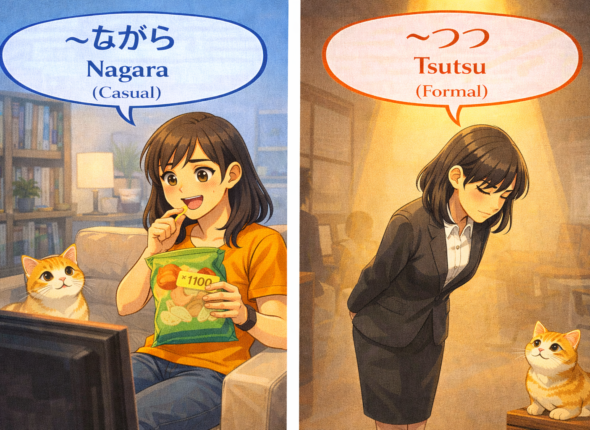
The Difference Between〜ながら (nagara) vs 〜つつ (tsutsu)|Japanese Grammar (N5–N3)
(Joy eating while watching TV [Nagara] vs. Joy working formally [Tsutsu]) “I study while listening to music.” “We are moving forward while considering the problem.” Both use “While,” but the Japanese vibe...
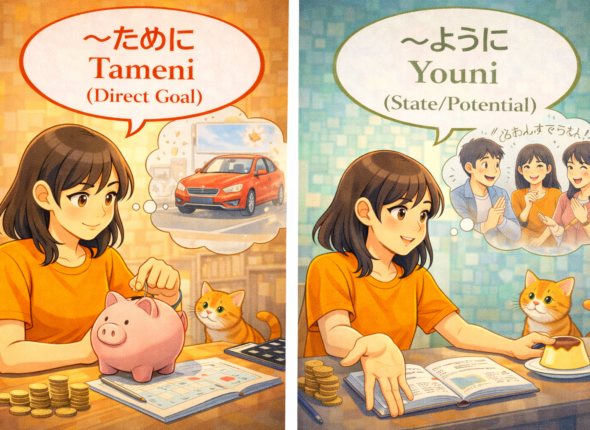
The Difference Between〜ように (yō ni) vs 〜ために (tame ni)|Japanese Grammar (N5–N3)
(Joy saving for a car [Tameni] vs. Joy studying to be able to speak [Youni]) “I study to pass the exam.” “I study so that I can speak Japanese.” In Japanese, both...
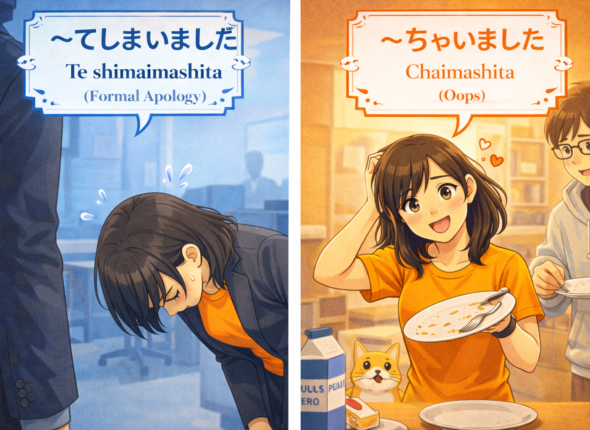
The Difference Between 〜てしまいました vs 〜ちゃいました|Japanese Grammar (N5–N3)
(Joy apologizing formally [Shimaimashita] vs. Joy saying ‘Oops’ playfully [Chaimashita]) “I forgot!” (Wasurete shimaimashita) “I forgot!” (Wasure chaimashita) Both mean “I accidentally did it (and I regret it).” However, one is suitable...
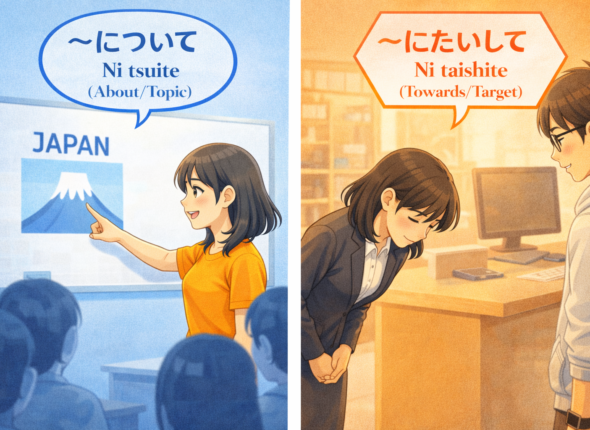
The Difference Between について (ni tsuite) vs に対して (ni taishite)|Japanese Grammar (N5–N3)
(Joy explaining a topic [Ni tsuite] vs. Joy acting towards a person [Ni taishite]) “I want to talk about you.” (Anata ni tsuite) “I am kind to you.” (Anata ni taishite) Both...
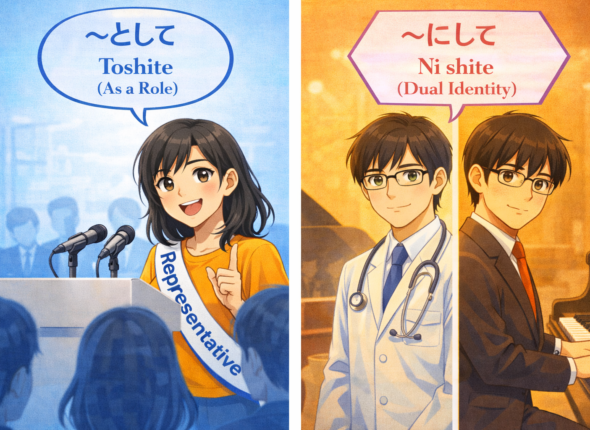
The Difference Between として (toshite) vs にして (nishite) |Japanese Grammar (N5–N3)
(Joy acting AS a representative [Toshite] vs. Ken being a doctor AND pianist [Ni shite]) “I speak as a friend.” (Tomodachi toshite) “He is a genius and a hard worker.” (Tensai ni...
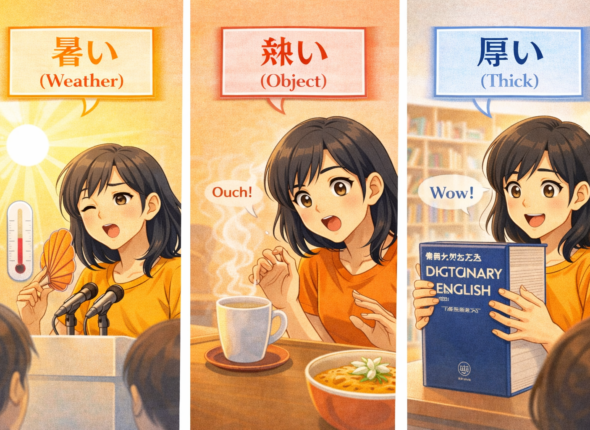
The Difference Between 暑い vs 熱い vs 厚い (Atsui) |Japanese Grammar (N5–N3)
br> (Joy sweating [暑い], touching hot tea [熱い], holding a thick book [厚い]) “It’s hot today.” “This tea is hot.” “This book is thick.” In Japanese, all of these are pronounced 「あつい...