
Blog
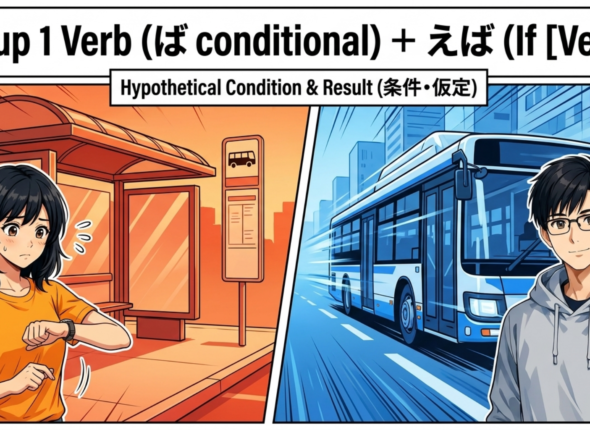
GrammarBook: ば conditional (verb G1): Change final う to え + ば
N4-G-081 ば conditional (verb G1): Change final う to え + ば Core / Hypothetical Conditions & Logic 👀 Layer A: Visual Guide 📝 Quick Summary The ば conditional form (仮定形 –...
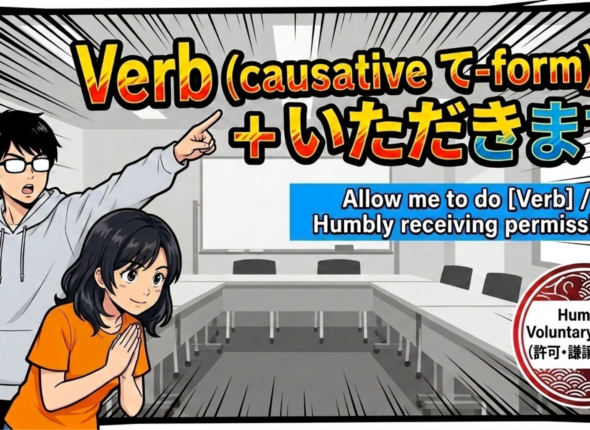
GrammarBook: Verb (causative て-form) + いただきます (Allow me to do [Verb])
N4-G-080 Verb (causative て-form) + いただきます (Allow me to do [Verb]) Peripheral / Permission & Humble Voluntary Action 👀 Layer A: Visual Guide 📝 Quick Summary This grammar pattern combines a verb...
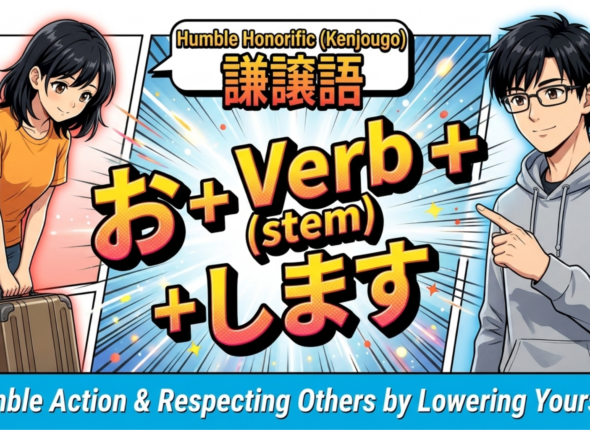
GrammarBook: お + Verb (stem) + します (Humble Honorific / Kenjougo)
N4-G-079 お + Verb (stem) + します (Humble Honorific / Kenjougo) Supporting / Humbly Lowering Your Own Actions 👀 Layer A: Visual Guide 📝 Quick Summary This grammar pattern is a regular...
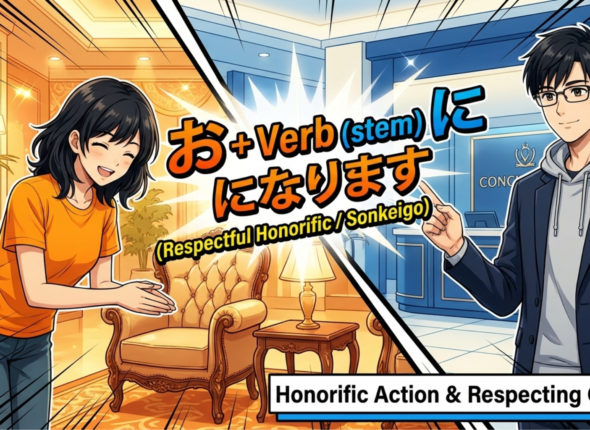
GrammarBook: お + Verb (stem) + になります (Respectful Honorific / Sonkeigo)
N4-G-078 お + Verb (stem) + になります (Respectful Honorific / Sonkeigo) Supporting / Respecting Others’ Actions 👀 Layer A: Visual Guide 📝 Quick Summary This grammar pattern is a regular formula for...
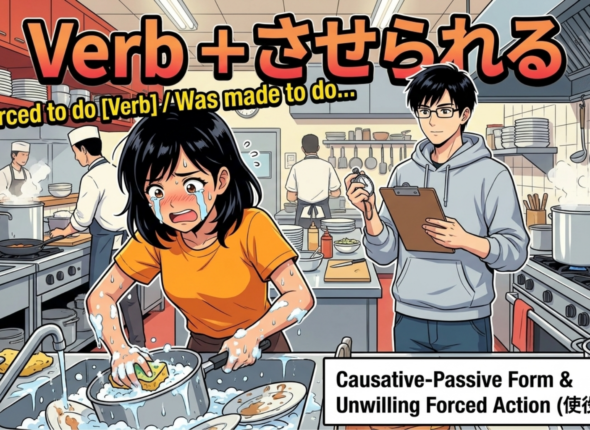
GrammarBook: Verb+させられる (Forced to do [Verb] / Made to do)
N4-G-077 Verb+させられる (Forced to do [Verb] / Made to do) Peripheral / Expressing Unwilling Forced Action 👀 Layer A: Visual Guide 📝 Quick Summary The Causative-Passive Form (使役受身形 – しえきうけみけい) combines the...
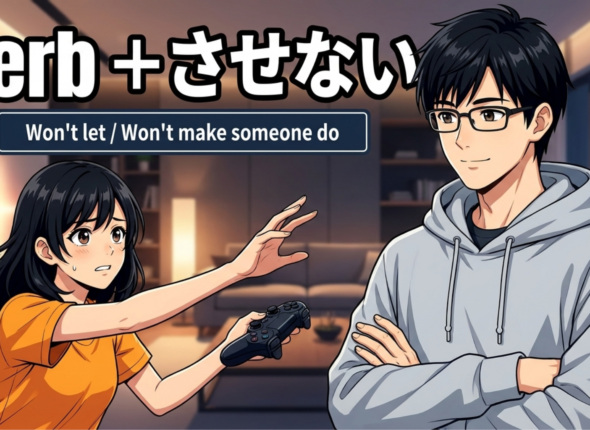
GrammarBook: Verb + させない (Won’t let / Won’t make [Verb])
N4-G-076 Verb + させない (Won’t let / Won’t make [Verb]) Supporting / Refusing Permission & Compulsion 👀 Layer A: Visual Guide 📝 Quick Summary The Causative Negative Form (使役否定形) expresses refusing permission...
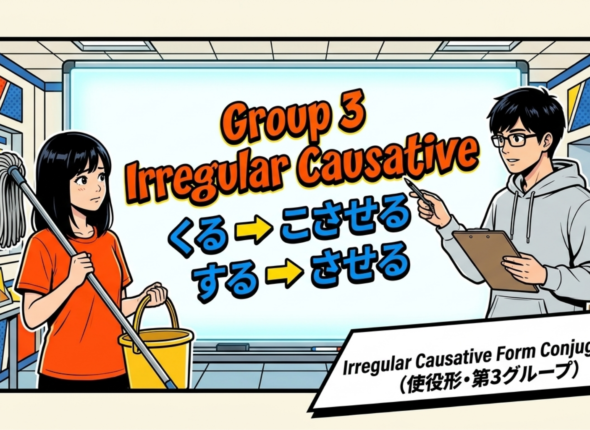
GrammarBook: Irregular causative Verbs: する → させる / くる → こさせる
N4-G-075 Irregular causative Verbs: する → させる / くる → こさせる Supporting / Expressing Compulsion & Permission 👀 Layer A: Visual Guide 📝 Quick Summary The Causative Form (使役形 – しえきけい) expresses...
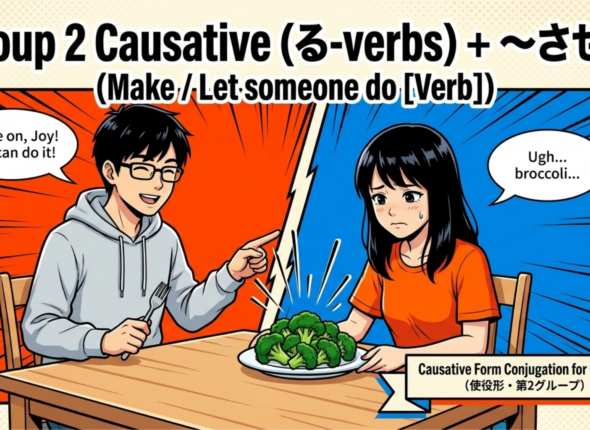
GrammarBook: Group 2 causative (る-verbs): Remove る + させる
N4-G-074 Group 2 causative (る-verbs): Remove る + させる Supporting / Expressing Compulsion & Permission 👀 Layer A: Visual Guide 📝 Quick Summary The Causative Form (使役形 – しえきけい) expresses making someone...
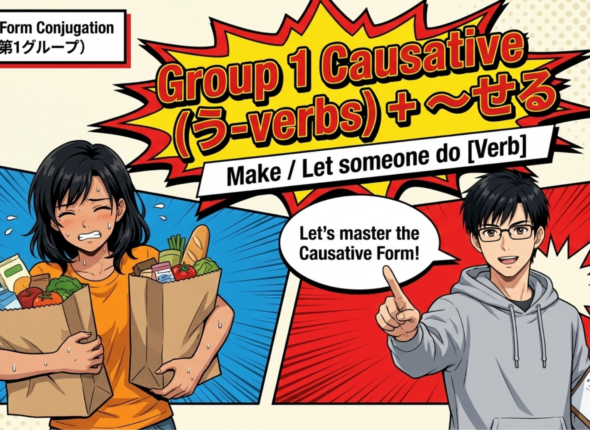
GrammarBook: Group 1 causative (う-verbs): Change u → a + せる
N4-G-073 Group 1 causative (う-verbs): Change u → a + せる Supporting / Expressing Compulsion & Permission 👀 Layer A: Visual Guide 📝 Quick Summary The Causative Form (使役形 – しえきけい) expresses...
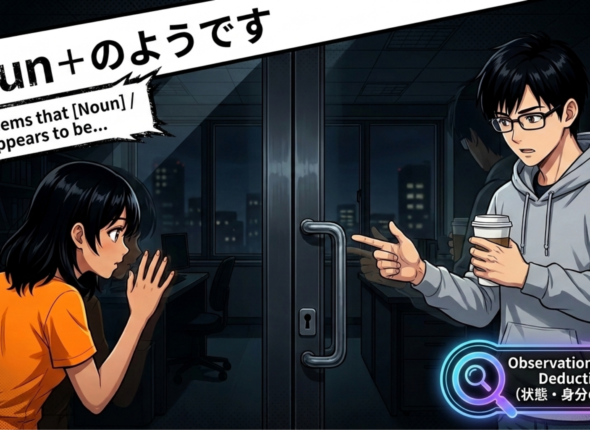
GrammarBook: Noun + の ようです (It seems [Noun])
N4-G-072 Noun + の ようです (It seems [Noun]) Core / Conjectural & Observation-based Supposition 👀 Layer A: Visual Guide 📝 Quick Summary This grammar pattern connects a Noun to ようです using the...
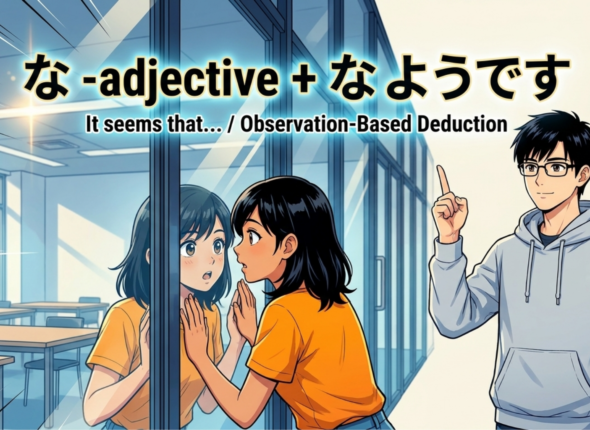
GrammarBook: な-adjective + な ようです (It seems [Na-adjective])
N4-G-071 な-adjective + な ようです (It seems [Na-adjective]) Core / Conjectural & Observation-based Supposition 👀 Layer A: Visual Guide 📝 Quick Summary This grammar pattern connects a な-adjective to ようです by attaching...
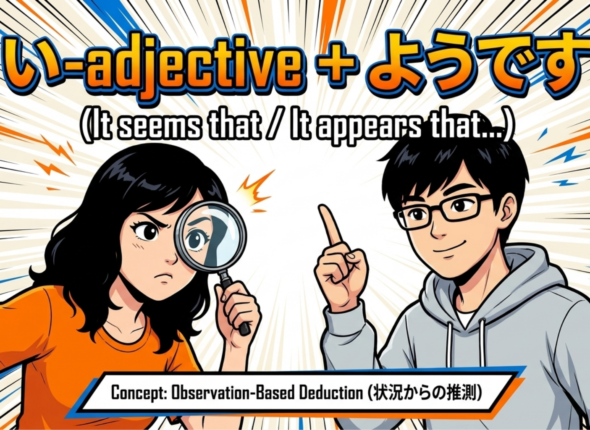
GrammarBook: い-adjective + ようです (It seems [I-adjective])
N4-G-070 い-adjective + ようです (It seems [I-adjective]) Core / Conjectural & Observation-based Supposition 👀 Layer A: Visual Guide 📝 Quick Summary This grammar pattern connects an い-adjective in its Plain Form directly...
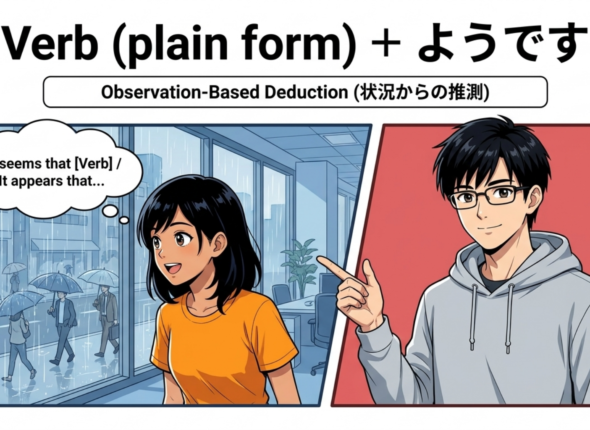
GrammarBook: Verb (plain form) + ようです (It seems/appears that [Verb])
N4-G-069 Verb (plain form) + ようです (It seems/appears that [Verb]) Core / Conjectural & Observation-based Supposition 👀 Layer A: Visual Guide 📝 Quick Summary This grammar pattern connects a verb in its...
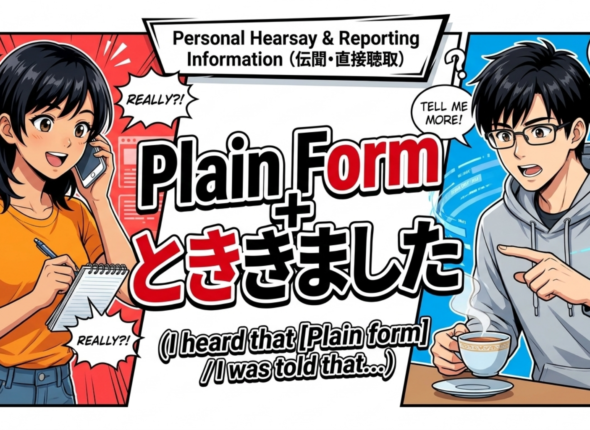
GrammarBook: Plain form + とききました (I heard that [Plain form])
N4-G-068 Plain form + とききました (I heard that [Plain form]) Supporting / Hearsay & Reporting Information 👀 Layer A: Visual Guide 📝 Quick Summary This grammar pattern connects a clause in its...
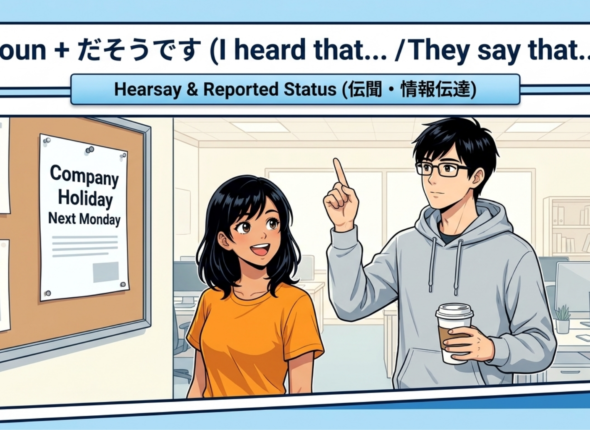
GrammarBook: Noun + だ そうです (I heard that [Noun])
N4-G-067 Noun + だ そうです (I heard that [Noun]) Core / Hearsay & Reporting Information 👀 Layer A: Visual Guide 📝 Quick Summary This grammar pattern connects a Noun in its Plain...
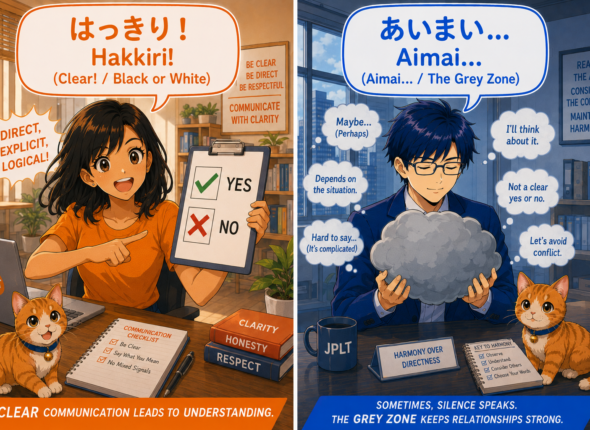
【使い分け】あいまい表現と明確表現、日本語と英語の違い の違い [日本語学習]
(はっきりとしたYES/NOのバインダーを持ち自信満々なJoy [明確/英語圏] vs. 形のないグレーの雲を持ち、曖昧に微笑むKen [あいまい/日本]) 「このアイデアはダメだ。やめよう。」→ 明確表現(Meikaku – 白黒はっきり / 英語) 「前向きに検討させていただきます。」→ あいまい表現(Aimai – グレーゾーン / 日本) 英語圏の文化において、曖昧さ(アンビギュイティ)はビジネスの敵です。明確で、正確で、「白か黒か」はっきりしていることが、知性と敬意の表れです。しかし日本では、物事を「白か黒か」で強制的に割り切ることは、勝者と敗者を生み出し、調和(和)を破壊する行為とされます。関係性を壊さずに生き残るため、日本人は「あいまい(グレーゾーン)」を多用します。Joyが重要なマーケティングのPRビジュアルを提出した時、何が起こるか見てみましょう。 🗣 会話シーン (Conversation Scene) Joyは、マレーシア市場向けの新しいプログラムのPRビジュアル素材を作成し終え、田中ディレクターにチェックを求めています。 Joy ディレクター!マレーシア向けの新規プログラムのPRビジュアルが完成しました!いかがですか? (Director! The PR visual for the new...
The Difference Between あいまい表現と明確表現、日本語と英語の違い の違い |Japanese Grammar (N5–N3)
(Joy holding a clear YES/NO clipboard [Black or White] vs. Ken holding a vague grey cloud [Aimai / The Grey Zone]) “This idea is bad. Let’s not do it.” -> 明確表現 (Meikaku...
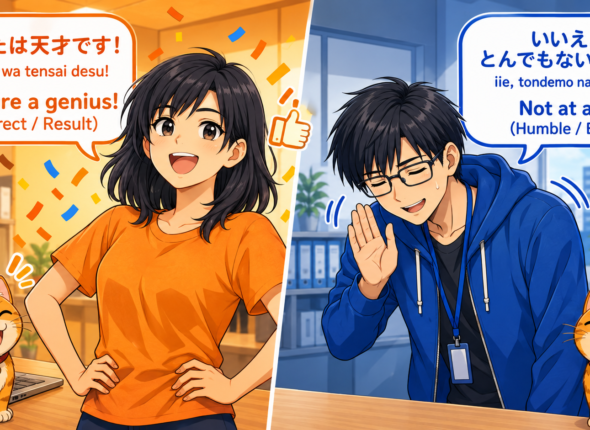
The Difference Between 直接褒める英語と控えめに褒める日本語の違い の違い |Japanese Grammar (N5–N3)
(Joy accepting praise proudly [Direct/English] vs. Ken humbly waving his hand to deflect praise [Kenson/Japanese]) “You are an absolute genius!” -> Direct Praise (Focus on Talent) “No, no, I still have much...
【使い分け】直接褒める英語と控えめに褒める日本語の違い の違い [日本語学習]
(褒め言葉を誇らしげに受け入れて喜ぶJoy [直接的/英語圏] vs. 笑顔で顔の前で手を振り、謙虚に褒め言葉を否定するKen [謙遜/日本]) 「あなたは本当に天才ですね!」→ 直接的な称賛(才能・結果にフォーカス) 「いえいえ、まだまだ勉強中です。」→ 謙遜(Kenson – 日本の美徳) 西洋の文化において、褒め言葉に対して明るく「ありがとう!一生懸命やったからね!」と受け入れることは、健全な自尊心(自己肯定感)の表れです。もし褒め言葉を否定すれば、自信がない人だと思われるかもしれません。しかし日本では、謙遜(Kenson)の概念が社会的ルールの中心にあります。褒め言葉をすぐに受け入れると、傲慢でチームの和を乱す人に見られかねません。Joyが、ソーシャルメディアのビジュアルデザインについて褒められた時に何が起こるか見てみましょう。 🗣 会話シーン (Conversation Scene) JoyはWordPressを使って、学校のSNSキャンペーン用の新しいランディングページのビジュアルレイアウトを完成させました。田中ディレクターはそれに非常に感銘を受けています。 田中 Joyさん、このWordPressのランディングページ、素晴らしいですね!ビジュアルのセンスが本当に良いです。 (Joy, this WordPress landing page is wonderful! Your visual sense is truly great.)...
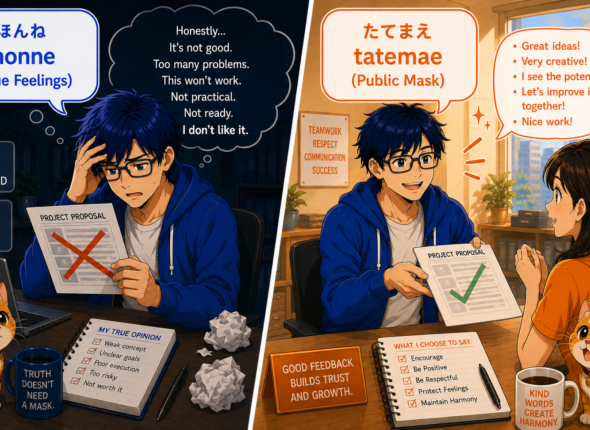
【使い分け】建前と本音の違いで失敗しない日本語 の違い [日本語学習]
(思考の吹き出しの中で「ダメだ」と厳しい本音を見せるKen [本音] vs. 笑顔で相手を傷つけないようにフィードバックを返すKen [建前]) 「このデザインはひどい。」→ 本音(Honne – 真実の感情) 「とても個性的なデザインですね!」→ 建前(Tatemae – 表向きの顔) 多くの西洋文化では、「正直であること(Honesty is the best policy)」が最善とされます。自分の本当の意見を隠す人は、偽善的で信頼できないと見なされがちです。しかし日本では、グループの居心地の良さよりも「自分の生の感情」を優先することは、自分勝手で子供っぽいと見なされます。日本の社会は、本音(Honne)と建前(Tatemae)の絶妙なバランスによって円滑に回っているのです。JoyがアクティブシーズンのSNS用ビジュアルデザインを提出した時に、何が起こるか見てみましょう。 🗣 会話シーン (Conversation Scene) Joyは何時間もかけて、語学学校のSNS向けに大胆でネオンカラーのビジュアル素材を作成しました。最終承認を得るため、田中ディレクターにそれを見せます。 Joy ディレクター、今シーズンのSNS用のビジュアルデザインが完成しました!いかがですか? (Director, the visual designs for this active...