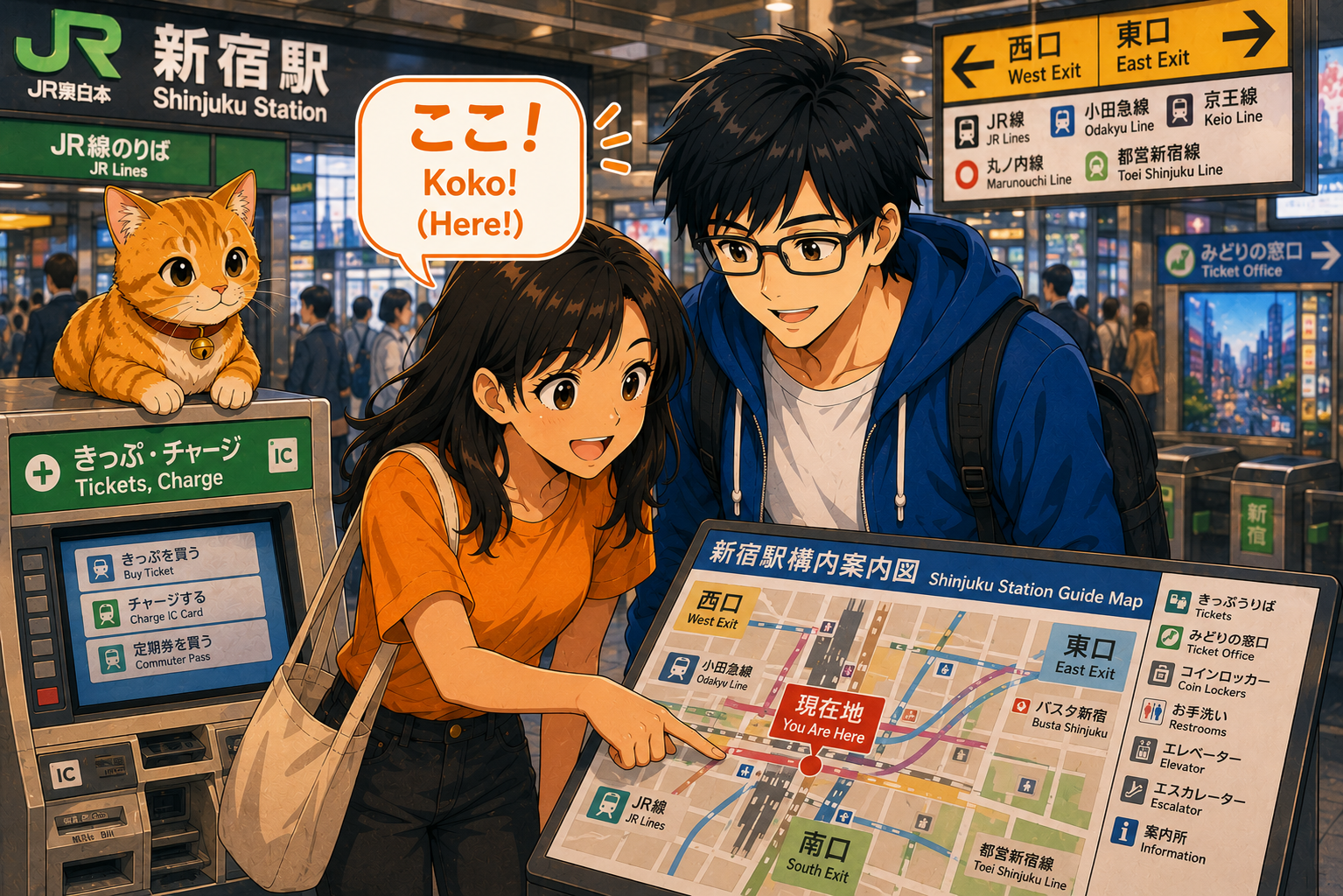
 (Alt Text: Joy pointing at a station map saying “Koko!”, standing with Ken while a cute orange cat sits on a ticket machine)
Welcome to “Japanese You Keep Seeing”!
In this series, we break down the most common, everyday Japanese words that textbooks overcomplicate. If you plan to navigate the massive train stations of Tokyo or the winding streets of Kyoto, there is one location word you absolutely must know: ここ (Koko).
🗣 Conversation Scene
Joy and Ken are trying to find their train platform inside the famously confusing Shinjuku Station. Joy stops to look at a large directory map.Joy
Ken, wait! We are lost. ここはどこですか?
(Ken, wait! We are lost. Where is “Koko” [Here]?)
Ken
Ah, let’s look at the map. Look at the red dot… ここです!
(Ah, let’s look at the map. Look at the red dot… it is “Koko” [Here]!)
💡 Explanation: The Location System
Just like pointing at physical objects (Kore/Sore/Are), Japanese locations follow the exact same Ko-So-A-Do pattern. Instead of adding “-re” for objects, you add “-ko” for places!1. ここ (Koko) = Here (Where I am) 👇
Use “Koko” to talk about the physical place you are currently standing, or a spot on a map you are pointing directly at.- ここはどこですか? (Koko wa doko desu ka?) Where is here? (Translation: Where am I right now?)
- トイレはここです。 (Toire wa koko desu.) The toilet is here. (When standing right in front of it).
2. そこ (Soko) = There (Near you) 👉
Use “Soko” when the location is close to the person you are talking to, or just a few steps away from both of you.- そこを右に曲がってください。(Soko o migi ni magatte kudasai) Please turn right there. (Pointing to a corner just up ahead).
3. あそこ (Asoko) = Over there (Far away) 🫵
Use “Asoko” when the place is physically far away from both of you, but you can usually still see it in the distance.- コンビニはあそこです。(Konbini wa asoko desu) The convenience store is over there. (Pointing down the street).
4. どこ (Doko) = Where? 🤷♀️
This is your question word. If you memorize “Doko,” you will never stay lost for long!- 駅はどこですか?(Eki wa doko desu ka?) Where is the station?
💎 Pro Tip: The Polite Versions
If you are speaking to a client or a hotel staff member, Japanese people use a slightly fancier version of these words. Koko -> Kochira Soko -> Sochira Asoko -> Achira Doko -> Dochira If a waiter points to your table and says “Kochira e douzo”, it means “Right this way, please!”
🔥 Practice Quiz
Tap to check the answer!Ready to master the Ko-So-A-Do system?
Want to dive deeper? Check out our official Beginner’s Grammar Book for more examples, detailed explanations, and practice exercises to perfect your Japanese pointing skills!
📖 Read more in the Grammar Book: これ/それ/あれ/どれ