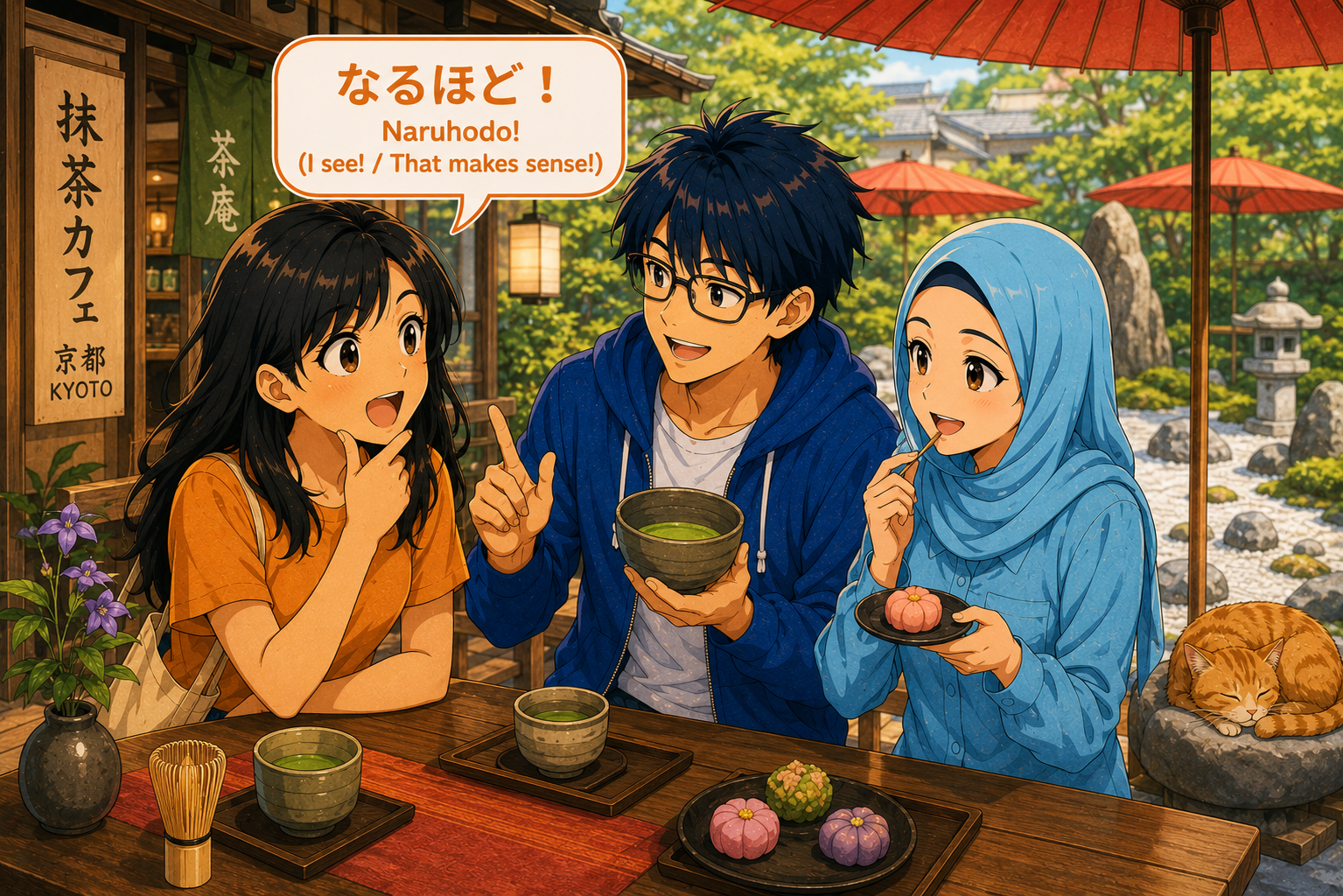
 (Joy having an “Aha!” moment saying “Naruhodo!” at a Kyoto matcha cafe with Ken, Raya, and a sleeping orange cat)
Welcome to “Japanese You Keep Seeing”!
When you watch anime or listen to a casual Japanese conversation, you will inevitably hear someone say なるほど (Naruhodo) while nodding deeply. It sounds smart, engaging, and profound. But what exactly does it mean, and why do Japanese teachers often warn beginners *not* to use it in the office? Let’s explore the ultimate Japanese “Aha!” moment!
🗣 Conversation Scene
Joy, Ken, and Raya are taking a weekend trip to Kyoto. They are sitting at an outdoor cafe, enjoying traditional bitter matcha tea and sweet wagashi. Joy was wondering why the tea had to be so bitter.Ken
和菓子はすごく甘いから、苦い抹茶と一緒に飲むとバランスが完璧になるんだよ。(Wagashi is very sweet, so drinking it with bitter matcha creates the perfect balance.)
Joy
Line 1: なるほど!
Line 2: Naruhodo!
Line 3: (I see! / That makes sense!)
だからお茶がこんなに苦いんですね!(I see! That’s why the tea is so bitter!)
Raya
It really is a genius combination!
💡 Explanation: The “Aha!” Moment
In Japanese, なるほど (Naruhodo) is an adverb used to express agreement, realization, or understanding. It is one of the most satisfying words to use in conversation.1. What does it mean? 🧩
Naruhodo translates to “I see,” “That makes sense,” or “Indeed.” You use it when you receive new information that connects the dots in your mind. Joy didn’t understand why the tea was so bitter, but once Ken explained the pairing with the sweet candy, she had an “Aha!” moment and said, “Naruhodo!”2. The Danger Zone (Why it can be rude) ⚠️
While “Naruhodo” is perfectly fine to use with friends and family, you must never use it with your boss, superiors, or clients. Why? Because “Naruhodo” implies that you are evaluating or judging what the other person said and deciding that it is correct. In Japanese culture, evaluating a superior from a top-down perspective is highly disrespectful.3. The Polite Alternatives 👔
If your boss or a client explains something to you and you want to say “That makes sense,” use these humble business phrases instead:- おっしゃる通りです (Ossharu toori desu) “You are exactly right.” (Used when you agree with their opinion).
- 承知いたしました (Shouchi itashimashita) “I understand.” (Used when you comprehend an instruction or new fact).
- 勉強になります (Benkyou ni narimasu) “I am learning a lot from you.” (The ultimate polite phrase when a boss teaches you something new!).
🔥 Practice Quiz
Ready to master the Ko-So-A-Do system?
Want to dive deeper? Check out our official Beginner’s Grammar Book for more examples, detailed explanations, and practice exercises to perfect your Japanese pointing skills!
📖 Read more in the Grammar Book: これ/それ/あれ/どれ