

GrammarBook N4: Verb (potential form) + ようになります (Come to be able to)
N4-G-035 Verb (potential form) + ようになります (Come to be able to) Core / Changes in Ability 👀 Layer A: Visual Guide 📝 Quick Summary This grammar point expresses a change from not...
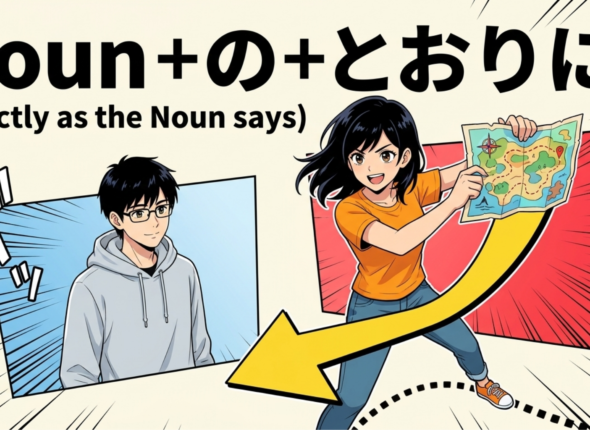
GrammarBook N4: Noun + の + とおりに (Exactly as)
N4-G-034 Noun + の + とおりに (Exactly as) Supporting / Duplication & Instructions 👀 Layer A: Visual Guide 📝 Quick Summary This grammar point is used to state that an action is...
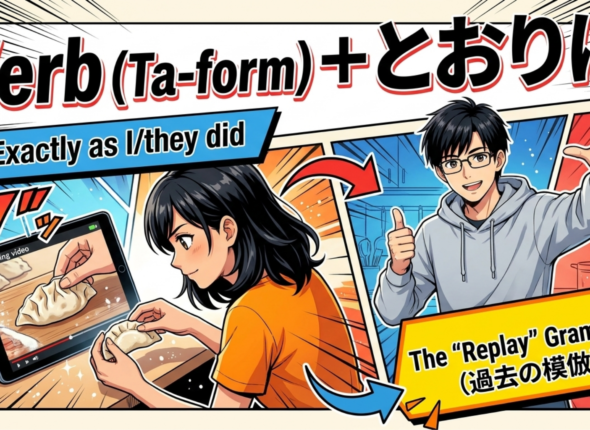
GrammarBook N4: Verb た+とおりに (Exactly as I/they did)
N4-G-033 Verb た+とおりに (Exactly as I/they did) Supporting / Duplication & Past Actions 👀 Layer A: Visual Guide 📝 Quick Summary This grammar point is used to perform an action in the...

GrammarBook N4: Verb (dictionary form) + とおりに (Exactly as)
N4-G-032 Verb (dictionary form) + とおりに (Exactly as) Supporting / Duplication & Instructions 👀 Layer A: Visual Guide 📝 Quick Summary This grammar point is used when you want someone to perform...

GrammarBook N4 : Plain form+と言っていました (He/She said that…)
N4-G-031 Plain form+と言っていました (He/She said that…) Core / Reported Speech 👀 Layer A: Visual Guide 📝 Quick Summary This grammar point is used to report what a third person said. The particle...

GrammarBook N4 : Prohibitive (Don’t do!) / 禁止
N4-G-030 Prohibitive (Don’t do!) / 禁止 Supporting / Negative Commands & Signs 👀 Layer A: Visual Guide 📝 Quick Summary The Prohibitive form (禁止 – Kinshi) is the strongest way to tell...
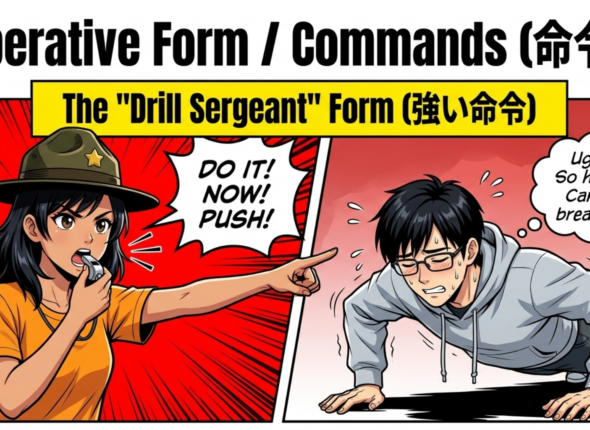
GrammarBook N4 : Imperative (Commands) / 命令形
N4-G-029 Imperative (Commands) / 命令形 Peripheral / Extreme Orders & Signs 👀 Layer A: Visual Guide 📝 Quick Summary The Imperative form (命令形 – Meireikei) is the strongest and most direct way...
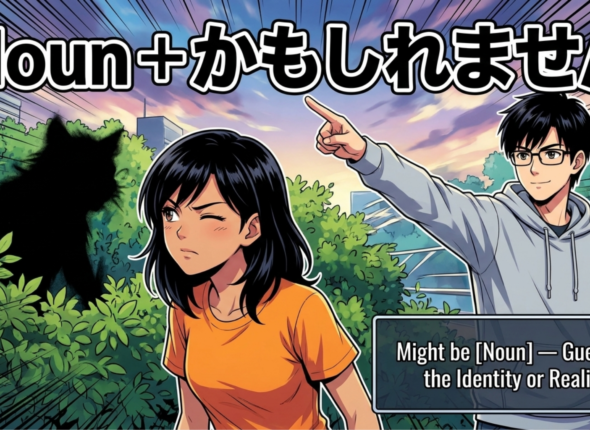
GrammarBook N4 : Noun(no だ)+かもしりません (Might be)
N4-G-028 Noun(no だ)+かもしりません (Might be) Core / Probability with Nouns 👀 Layer A: Visual Guide 📝 Quick Summary This grammar expresses a guess or possibility about what something is, or what the...

GrammarBook N4 : Na adjective plain form+かもしりません (Might be)
N4-G-027 Na adjective plain form+かもしりません (Might be) Core / Probability with Na-Adjectives 👀 Layer A: Visual Guide 📝 Quick Summary Use this to express that someone or something might have a certain...

GrammarBook N4 : I adjective plain form+かもしりません (Might be)
N4-G-026 I adjective plain form+かもしりません (Might be) Core / Probability with Adjectives 👀 Layer A: Visual Guide 📝 Quick Summary Use this to express a possibility that something has a certain quality....

GrammarBook N4 : Verb Plain Form+かもしりません (Might)
N4-G-025 Verb Plain Form+かもしりません (Might) Core / Probability & Guessing 👀 Layer A: Visual Guide 📝 Quick Summary This grammar point expresses a possibility that something might happen or might be true....

GrammarBook N4 : まだ+Affirmative Form (Still / More)
N4-G-024 まだ+Affirmative Form (Still / More) Supporting / Continuity & Quantity 👀 Layer A: Visual Guide 📝 Quick Summary When “Mada” is used with a positive (affirmative) verb, it means “still.” It...
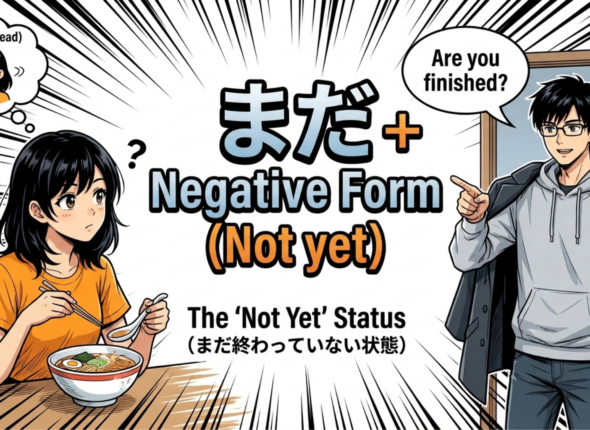
GrammarBook N4 : まだ+Negative Form (Not yet)
N4-G-023 まだ+Negative Form (Not yet) Core / Progress & Status 👀 Layer A: Visual Guide 📝 Quick Summary This grammar point expresses that an expected action has not yet occurred. While “Mada”...
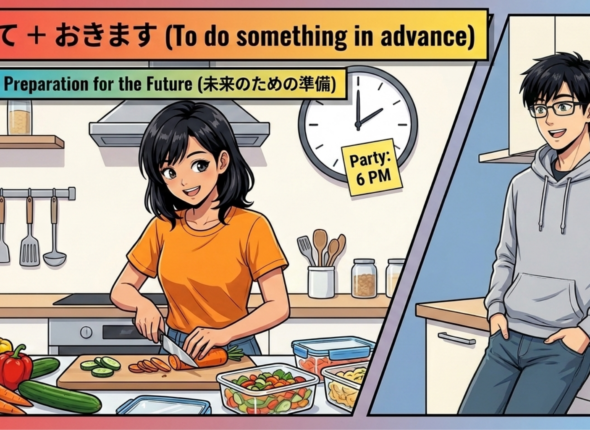
GrammarBook N4 : Verb ておきます (To do in advance)
N4-G-022 Verb ておきます (To do in advance) Core / Preparation & Maintenance 👀 Layer A: Visual Guide 📝 Quick Summary This grammar point expresses doing an action in advance to prepare for...

GrammarBook N4 : Verbて+みません (Won’t you try…?)
N4-G-021 Verbて+みません (Won’t you try…?) Supporting / Invitations & Suggestions 👀 Layer A: Visual Guide 📝 Quick Summary This grammar point is most commonly used in its question form: “~te mimasen ka?”....
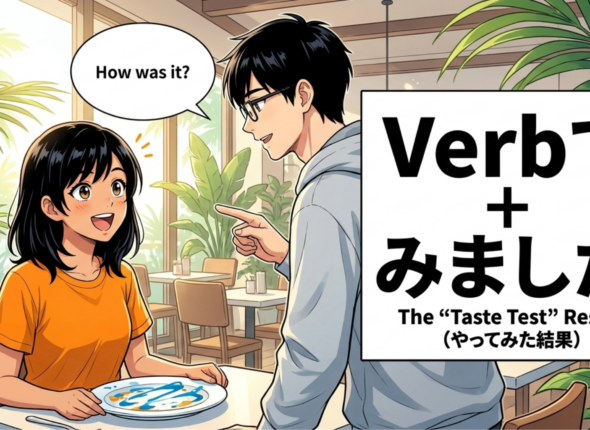
GrammarBook N4 : Verbて+みました (I tried doing…)
N4-G-020 Verbて+みました (I tried doing…) Supporting / Experience & Results 👀 Layer A: Visual Guide 📝 Quick Summary This is the past tense of “te-mimasu”. It means you actually performed an action...

GrammarBook N4 : Verbて+みます (To try doing something)
N4-G-019 Verbて+みます (To try doing something) Core / Experience & Experiment 👀 Layer A: Visual Guide 📝 Quick Summary This grammar point means “to try doing something to see what it is...
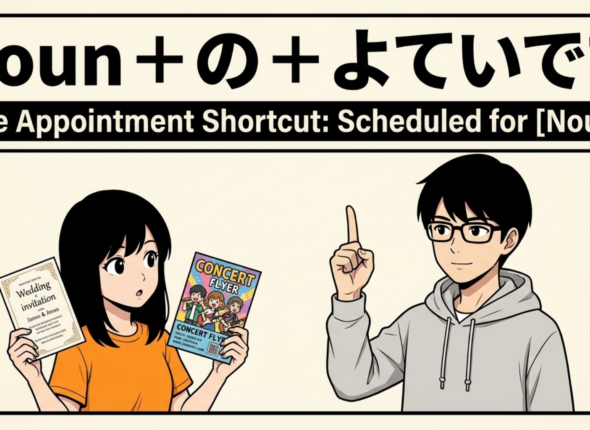
GrammarBook N4 : Noun+の+よていです (Scheduled for…)
N4-G-018 Noun+の+よていです (Scheduled for…) Supporting / Business & Appointments 👀 Layer A: Visual Guide 📝 Quick Summary This grammar point allows you to state official schedules using a noun instead of a...
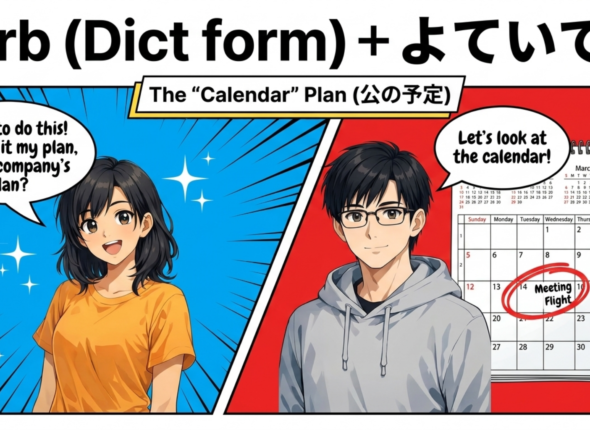
GrammarBook N4 : Verb dictionary form+よていです (Scheduled to)
N4-G-017 Verb dictionary form+よていです (Scheduled to) Core / Schedules & Official Plans 👀 Layer A: Visual Guide 📝 Quick Summary This grammar point is used to express an official schedule or a...

GrammarBook N4 : Verb ない+つもりです (I intend NOT to)
N4-G-016 Verb ない+つもりです (I intend NOT to) Supporting / Negative Intentions 👀 Layer A: Visual Guide 📝 Quick Summary This grammar point is used to express a firm decision not to do...