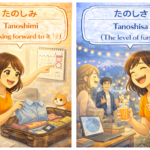
 (Raya pointing at a souvenir saying “Kore!”, standing with Joy and Ken while a cute orange cat sits on the counter)
Welcome to “Japanese You Keep Seeing”!
Have you ever noticed that the exact same words keep popping up in anime, Japanese dramas, and daily life? In this series, we break down the most common everyday words that textbooks often overcomplicate. Today, we look at the ultimate beginner survival word: これ (Kore).
🗣 Conversation Scene
Raya is exploring a traditional souvenir shop in Asakusa on her day off with Joy and Ken. She spots a keychain she wants to buy for a friend back in Malaysia.Raya
There are so many cute options… Ah! Excuse me, これをお願いします!
(…Ah! Excuse me, “Kore” please! [Pointing directly at the keychain])
Joy
Wow Raya, you used “Kore” perfectly to buy something! It really is the ultimate survival word.
Ken
Exactly! You don’t need to know complex vocabulary for every single item in the store. If you can point and say “Kore”, you can survive anywhere in Japan!
💡 Explanation: The “Ko-So-A-Do” System
In Japanese, demonstrative words (This, That, That over there) follow a very strict, logical system based on physical distance. Once you learn the starting sounds (Ko, So, A, Do), you unlock a massive part of the Japanese language.1. これ (Kore) = This (Near Me) 👇
Use “Kore” for things that are physically close to you (the speaker). If you are holding an item, pointing at a tag in your hand, or touching a menu, it is “Kore.”- これ、お願いします。(Kore, onegaishimasu) This one, please. (The ultimate phrase for ordering food or shopping!)
- これは何ですか? (Kore wa nan desu ka?) What is this? (Very useful when exploring Japan)
2. それ (Sore) = That (Near You) 👉
Use “Sore” for things that are close to the listener. If Joy is holding a bag and Ken wants to talk about it, Ken must use “Sore” because it is in Joy’s physical space.- それを取ってください。(Sore wo totte kudasai) Please pass me that. (Pointing to something next to your friend)
3. あれ (Are) = That over there (Far from both) 🫵
Use “Are” when the object is far away from both the speaker and the listener. If you and a friend are looking across the street at a strange building in the distance, it is “Are.”- あれは富士山ですか?(Are wa Fujisan desu ka?) Is that [mountain way over there] Mt. Fuji?
4. どれ (Dore) = Which one? 🤷♀️
Finally, if you have many options and want to ask “Which one?”, you use “Dore”.- どれが好きですか?(Dore ga suki desu ka?) Which one do you like?
💎 Pro Tip: The “Are?” Sound
If you hear a Japanese person suddenly say “Are?” (with a rising, questioning tone), they are not pointing at a distant object! In casual conversation, “Are?” means “Huh?” or “That’s weird…” It’s the sound people make when they realize they forgot their wallet or notice a mistake.
Ready to master the Ko-So-A-Do system?
Want to dive deeper? Check out our official Grammar Book for more examples, detailed explanations, and practice exercises to perfect your pointing skills in Japanese!
📖 Read more in the Grammar Book: これ/それ/あれ/どれ