N4-G-059
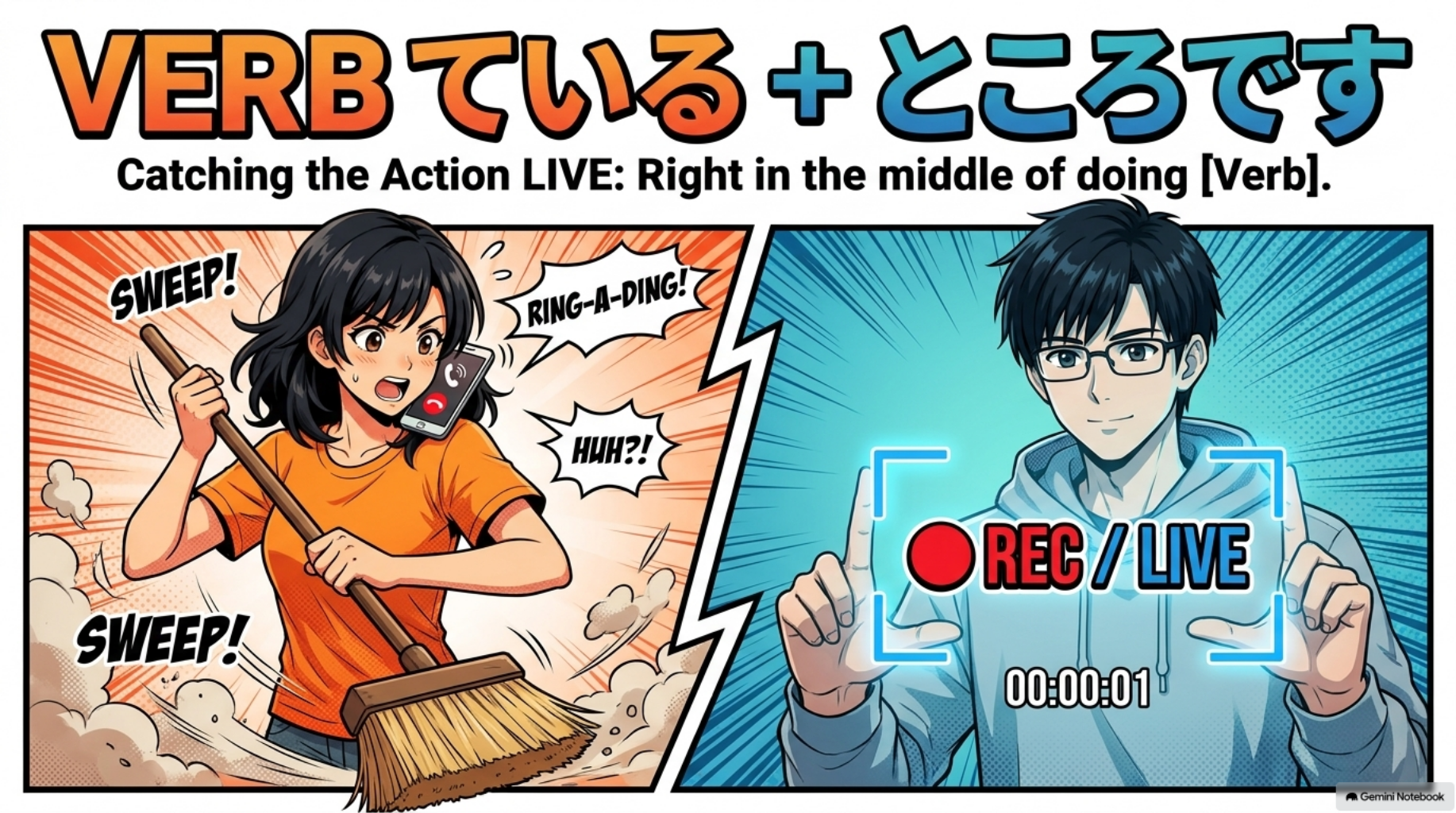
Verb ている + ところです (In the middle of doing [Verb])
Core / Action in Progress & Ongoing Stage
👀 Layer A: Visual Guide
📝 Quick Summary
This grammar pattern connects to the Verb 〜ている Form to express that an action is currently in active progress right at this moment (“in the middle of doing X”).
Structure: [Verb 〜ている Form] + ところです
Example 1: いま ひるごはんを たべている ところです (I am in the middle of eating lunch right now).
Example 2: いま べんきょうして いる ところです (I am in the middle of studying right now).
🔍 Layer B: Deepening
💡 Raya’s Hack
〜て います vs. 〜ている ところです
Both express ongoing actions, but adding tokoro desu emphasizes the exact point in time of the action:
– たべて います (tabete imasu): Standard continuous (“I am eating”).
– たべている ところです (tabete iru tokoro desu): Emphatic midpoint (“I am right in the middle of eating right now!”).
Use this when you want to highlight that you are busy performing an action at this very second (e.g. when answering a phone call).
🚧 Joy’s Mistake
Scene: Joy is actively sweeping the floor when his friend calls.
Joy: 「いま へやを そうじする ところです。」
(Ima heya o souji suru tokoro desu.)
❌ Used Dictionary form while ALREADY in progress!
Why?
Joy used the dictionary form souji suru. [Verb Dict Form] + tokoro desu means you have NOT started yet (0% completed). Since Joy was already sweeping, he should have used the 〜ている form (souji shite iru tokoro desu).
Correct: 「いま へやを そうじして いる ところです。」 (I am in the middle of cleaning my room right now.)
🔥 Layer C: Retrieval Practice Loop
Retrieve and apply! Express ongoing actions in progress. (Hiragana and English only)
Level 1: Structure Building (Verb ~ている + ところです)
Q1. In the middle of eating (たべます ➡️ たべている)
Q2. In the middle of studying (べんきょうします ➡️ べんきょうして いる)
Q3. In the middle of cooking (つくります ➡️ つくっている)
Q4. In the middle of driving (うんてんします ➡️ うんてんして いる)
Q5. In the middle of cleaning (そうじします ➡️ そうじして いる)
Level 2: Full Sentences
Q6. I am in the middle of eating lunch right now. (いま ひるごはんを / たべている)
Q7. I am in the middle of studying now. (いま / べんきょうして いる)
Q8. Tanaka-san is in the middle of cooking right now. (たなかさんは いま りょうりを / つくっている)
Q9. I am in the middle of driving, so I will call later. (いま うんてんして いる / だから あとで でんわします)
Q10. He is in the middle of cleaning his room right now. (かれは いま へやを / そうじして いる)