Skip to content
JPLT Online Japanese Language Training SchoolJPLT Online Japanese Language Training School
  • Courses
  • Plans
  • Get Started
    • What is JPLT Metaverse Campus
    • How to Enroll
  • JPLT LEARNING GYM
    • What is JPLT LEARNING GYM?
    • BootCamp
    • Studio
    • Season
    • Grammar Book
    • Optional Classes and AOTD
  • Schedule
  • Blog
  • About Us
    • What Is Dialog+ JPLT
    • Teachers
    • Company Profile
    • Contact Us
    • FAQs
  • Login
  • For Business
JPLT Online Japanese Language Training SchoolJPLT Online Japanese Language Training School
  • Courses
  • Plans
  • Get Started
    • What is JPLT Metaverse Campus
    • How to Enroll
  • JPLT LEARNING GYM
    • What is JPLT LEARNING GYM?
    • BootCamp
    • Studio
    • Season
    • Grammar Book
    • Optional Classes and AOTD
  • Schedule
  • Blog
  • About Us
    • What Is Dialog+ JPLT
    • Teachers
    • Company Profile
    • Contact Us
    • FAQs
  • Login
  • For Business
JPLT Blog

The Difference Between あいまい表現と明確表現、日本語と英語の違い の違い |Japanese Grammar (N5–N3)

  • 20 Aug, 2026
  • Com 0
あいまい表現と明確表現、日本語と英語の違い
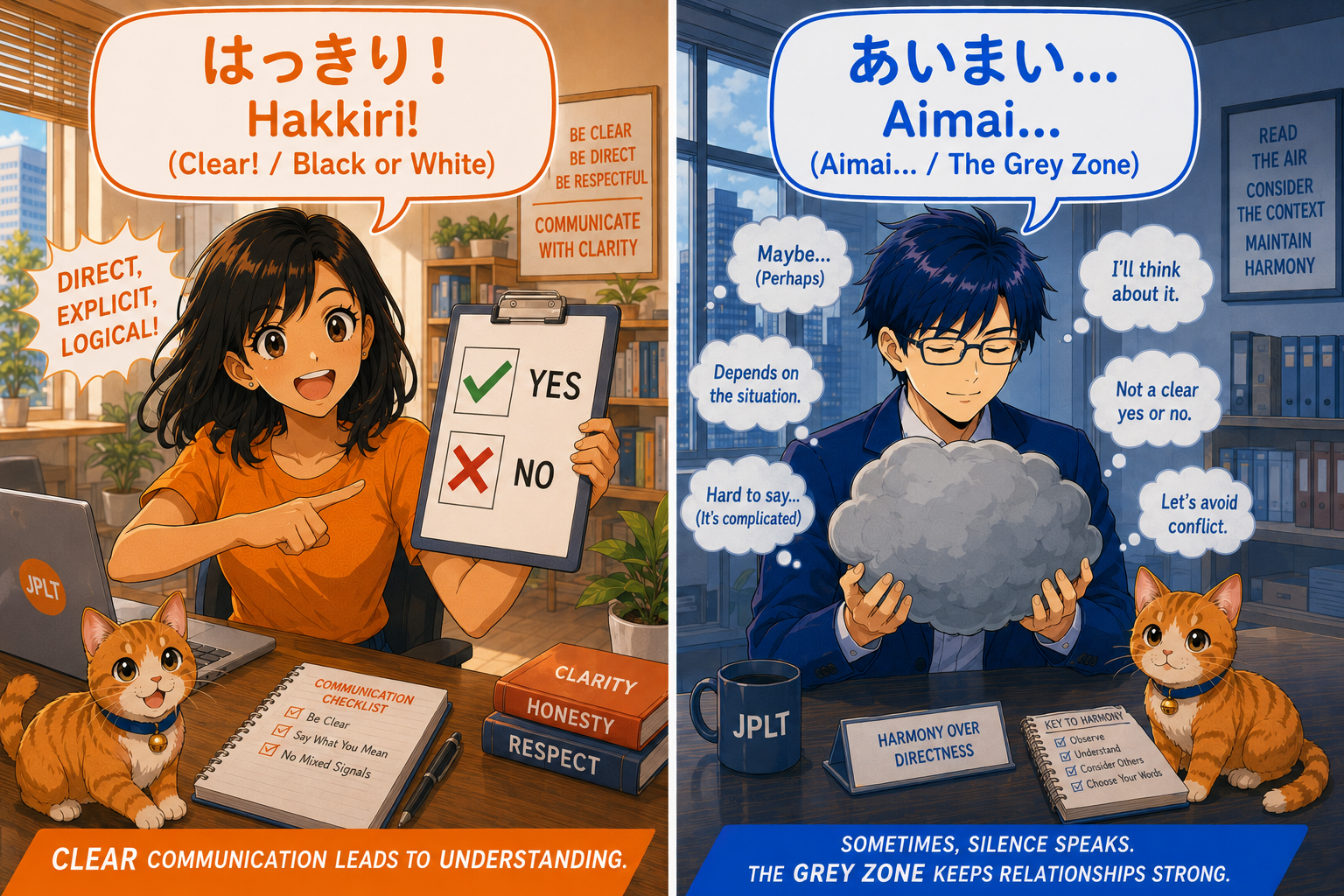
(Joy holding a clear YES/NO clipboard [Black or White] vs. Ken holding a vague grey cloud [Aimai / The Grey Zone])

“This idea is bad. Let’s not do it.” -> 明確表現 (Meikaku – Clear / Black & White)
“We will consider it in a forward-looking manner.” -> あいまい表現 (Aimai – Ambiguous / Grey Zone)
In English-speaking cultures, ambiguity is the enemy of business. Being clear, precise, and “black or white” is a sign of intelligence and respect. In Japan, however, forcing things into “black or white” creates winners and losers, which destroys harmony. To survive, Japanese people rely heavily on あいまい (Aimai – The Grey Zone). Let’s see what happens when Joy submits her new PR visual designs for a major marketing launch.

🗣 Conversation Scene

Joy has created the primary visual communication materials for an upcoming new program launch in Malaysia. She shows the draft to Director Tanaka.

Joy
ディレクター!マレーシア向けの新規プログラムのPRビジュアルが完成しました!いかがですか?
(Director! The PR visual for the new Malaysia program launch is complete! How is it?)
Tanaka
うーん……このデザインは、ちょっと「微妙(びみょう)」ですね……。
(Hmm… this design is a little “Bimyou”…)
Joy
「微妙(Subtle)」?ありがとうございます!今回は繊細でデリケートなデザインにしたんです!
(“Subtle”? Thank you! I went for a delicate design this time!)

[ Tanaka is stunned by her happy reaction. Ken quickly intervenes. ]

Ken
Joyさん!日本のビジネスで「微妙」は「繊細」という意味ではありません!「良くない(NG)」という意味の代表的なあいまい表現です!作り直しですよ!
(Joy! In Japanese business, “Bimyou” does not mean “subtle/delicate”! It is a classic “Aimai” [ambiguous] expression that means “Not good (NG)”! You have to remake it!)

💡 Explanation

The Power of “Aimai” (Ambiguity)

⚠️ The Core Concept:
あいまい (Aimai) means vague or ambiguous. Instead of using clear, aggressive words like “Bad,” “Impossible,” or “Perfect,” Japanese people use “Aimai” words to soften the impact, protect feelings, and leave room for the situation to change.

1. 微妙 (Bimyou) = The Ultimate Grey Word 🌫️

The dictionary translates Bimyou as “subtle” or “delicate.” However, in modern Japanese, it almost always means “Not great,” “I don’t really like it,” or “It’s questionable.” Because it literally means “delicate,” it allows the speaker to express a negative opinion without directly saying “It’s bad” (Warui). If your design is called “Bimyou,” it means you need to rethink it.

2. 一応 (Ichiou) = The Modesty Shield 🛡️

Another classic Aimai word is 一応 (Ichiou), which roughly translates to “for the time being” or “more or less.” In English, if a task is done, you say “It is finished!” In Japan, to avoid sounding arrogant or to protect yourself in case there is a mistake, you add “Ichiou.”
“Ichiou, kansei shimashita” (It is more or less finished). It doesn’t mean it’s half-done; it’s just an Aimai way to lower expectations and show humility.

3. 前向きに検討します (Maemuki ni kentou shimasu) = The Black Hole 🕳️

This is the most famous Aimai phrase in Japanese business. It translates to “We will consider it in a forward-looking manner.” In Western culture, this sounds like a 90% “YES.” In Japan, it is often a polite “NO.” It allows the meeting to end on a positive, harmonious note without anyone losing face, but the proposal will quietly disappear into the grey zone.

📊 Aimai Dictionary

Aimai Word Dictionary Translation True Japanese Meaning
微妙
(Bimyou)
Subtle / Delicate “Not good” / “I don’t like it.”
一応
(Ichiou)
For the time being “It’s done (but I’m being modest/careful).”
前向きに検討します
(Maemuki ni kentou shimasu)
Consider positively “Polite rejection / We won’t do it.”

🔥 Practice Quiz

Tap to check the answer!

Q1. A coworker asks how the new cafeteria food tastes. You think it tastes pretty bad. How do you respond using an Aimai expression?
A. Mazui desu. (It tastes bad.)
B. Bimyou desu ne. (It’s bimyou.)
Answer: B (Bimyou desu ne)
Saying it is bad directly is too harsh. “Bimyou” perfectly communicates that you don’t like it without using a negative word.
Q2. Your boss asks if you finished preparing the materials for the press release. You are 100% finished. What is the safest, most modest way to reply?
A. Kanpeki ni owarimashita! (It is perfectly finished!)
B. Ichiou, junbi dekimashita. (It is more or less ready.)
Answer: B (Ichiou, junbi dekimashita)
Using “Ichiou” protects you from sounding overconfident and leaves a grey zone just in case a tiny mistake is found later.

Related posts:

Challenges of Learning Japanese: 10 Solutions & Key Points Understanding Gakusei ja nai~n desu and Gakusei ja nai desu Tanoshimi vs Tanoshisa: Understanding their Differences The Difference Between 沈黙の意味が違う?日本語と英語の会話文化の違い |Japanese Grammar (N5–N3)
Share on:
The Difference Between 直接褒める英語と控えめに褒める日本語の違い の違い |Japanese Grammar (N5–N3)
【使い分け】あいまい表現と明確表現、日本語と英語の違い の違い [日本語学習]
JPLT Malaysia

Japanese Learning Resources:

Tips for Learning Japanese Learn Japanese with Mastery Tips Japanese Grammar Book Japanese Learning Hacks Japanese Learning FAQ (日本語) Japanese Learning FAQ (English)

Connect with us!

Inquire Now!
Send us a message to know the latest class schedules. Lessons are conducted in English and Taglish (Tagalog-English).
Please enable JavaScript in your browser to complete this form.
Name *
Loading

Latest Post

Thumb
【使い分け】あいまい表現と明確表現、日本語と英語の違い の違い [日本語学習]
20 Aug, 2026
Thumb
The Difference Between あいまい表現と明確表現、日本語と英語の違い の違い |Japanese Grammar
20 Aug, 2026
Thumb
The Difference Between 直接褒める英語と控えめに褒める日本語の違い の違い |Japanese Grammar
19 Aug, 2026

Categories

  • Courses (13)
  • Grammar Book (140)
  • JAPANESE LEARNING FAQ (23)
  • Japanese Learning Hacks (9)
  • Japanese Learning TIPS (204)
  • JPLT Blog (260)
  • JPLT NEWS (12)
  • List of media productions (5)
  • にほんごをまなぶTips (200)
  • 日本語学習ハック (9)
JPLT_logo (2)

JPLT (Japanese language training) online school by Dialogplus 

Icon-facebook Icon-instagram Youtube

株式会社ダイアログプラス(Dialog+ Co., Ltd.) 
神奈川県横浜市都筑区南山田二丁目1番1-206号 
Address: 2-1-1-206 Minamiyamada, Tsuzuki-ku, Yokohama Japan 
Website: https://www.dialogplus.co.jp/ 

Dialog+ Philippines
Philippine Address: Unit 7 2/F, Seung Lee Building, Lot 1 Greenwoods Park Rizal Highway, CBD Area, Subic Bay Freeport Zone, Philippines
Website: https://dialogplus.ph/
Email: info@jplt-dialogplus.com

  • Specified Commercial Transaction Law
  • Privacy Policy
  • Terms & Condition
  • Refund Policy
  • JPLT Calendar
  • Admin
JPLT Online Japanese Language Training SchoolJPLT Online Japanese Language Training School