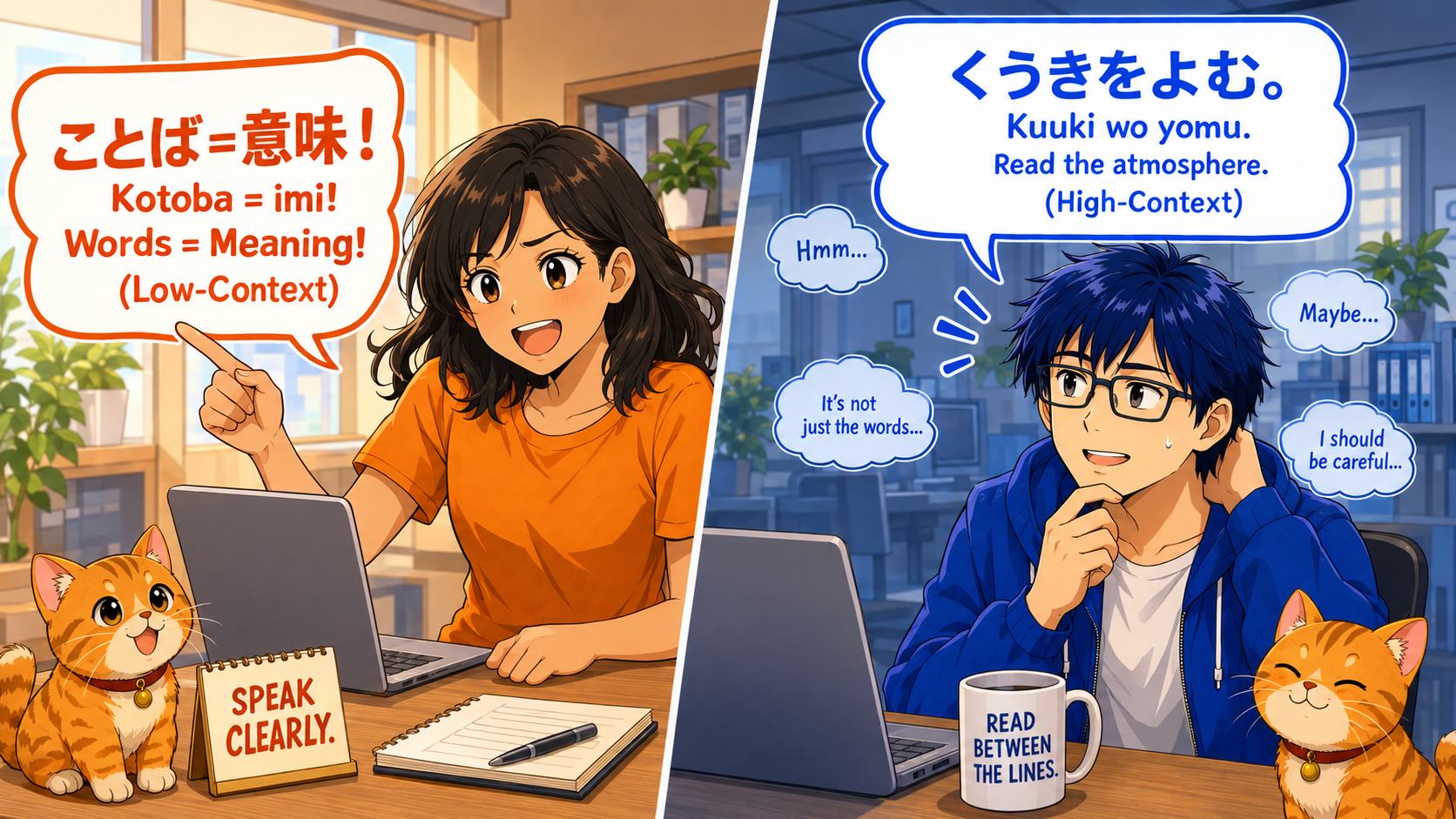
(Joy relying purely on spoken words [Low-Context] vs. Ken observing the atmosphere and unspoken cues [High-Context])
“Say exactly what you mean.” -> Low-Context Culture (English)
“Understand what is left unsaid.” -> High-Context Culture (Japanese)
Have you ever heard the phrase 空気を読む (Kuuki wo yomu – Reading the air)? If someone lacks this skill in Japan, they are called “KY” (Kuuki ga Yomenai). In English-speaking cultures, communication is like a written contract: if it isn’t spoken, it doesn’t exist. In Japan, communication is like a puzzle: the speaker gives you pieces, and you must put them together. Let’s see what happens when Joy tries to organize a teaching schedule with Director Tanaka.
🗣 Conversation Scene
Joy is coordinating the schedule for an upcoming three-hour instruction review and mock test session. She plans to co-conduct it with her colleague, Shannon-san.
(Director, for next week’s three-hour mock test, I am thinking Shannon-san and I will divide the instruction hours in half [50/50]!)
(Hmm… Shannon-san has a lot of student assessment evaluations to do during her regular shift hours this week…) [Trails off into silence]
(Oh, she is on her regular shift! That’s good. Then 50/50 is no problem!)
[ Tanaka gives a troubled smile. Ken pulls Joy aside. ]
(Joy! Read the air! The Director is implicitly saying, “Shannon-san is too busy, so Joy, please take on more of the hours”!)
💡 Explanation
Low-Context vs. High-Context Communication
In English (Low-Context), the speaker is 100% responsible for sending a clear message. In Japanese (High-Context), the listener is 50% responsible for decoding the unsaid message by reading the context.
1. The English Way (Low-Context) 🗣️
In a low-context culture, if you want Joy to take more hours, you say it directly: “Shannon is busy, so please take 2 hours and let her do 1 hour.” If you don’t say it clearly, the resulting mistake is the speaker’s fault. Words are treated as absolute facts.
2. The Japanese Way (High-Context / Kuuki wo Yomu) 🌫️
Japan is an island nation with a long history of shared culture. Because people share the same background, they don’t need to explain everything from zero. 空気を読む (Kuuki wo yomu) is not telepathy; it is the skill of picking up context clues.
- The Unfinished Sentence: When Tanaka said, “Shannon has a lot of evaluations…”, he left the end of the sentence blank. This blank space is where the listener is supposed to read the air and say, “Ah, should I take on more hours?”
- Protecting Harmony: Why doesn’t Tanaka just order Joy to do it? Because forcing a command creates friction. By letting Joy “realize” it herself, he preserves the illusion of harmony and teamwork.
📊 Cultural Communication Table
💎 How to tell if you missed the air
If you make a direct statement and your Japanese counterpart inhales sharply, tilts their head, says “Sou desu ne…” (Well…), and falls silent, you have missed the air. They are waiting for you to reconsider your statement.
🔥 Practice Quiz
Tap to check the answer!