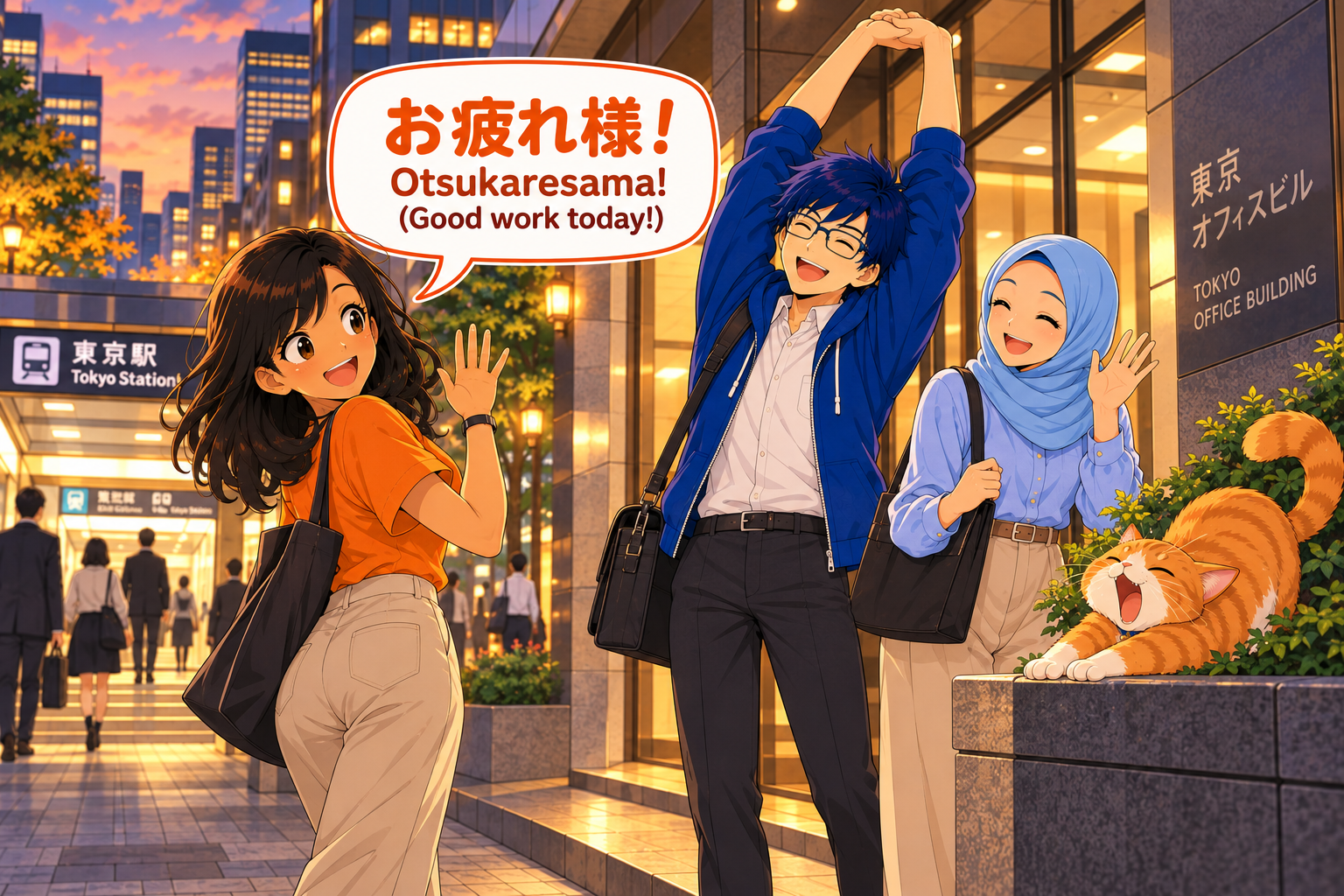
 (Joy waving goodbye to Ken and Raya outside the office saying “Otsukaresama!”, with Ken stretching and an orange cat yawning on a planter box)
Welcome to “Japanese You Keep Seeing”!
If you work in Japan or watch any Japanese office dramas, you will hear one phrase repeated dozens of times a day: お疲れ様 (Otsukaresama). There is absolutely no direct English equivalent for this word! It acts as a greeting, a farewell, and a compliment all at the same time. It is the social glue of Japanese society. Let’s decode this magical phrase so you can use it like a pro!
🗣 Conversation Scene
It is 6:00 PM. Joy, Ken, and Raya have just finished a massive project at the design studio. They step outside the building and prepare to head their separate ways for the evening.💡 Explanation: The “Honorable Tired Person”
To understand why this phrase is used so universally, we need to look at its literal translation and how deeply Japan values collective effort.1. What does it literally mean? 🥱
The root of this phrase is the verb 疲れる (Tsukareru), which means “To get tired.” When you add the polite prefix “O” and the respectful suffix “Sama,” it literally becomes: “Mr./Ms. Honorable Tired Person.” By calling someone this, you are politely acknowledging: “You worked so hard today that you must be tired, and I appreciate your effort!”2. Casual vs. Polite Form 👔
Just like most Japanese phrases, there is a strict rule on who gets the long version and who gets the short version: ✅ お疲れ様 (Otsukaresama): Casual. Use this with your close friends, peers, or people who report to you. ✅ お疲れ様でした (Otsukaresama deshita): Polite/Past Tense. Use this with your boss, older coworkers, clients, or when officially leaving the office for the day.3. When do you use it? 🕒
You can use it almost anytime during the workday! • When passing a coworker in the hallway (acts as “Hello”). • When someone finishes a presentation (acts as “Good job”). • At a drinking party (Nomikai) when doing a toast. • At the end of the day when leaving the office (acts as “Goodbye”).💎 Pro Tip: The “Gokurousama” Trap
You might hear older people say 「ご苦労様」 (Gokurousama). This also means “Thanks for your hard work,” but there is a massive cultural trap here! Gokurousama can ONLY be said by a boss/superior down to a subordinate. If you say “Gokurousama” to your boss, it is highly offensive! When in doubt, ALWAYS use Otsukaresama deshita to be perfectly polite to everyone.
🔥 Practice Quiz
Ready to master the Ko-So-A-Do system?
Want to dive deeper? Check out our official Beginner’s Grammar Book for more examples, detailed explanations, and practice exercises to perfect your Japanese pointing skills!
📖 Read more in the Grammar Book: これ/それ/あれ/どれ