Skip to content
JPLT Online Japanese Language Training SchoolJPLT Online Japanese Language Training School
  • Courses
  • Plans
  • Get Started
    • What is JPLT Metaverse Campus
    • How to Enroll
  • JPLT LEARNING GYM
    • What is JPLT LEARNING GYM?
    • BootCamp
    • Studio
    • Season
    • Grammar Book
    • Optional Classes and EOD
  • Schedule
  • Blog
  • About Us
    • What Is Dialog+ JPLT
    • Teachers
    • Company Profile
    • Contact Us
    • FAQs
  • Login
  • For Business
JPLT Online Japanese Language Training SchoolJPLT Online Japanese Language Training School
  • Courses
  • Plans
  • Get Started
    • What is JPLT Metaverse Campus
    • How to Enroll
  • JPLT LEARNING GYM
    • What is JPLT LEARNING GYM?
    • BootCamp
    • Studio
    • Season
    • Grammar Book
    • Optional Classes and EOD
  • Schedule
  • Blog
  • About Us
    • What Is Dialog+ JPLT
    • Teachers
    • Company Profile
    • Contact Us
    • FAQs
  • Login
  • For Business
JPLT Blog

Japanese You Keep Seeing: 商品に書いてある「人気」って何 |Japanese Grammar (N5–N3)

  • 22 Sep, 2026
  • Com 0
 
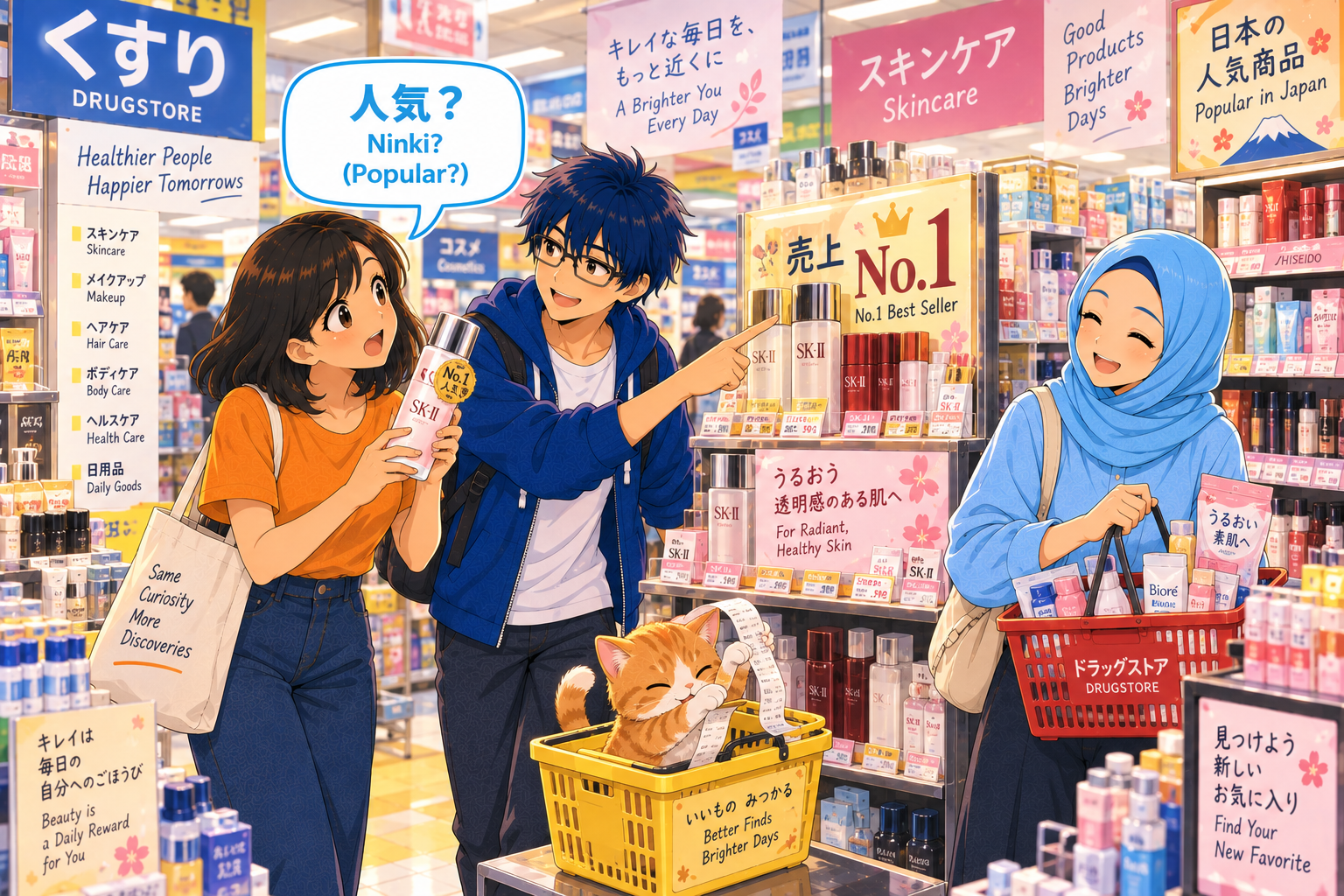
商品に書いてある「人気」って何 ( Joy holding a skincare bottle asking “Ninki?” in a brightly lit Japanese drugstore, while Ken points at a sign and an orange cat plays with a receipt)

Welcome to “Japanese You Keep Seeing”!

If you walk into any Japanese drugstore, supermarket, or souvenir shop, you will see a specific kanji word plastered on bright, shiny stickers everywhere: 人気 (Ninki). Often followed by “No. 1,” this word is the ultimate driving force of Japanese retail marketing. But what exactly does it mean, and how is it different from just being “famous”? Let’s go shopping and find out!

🗣 Conversation Scene

Joy, Ken, and Raya are shopping at a bustling Tokyo drugstore. Joy is looking for a good moisturizer, but the sheer number of options on the shelves is completely overwhelming.
Joy
Line 1: 人気? Line 2: Ninki? Line 3: (Popular?)
Kenさん、このシールに「人気ナンバーワン」って書いてあります。(Ken-san, this sticker says “Ninki Number One”.)
Ken
あ、それは一番よく売れているという意味ですよ。みんなが買っているんです。(Ah, that means it is selling the best. Everyone is buying it.)
Raya
If it’s Ninki No. 1, I’m definitely going to buy one too!

💡 Explanation: The Power of Popularity

In a society that values consensus and group harmony, Japanese consumers often feel most comfortable buying what everyone else is buying. That is why highlighting the “Ninki” (Popularity) of an item is the best way to sell it.

1. The Literal Translation 👥

The word 人気 (Ninki) is made of two kanji: 人 (Hito/Nin) meaning “Person,” and 気 (Ki) meaning “Spirit/Energy/Feeling.” Literally, it means the feelings or interest of the people are gathered around this item. It translates directly to “Popular.”

2. “Ninki No. 1” (人気ナンバーワン) 🥇

You will see this everywhere: on restaurant menus, cosmetic bottles, and snack displays. 人気No.1 (Ninki Nanbaa Wan) simply means it is the most popular, best-selling item in that category. If you ever feel lost in a Japanese store, just grab the item with the shiny “No. 1” crown sticker. You can’t go wrong!

3. Leveling Up: Dai-Ninki (大人気) 🚀

If something is not just popular, but a massive, sold-out trend, Japanese people add the character for “Big” (大 – Dai) to the front. 大人気 (Dai-ninki) means “Super popular” or “A massive hit.” Example: “Kono anime wa dai-ninki desu!” (This anime is super popular!)

💎 Pro Tip: Ninki vs. Yuumei

Do not confuse 人気 (Ninki – Popular) with 有名 (Yuumei – Famous). A terrible movie might be Yuumei (Famous) because everyone knows about how bad it is. But it is definitely not Ninki (Popular), because nobody actually likes it!

🔥 Practice Quiz

Q1. You see a gold sticker on a bottle of shampoo that says “人気 No. 1”. What does it mean? A. It is the most expensive shampoo. B. It is the most popular/best-selling shampoo.
Answer: B “Ninki No. 1” guarantees that it is the item most loved and purchased by other customers.
Q2. A restaurant has bad food, but everyone in town knows its name. Is the restaurant “Ninki” (Popular) or “Yuumei” (Famous)? A. Ninki B. Yuumei
Answer: B (Yuumei) It is famous (Yuumei) because people know it, but it is not popular (Ninki) because people don’t actually like eating there!
Q3. You want to tell your friend that a new video game is a MASSIVE hit in Japan right now. What word do you use? A. Dai-ninki B. Osusume
Answer: A (Dai-ninki) Adding “Dai” (Big) to “Ninki” turns it into “Super popular” or a massive hit.

Ready to master the Ko-So-A-Do system?

Want to dive deeper? Check out our official Beginner’s Grammar Book for more examples, detailed explanations, and practice exercises to perfect your Japanese pointing skills!

📖 Read more in the Grammar Book: これ/それ/あれ/どれ


    JPLT Online School

    Learn Japanese with JPLT Online School


    Want to study Japanese in a more guided and beginner-friendly way?
    Feel free to contact us and we’ll help you find the right course for your level and goal.


    We’re happy to help you start your Japanese learning journey with confidence.

    Related posts:

    Challenges of Learning Japanese: 10 Solutions & Key Points Understanding Gakusei ja nai~n desu and Gakusei ja nai desu Tanoshimi vs Tanoshisa: Understanding their Differences The Difference Between 沈黙の意味が違う?日本語と英語の会話文化の違い |Japanese Grammar (N5–N3)
    Share on:
    【よく目にする日本語】お店で見る「おすすめ」ってどういう意味? [日本語学習]
    【よく目にする日本語】商品に書いてある「人気」って何? [日本語学習]
    JPLT Malaysia

    Japanese Learning Resources:

    Tips for Learning Japanese Learn Japanese with Mastery Tips Japanese Grammar Book Japanese Learning Hacks Japanese Learning FAQ (日本語) Japanese Learning FAQ (English)

    Connect with us!

    Inquire Now!
    Send us a message to know the latest class schedules. Lessons are conducted in English and Taglish (Tagalog-English).
    Please enable JavaScript in your browser to complete this form.
    Name *
    Loading

    Latest Post

    Thumb
    【よく目にする日本語】「限定」を見つけたら何が特別? [日本語学習]
    22 Sep, 2026
    Thumb
    Japanese You Keep Seeing: 「限定」を見つけたら何が特別? |Japanese Grammar
    22 Sep, 2026
    Thumb
    【よく目にする日本語】商品に書いてある「人気」って何? [日本語学習]
    22 Sep, 2026

    Categories

    • Courses (13)
    • Grammar Book (169)
    • JAPANESE LEARNING FAQ (23)
    • Japanese Learning Hacks (9)
    • Japanese Learning TIPS (226)
    • JPLT Blog (306)
    • JPLT NEWS (12)
    • List of media productions (5)
    • にほんごをまなぶTips (224)
    • 日本語学習ハック (9)
    JPLT_logo (2)

    JPLT (Japanese language training) online school by Dialogplus 

    Icon-facebook Icon-instagram Youtube

    株式会社ダイアログプラス(Dialog+ Co., Ltd.) 
    神奈川県横浜市都筑区南山田二丁目1番1-206号 
    Address: 2-1-1-206 Minamiyamada, Tsuzuki-ku, Yokohama Japan 
    Website: https://www.dialogplus.co.jp/ 

    Dialog+ Philippines
    Philippine Address: Unit 7 2/F, Seung Lee Building, Lot 1 Greenwoods Park Rizal Highway, CBD Area, Subic Bay Freeport Zone, Philippines
    Website: https://dialogplus.ph/
    Email: info@jplt-dialogplus.com

    • Specified Commercial Transaction Law
    • Privacy Policy
    • Terms & Condition
    • Refund Policy
    • JPLT Calendar
    • Admin
    JPLT Online Japanese Language Training SchoolJPLT Online Japanese Language Training School