Skip to content
JPLT Online Japanese Language Training SchoolJPLT Online Japanese Language Training School
  • Courses
  • Plans
  • Get Started
    • What is JPLT Metaverse Campus
    • How to Enroll
  • JPLT LEARNING GYM
    • What is JPLT LEARNING GYM?
    • BootCamp
    • Studio
    • Season
    • Grammar Book
    • Optional Classes and EOD
  • Schedule
  • Blog
  • About Us
    • What Is Dialog+ JPLT
    • Teachers
    • Company Profile
    • Contact Us
    • FAQs
  • Login
  • For Business
JPLT Blog

Japanese You Keep Seeing: 「乗り換え」という日本語を駅でよく見る理由|Japanese Grammar (N5–N3)

  • 25 Oct, 2026
  • Com 0
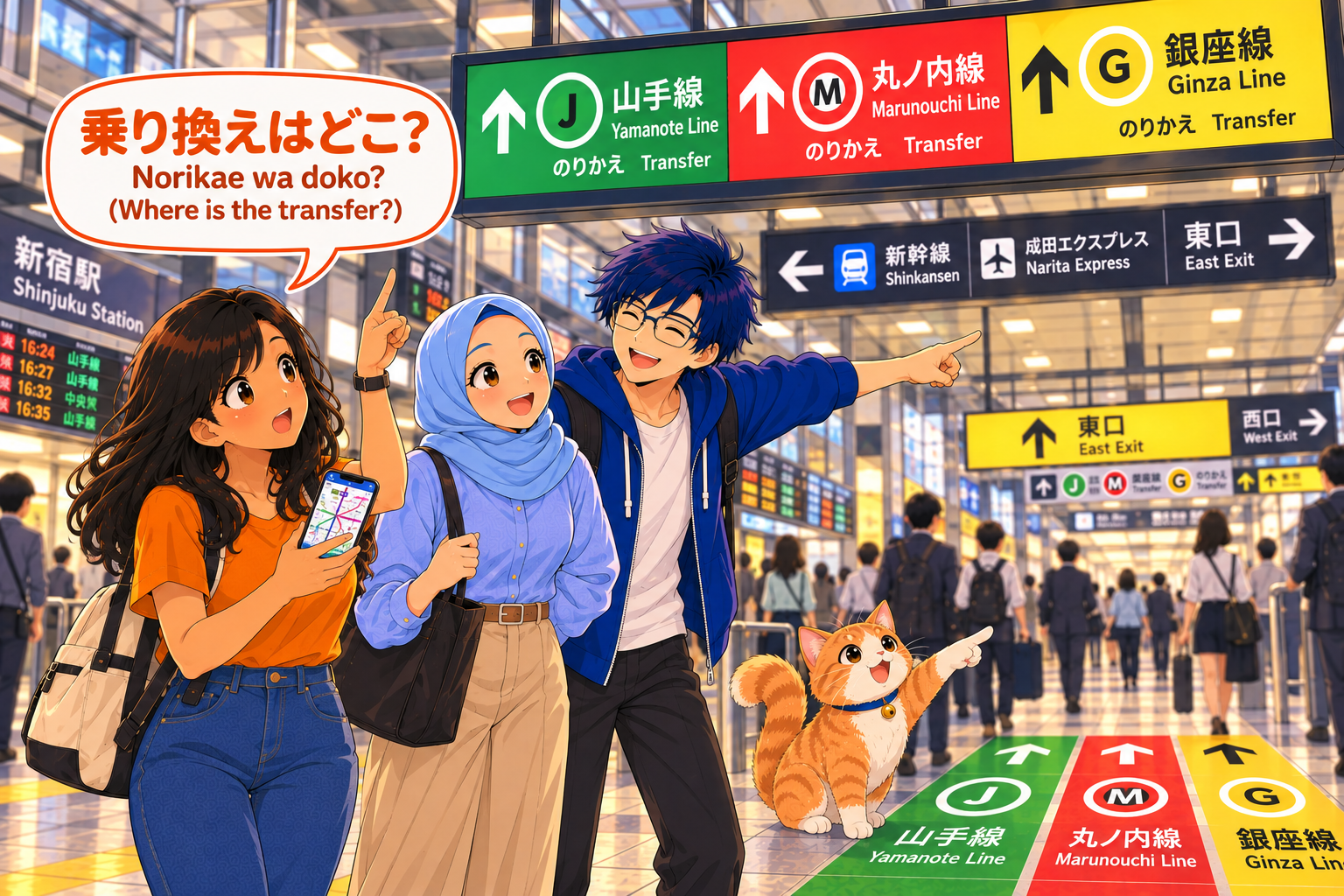
Tokyo Station Transfer Adventure (Joy pointing at a colorful overhead train sign asking “Norikae wa doko?”, with Ken pointing the way, Raya smiling, and an orange cat acting as a floor guide)

Welcome to “Japanese You Keep Seeing”!

You have mastered finding the Entrance (Iriguchi) and Exit (Deguchi). You know how to listen for the Next Stop (Tsugi wa). But in a mega-city like Tokyo or Osaka, you rarely take just one train to reach your destination. You will have to switch trains, which means you will see the word 乗り換え (Norikae) painted on walls, floors, and signs everywhere! Let’s decode the ultimate transit survival word.

🗣 Conversation Scene

Joy, Ken, and Raya are at Tokyo Station. They just got off a subway line and need to switch to the JR Yamanote Line. Joy is looking at the colorful signs above her head.
Joy
Line 1: 乗り換えはどこ? Line 2: Norikae wa doko? Line 3: (Where is the transfer?)
看板がたくさんありますね。山手線の乗り換えはどこですか? (There are so many signs. Where is the transfer for the Yamanote Line?)
Ken
黄緑色のマークを探してください。あっちです! (Look for the light green mark. It’s that way!)
Raya
In Japanese stations, colors are your best friend when looking for a transfer!

💡 Explanation: The Art of Switching Trains

Japan’s railway network is famously complex because it is operated by dozens of different private and public companies. To navigate it, you must understand how to “change your ride.”

1. What does it literally mean? 🔄

The word 乗り換え (Norikae) is made of two separate verbs: ✅ 乗る (Noru): To ride / to board a vehicle. ✅ 換える (Kaeru): To change / to exchange. Put them together, and it literally translates to “Change your ride.” This is the universal Japanese word for a transit transfer.

2. The Rainbow of Lines 🌈

When you need a Norikae, you shouldn’t just read the text—you should follow the colors! Every single train line in Tokyo has an assigned color. For example, if you need the Ginza Line, you just follow the bright Orange circles that say 乗り換え (Norikae). If you need the Yamanote Line, you follow the Light Green signs. You don’t even need to read Japanese to transfer successfully!

3. The “Transfer Gate” Trap 🎟️

Here is the tricky part: because there are different companies (like JR and Tokyo Metro), sometimes a Norikae requires you to exit one company’s ticket gate and enter another’s. Look for special gates labeled のりかえ改札口 (Norikae kaisatsu-guchi – Transfer Gate). If you tap your IC card (like Suica or Pasmo) here, it seamlessly checks you out of the first train company and into the next one without forcing you to walk outside!

💎 Pro Tip: Look Down!

If you get lost in a massive station like Shinjuku or Tokyo, don’t just look up at the ceiling. Look at the floor! Major stations often have thick, color-coded lines painted directly on the floor. If you need a specific transfer, just step on the matching colored line and follow it like a path!

🔥 Practice Quiz

Q1. What is the literal translation of “Norikae”? A. Change your ride. B. The exit door.
Answer: A (Change your ride) It combines “Noru” (ride) and “Kaeru” (change), meaning a transit transfer!
Q2. You want to transfer to a different train line, but you can’t read the kanji on the signs. What is the best way to find your “Norikae”? A. Follow the specific color assigned to your next train line. B. Always follow the yellow signs.
Answer: A Every train line has a specific color (like Green for Yamanote). Following that color is the easiest way to transfer. (Yellow is specifically for Exits/Deguchi!)
Q3. You see a gate labeled “Norikae kaisatsu-guchi”. What is this used for? A. It is a gate to exit the station and go outside. B. It is a special transfer gate to switch between different train companies without going outside.
Answer: B Transfer gates allow you to tap your IC card and smoothly move from one company’s network into another.

Ready to master the Ko-So-A-Do system?

Want to dive deeper? Check out our official Beginner’s Grammar Book for more examples, detailed explanations, and practice exercises to perfect your Japanese pointing skills!

📖 Read more in the Grammar Book: これ/それ/あれ/どれ


    JPLT Online School

    Learn Japanese with JPLT Online School


    Want to study Japanese in a more guided and beginner-friendly way?
    Feel free to contact us and we’ll help you find the right course for your level and goal.


    We’re happy to help you start your Japanese learning journey with confidence.

    Related posts:

    Challenges of Learning Japanese: 10 Solutions & Key Points Understanding Gakusei ja nai~n desu and Gakusei ja nai desu Tanoshimi vs Tanoshisa: Understanding their Differences The Difference Between 沈黙の意味が違う?日本語と英語の会話文化の違い |Japanese Grammar (N5–N3)
    Share on:
    【よく目にする日本語】電車で見る「次は〜」が分かると何が便利?[日本語学習]
    【よく目にする日本語】「乗り換え」という日本語を駅でよく見る理由 [日本語学習]
    JPLT Malaysia

    Japanese Learning Resources:

    Tips for Learning Japanese Learn Japanese with Mastery Tips Japanese Grammar Book Japanese Learning Hacks Japanese Learning FAQ (日本語) Japanese Learning FAQ (English)

    Connect with us!

    Inquire Now!
    Send us a message to know the latest class schedules. Lessons are conducted in English and Taglish (Tagalog-English).
    Please enable JavaScript in your browser to complete this form.
    Name *
    Loading

    Latest Post

    Thumb
    【よく目にする日本語】ホテルで聞く「チェックインはこちらです」はどこへ行けばいい? [日本語学習]
    25 Oct, 2026
    Thumb
    Japanese You Keep Seeing: ホテルで聞く「チェックインはこちらです」はどこへ行けばいい?|Japanese Grammar (N5–N3)
    25 Oct, 2026
    Thumb
    【よく目にする日本語】「乗り換え」という日本語を駅でよく見る理由 [日本語学習]
    25 Oct, 2026

    Categories

    • Courses (13)
    • Grammar Book (169)
    • JAPANESE LEARNING FAQ (23)
    • Japanese Learning Hacks (9)
    • Japanese Learning TIPS (252)
    • JPLT Blog (358)
    • JPLT NEWS (12)
    • List of media productions (5)
    • にほんごをまなぶTips (250)
    • 日本語学習ハック (9)

    Archives

    • October 2026
    • September 2026
    • August 2026
    • July 2026
    • June 2026
    • May 2026
    • April 2026
    • March 2026
    • February 2026
    • January 2026
    • December 2025
    • November 2025
    • October 2025
    • July 2025
    • March 2025
    • January 2025
    • December 2024
    • November 2024
    • October 2024
    • September 2024
    • August 2024
    • July 2024
    • June 2024
    • May 2024
    • April 2024

    Categories

    • Courses
    • Grammar Book
    • JAPANESE LEARNING FAQ
    • Japanese Learning Hacks
    • Japanese Learning TIPS
    • JPLT Blog
    • JPLT NEWS
    • List of media productions
    • にほんごをまなぶTips
    • 日本語学習ハック
    JPLT_logo (2)

    JPLT (Japanese language training) online school by Dialogplus 

    Icon-facebook Icon-instagram Youtube

    株式会社ダイアログプラス(Dialog+ Co., Ltd.) 
    神奈川県横浜市都筑区南山田二丁目1番1-206号 
    Address: 2-1-1-206 Minamiyamada, Tsuzuki-ku, Yokohama Japan 
    Website: https://www.dialogplus.co.jp/ 

    Dialog+ Philippines
    Philippine Address: Unit 7 2/F, Seung Lee Building, Lot 1 Greenwoods Park Rizal Highway, CBD Area, Subic Bay Freeport Zone, Philippines
    Website: https://dialogplus.ph/
    Email: info@jplt-dialogplus.com

    • Specified Commercial Transaction Law
    • Privacy Policy
    • Terms & Condition
    • Refund Policy
    • JPLT Calendar
    • Admin
    JPLT Online Japanese Language Training SchoolJPLT Online Japanese Language Training School