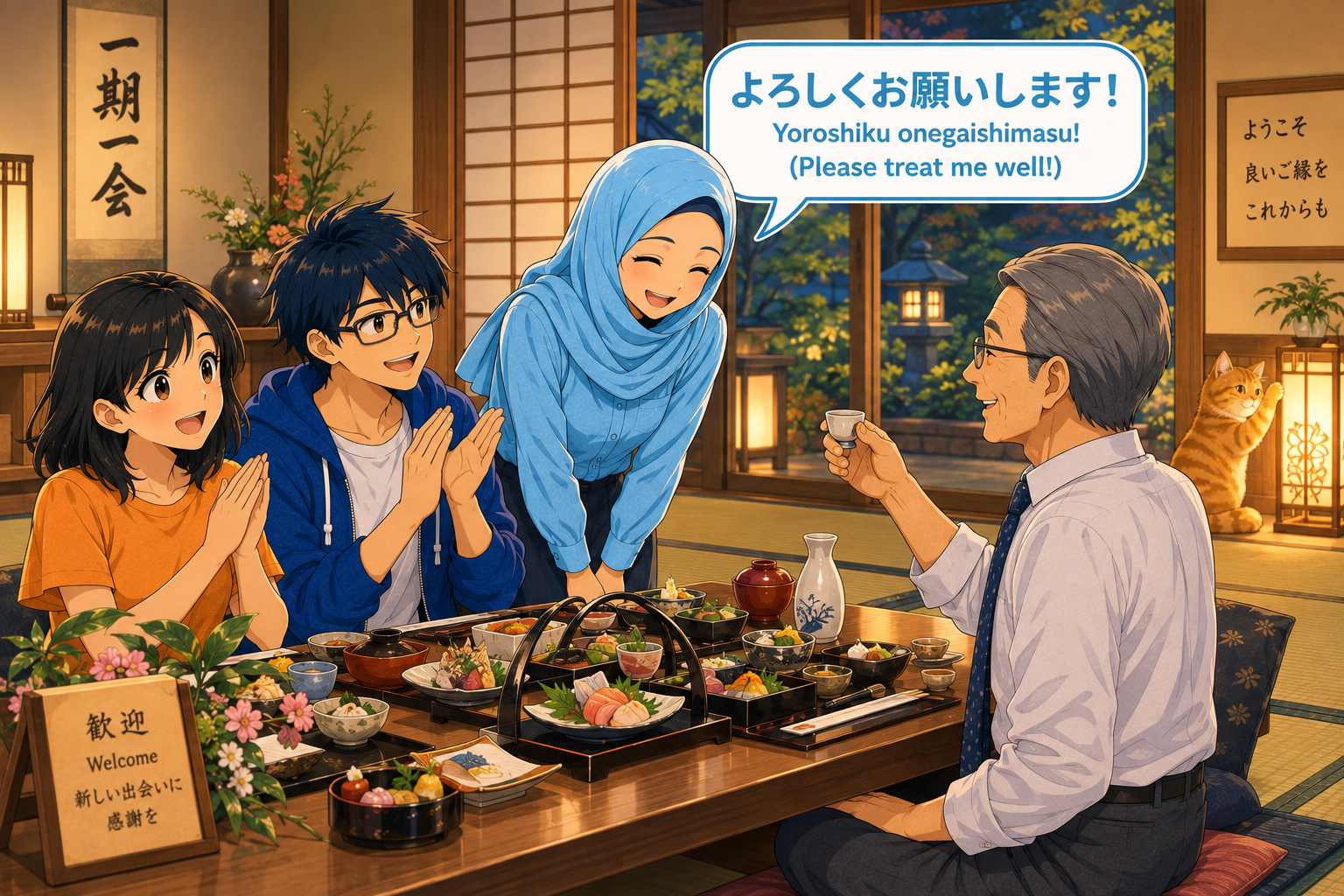
 (Raya standing up and bowing at a traditional welcome dinner, saying “Yoroshiku onegaishimasu” to Director Tanaka. An orange cat plays with a lantern nearby.)
Welcome to “Japanese You Keep Seeing”!
In our previous lessons, we learned that a Japanese self-introduction is like a sandwich. It starts with “Hajimemashite”, has your name in the middle, and always ends with one very long, very important phrase: よろしくお願いします (Yoroshiku onegaishimasu). If you translate it literally, it sounds very strange in English. Let’s decode the magic behind this essential Japanese phrase!
🗣 Conversation Scene
Joy, Ken, and Director Tanaka are hosting an official welcome dinner for Raya at a traditional Japanese restaurant (Ryotei). Before the official toast (Kanpai), Raya stands up to give her self-introduction to the team.💡 Explanation: The Social Contract
There is no perfect English translation for “Yoroshiku onegaishimasu” because it represents a uniquely Japanese cultural concept: relying on others to maintain harmony.1. What does it literally mean? 🔍
The phrase is made of two parts: よろしく (Yoroshiku) meaning “well” or “suitably,” and お願いします (Onegaishimasu) meaning “I make a request.” Literally, you are saying “Please do things well for me.” In English, this sounds bossy! But in Japanese, it is incredibly humble. You are saying, “I am trusting you to treat me kindly and guide me.”2. Why say it at the end of an introduction? 🤝
When you finish your self-introduction with this phrase, it means: “I look forward to our future relationship, please take care of me.” It is the verbal equivalent of a handshake. It acknowledges that from this point forward, you are part of the same group and will rely on each other.3. The Ultimate Multi-Tool Phrase 🛠️
“Yoroshiku onegaishimasu” isn’t just for meeting people! You will hear it constantly in these situations:- Before a meeting or project starts: “Let’s work hard together.”
- At the end of an email: “Thank you in advance.” (It is the standard sign-off for almost all Japanese business emails).
- When asking for a favor: “I leave it in your capable hands.”
💎 Pro Tip: “Kochira koso”
If someone says “Yoroshiku onegaishimasu” to you, how do you reply? You simply say it right back! To sound super fluent, add こちらこそ (Kochira koso) to the front. It means “The pleasure is mine” or “Likewise!”
🔥 Practice Quiz
Ready to master the Ko-So-A-Do system?
Want to dive deeper? Check out our official Beginner’s Grammar Book for more examples, detailed explanations, and practice exercises to perfect your Japanese pointing skills!
📖 Read more in the Grammar Book: これ/それ/あれ/どれ