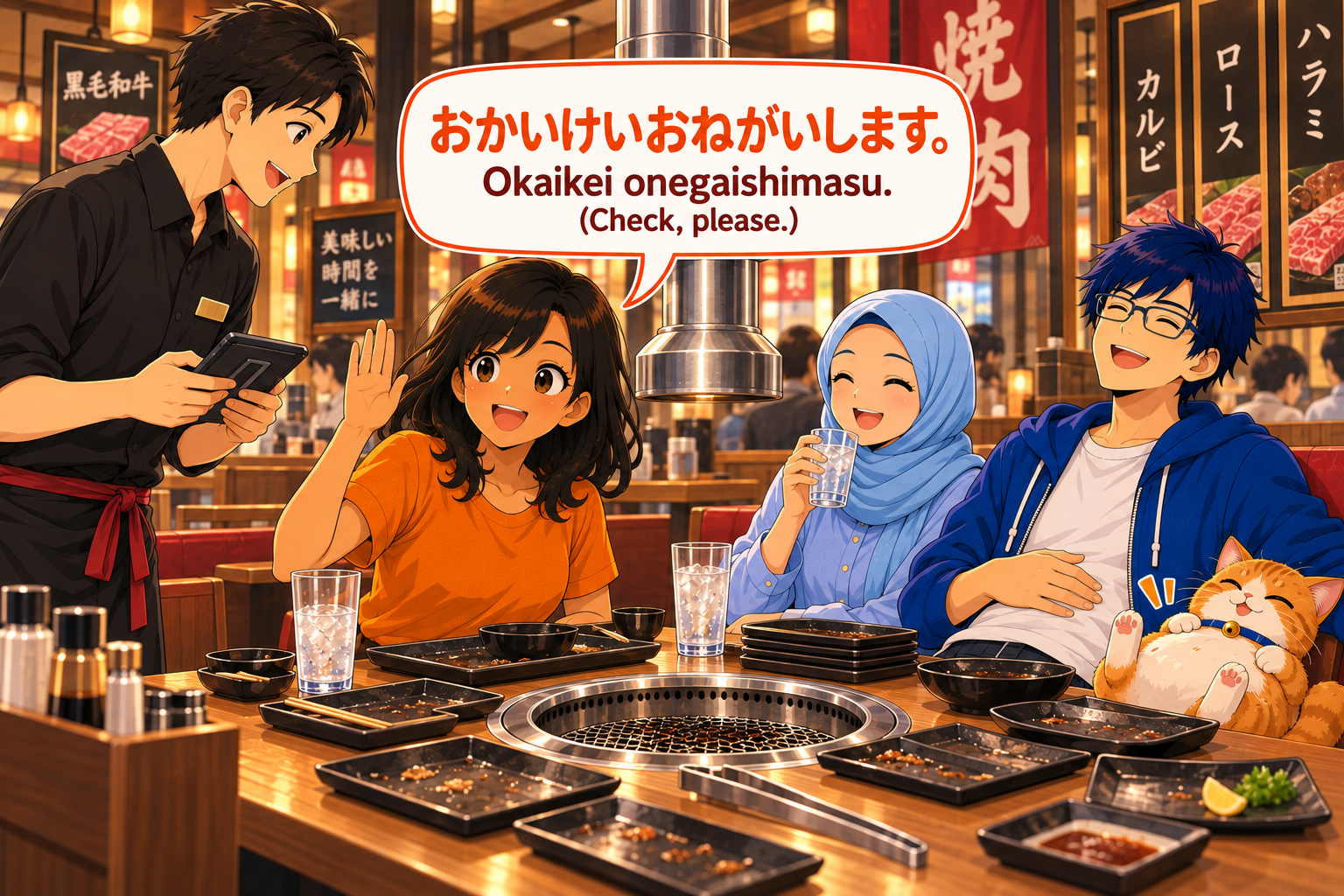
 (Joy raising her hand to ask the waiter “Okaikei onegaishimasu” at a Yakiniku restaurant, with Ken and Raya looking full, and an orange cat patting its round belly)
Welcome to “Japanese You Keep Seeing”!
The food was delicious, and you have officially said your Gochisousama. Now comes the final hurdle: paying the bill! In many Western countries, you wait for the server to bring the check to your table. In Japan, however, the payment system can change depending on the type of restaurant you are in. When exactly are you supposed to say お会計お願いします (Okaikei onegaishimasu)? Let’s figure out the rules of the Japanese register!
🗣 Conversation Scene
Joy, Ken, and Raya have just finished a massive, delicious meal at a local Yakiniku (Japanese BBQ) restaurant. The grill is turned off, and they are ready to head back to the hotel.💡 Explanation: The Register vs. The Table
The phrase お会計 (O-kaikei) means “The bill,” “The check,” or “The payment.” Adding お願いします (Onegaishimasu) turns it into a polite request. But *when* you say it depends entirely on what is sitting on your table.1. Scenario A: You already have the bill 🧾
In about 90% of Japanese family restaurants, cafes, and diners, the server will leave a small clipboard or a wooden number block on your table when they deliver your food. What to do: You do NOT need to say “Okaikei onegaishimasu.” When you are ready to leave, simply pick up the clipboard and walk directly to the cash register (レジ – Reji) at the front of the store.2. Scenario B: You do NOT have the bill 🙋♀️
At Yakiniku restaurants, Izakayas, and high-end dining establishments, there is no bill on your table because you have been ordering multiple rounds of food and drinks. What to do: This is when you MUST call the waiter over and say: 「お会計お願いします」 (Okaikei onegaishimasu). The waiter will then calculate your total and hand you a slip of paper. You take that paper to the register to pay.3. The Non-Verbal Request: The “Batsu” Sign ❌
If you are in a loud, busy Izakaya and the waiter is far away, you can catch their eye and cross your two index fingers together to form an “X” shape. This is the universal Japanese restaurant sign language for “Check, please.” The waiter will nod and immediately bring your bill!💎 Pro Tip: Table Charge (Otoushi)
When you receive your bill at an Izakaya, you might notice a small fee of 300 to 500 yen per person that you didn’t order. This is called the お通し (Otoushi). It is a mandatory seating charge/appetizer fee. It is perfectly normal and happens to everyone, so don’t be alarmed when you see it on your Okaikei!
🔥 Practice Quiz
Ready to master the Ko-So-A-Do system?
Want to dive deeper? Check out our official Beginner’s Grammar Book for more examples, detailed explanations, and practice exercises to perfect your Japanese pointing skills!
📖 Read more in the Grammar Book: これ/それ/あれ/どれ