

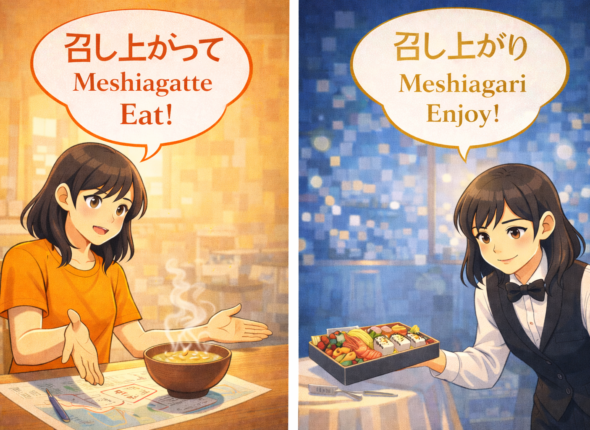
The Difference Between “召し上がりください (meshiagarikudasai)” and “召し上がってください (meshiagatte kudasai)”
(Joy urging to eat hot food [Meshiagatte] vs. Joy presenting a meal elegantly [Meshiagari]) “Please eat.” 召し上がって ください。 (Meshiagatte kudasai) (お) 召し上がり ください。 ((O) Meshiagari kudasai) Both are polite Honorifics (Sonkeigo). But...
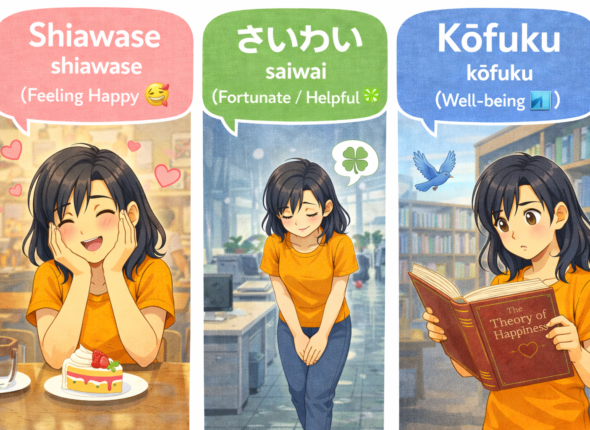
The Difference Between “幸せ” (Shiawase), “幸い” (Saiwai), and “幸福” (Kōfuku)
(Emotional Joy [Shiawase], Formal/Lucky Joy [Saiwai], Philosophical Joy [Kōfuku]) “I feel happy.” (Shiawase) “It would be appreciated.” (Saiwai) “The pursuit of happiness.” (Kōfuku) Japanese has multiple words for happiness. 幸せ (Shiawase) is...
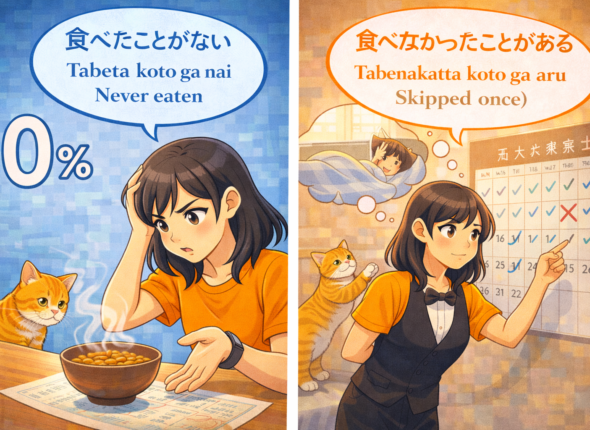
The Difference Between “食べたことがない” (Tabeta koto ga nai) and “食べなかったことがある” (Tabenakatta koto ga aru)
(Joy with zero experience [Tabeta koto nai] vs. Joy remembering one skipped meal [Tabenakatta koto aru]) “I have never eaten breakfast.” (Lifestyle) “There was a time I didn’t eat breakfast.” (Exception) These...
The Difference Between “食べてはいけません” (Tabete wa ikemasen) and “食べないでください” (Tabenai de kudasai)
(Joy breaking a rule [Ikemasen] vs. Joy taking Ken’s food [Naide kudasai]) “You must not eat here.” (Rule) “Please don’t eat this.” (Request) Both mean “Don’t eat,” but the vibe is completely...
Understanding the Meaning of “お伺いしておりますか” (Oukagai shiteimasu ka)
Understanding the Meaning of “お伺いしておりますか” (Oukagai shiteimasu ka) Have you ever heard the phrase “お伺いしておりますか” (Oukagai shiteimasu ka) and wondered what it really means? Maybe you’ve encountered it in business contexts but...
Explore Japan’s Long History! A Beginner’s Guide to History
Explore Japan’s Long History! A Beginner’s Guide to History “Japanese history seems difficult” or “Where should I start studying?” Have you ever thought about that? History is not just about memorizing past...
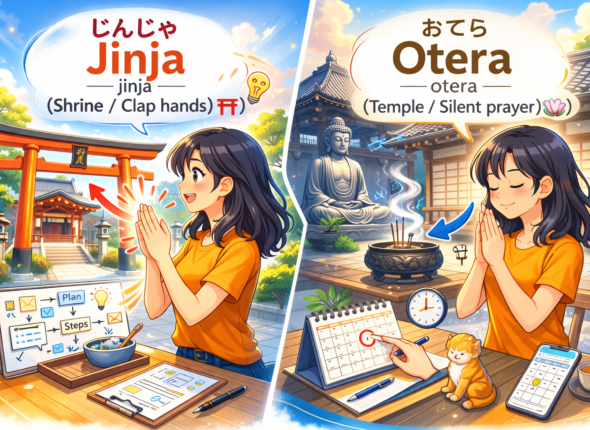
Let’s Learn the Difference Between Shrines and Temples in Japan!
In Japan, shrines (jinja) are primarily Shinto places of worship, characterized by rituals and offerings to kami, while temples (otera) are Buddhist sites focused on meditation and spiritual practice. Understanding these distinctions...
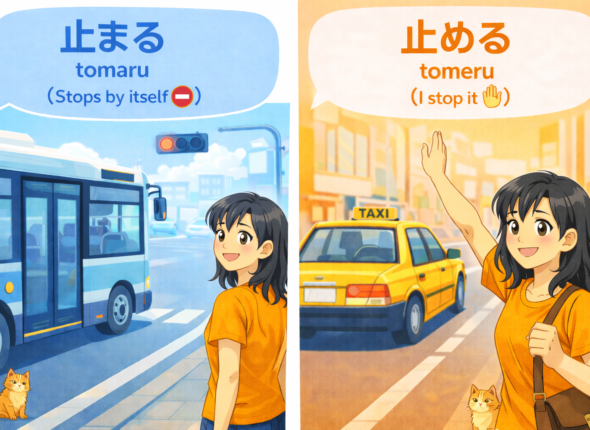
Clarifying “止まる” (Tomaru) vs. “止める” (Tomeru): Key Differences
(Bus stopping [Tomaru] vs. Joy stopping a taxi [Tomeru]) “The car stops.” (Kuruma ga tomaru) “I stop the car.” (Kuruma o tomeru) In Japanese, we distinguish between things happening naturally (Intransitive) and...
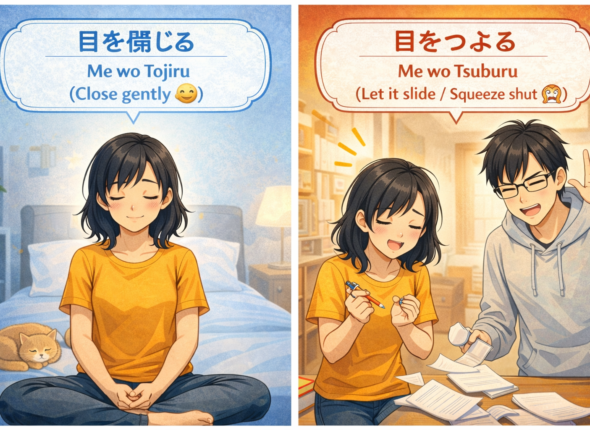
Eyes Closed: Me wo Tsuburu vs Me wo Tojiru Differences
(Joy closing her eyes peacefully [Tojiru] vs. Ken squeezing his eyes shut to ignore a mistake [Tsuburu]) “I closed my eyes to sleep.” (Me wo tojiru) “I turned a blind eye to...
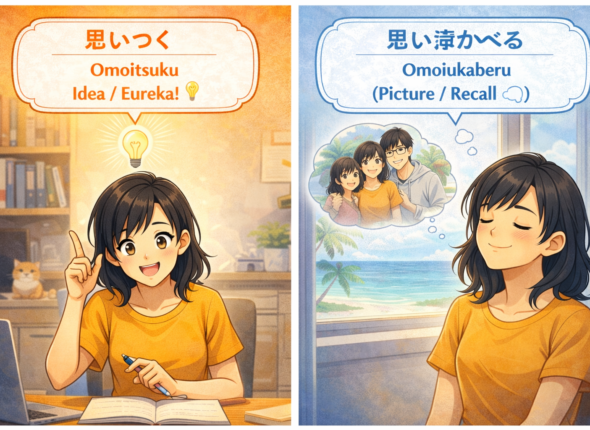
Clarifying ‘思いつく’ (Omoitsuku) and ‘思い浮かべる’ (Omoikaberu): What’s the Difference?
(Joy having a lightbulb moment [Omoitsuku] vs. Joy picturing a memory in a thought bubble [Omoiukaberu]) “I came up with a plan.” (Omoitsuku) “I pictured her face.” (Omoiukaberu) In Japanese, the verbs...
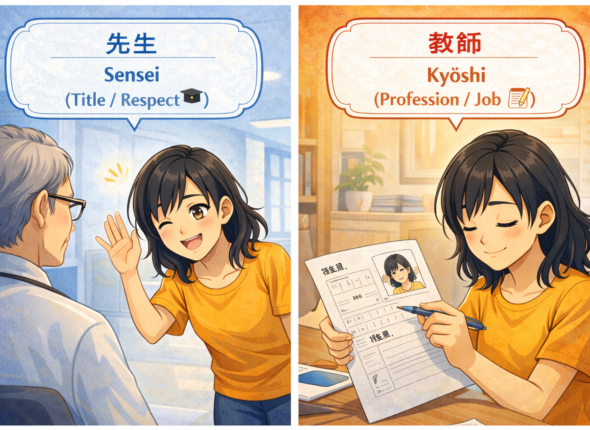
教師 (Kyoshi) vs. 先生 (Sensei): A Deep Dive Into What Sets Them Apart
(Joy bowing to a doctor [Sensei] vs. Joy writing her occupation on a resume [Kyoushi]) “Good morning, Tanaka-sensei!” “My occupation is Kyoushi.” If you look up “Teacher” in a dictionary, you will...
Unpacking “通りすがり” (Toorisugari): What Does “Sugari” Mean?
Exploring the Meaning of “通りすがり” (Toorisugari): What Does “Sugari” Mean? When you first encounter the term “通りすがり” (toorisugari), you might wonder about the meaning of “すがり” (sugari). This term seems unique and...
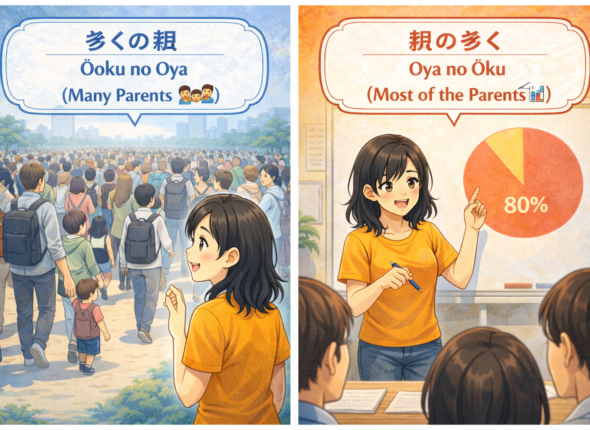
Ooku no Oya vs Oya no Ooku: Understanding Their Nuances
(Joy looking at a crowd [Ooku no Oya] vs. Joy pointing to a pie chart [Oya no Ooku]) “Many parents read books.” (Ooku no oya) “Most of the parents read books.” (Oya...
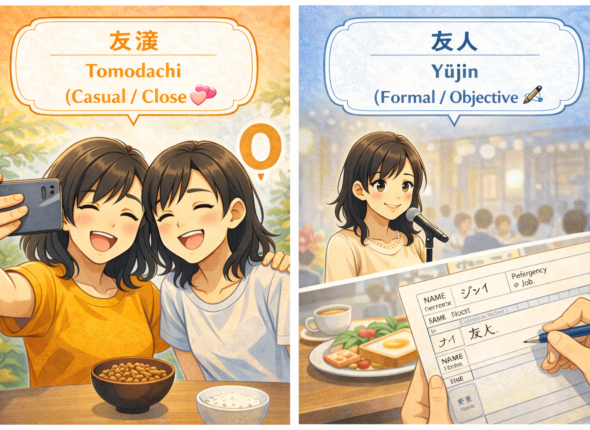
Tomodachi vs. Yuujin: Choosing the Right Word for ‘Friend’
(Joy taking a selfie with a friend [Tomodachi] vs. Joy giving a formal speech [Yuujin]) “I’m hanging out with my friend.” (Tomodachi) “As a representative of her friends…” (Yuujin) In English, a...
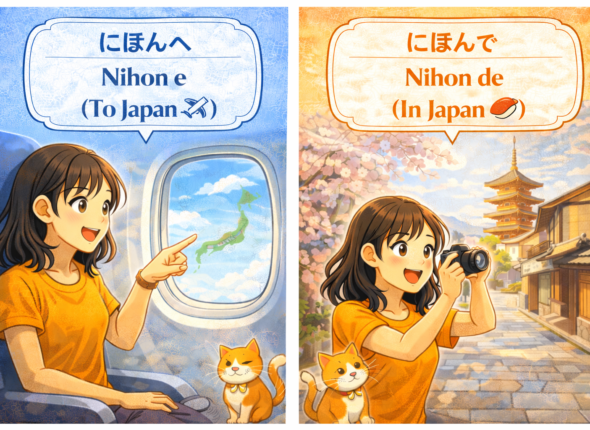
“Nihon de” vs. “Nihon e”: Travel Contexts in Japanese Explained
(Joy flying in an airplane [Nihon e] vs. Joy eating sushi in Kyoto [Nihon de]) “I want to go to Japan.” (Nihon e) “I want to eat sushi in Japan.” (Nihon de)...
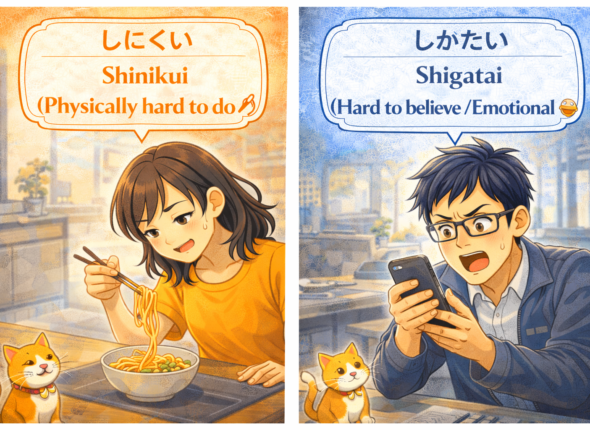
Shinikui vs Shigatai: Understanding Their Subtle Differences
(Joy struggling to use chopsticks [~nikui] vs. Ken looking shocked at unbelievable news [~gatai]) “These chopsticks are hard to use.” (Tsukai-nikui) “His excuse is hard to believe.” (Shinji-gatai) In English, we just...
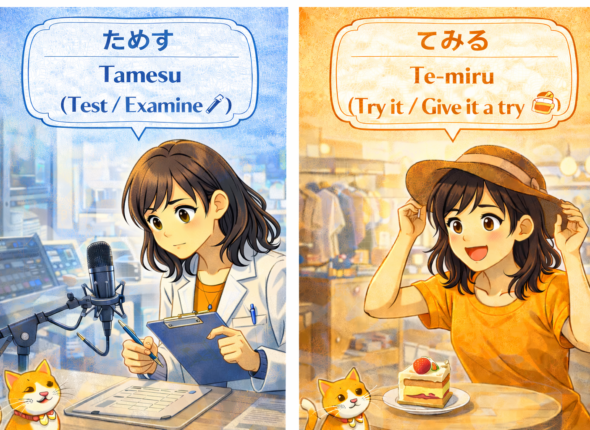
Ichido vs. Ikkai: Nuances of “Once” in Japanese Explained
(Joy testing a machine [Tamesu] vs. Joy trying a cake [Te-miru]) “I want to try this cake!” “I want to test this microphone.” In Japanese, both are translated as “try,” but we...
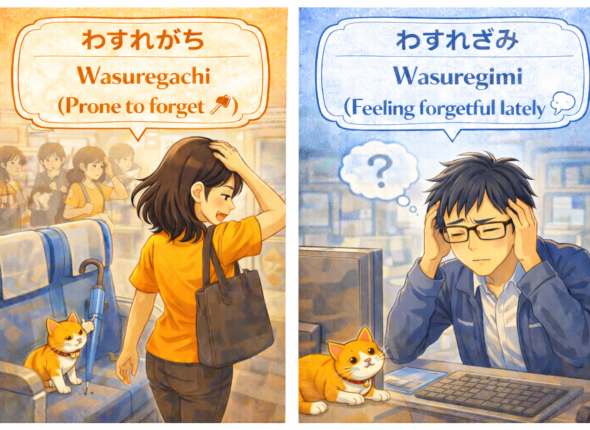
“Wasuregachi” vs. “Wasuregimi”: Understanding Japanese Forgetfulness Nuances
(Joy frequently leaving her umbrella [Wasuregachi] vs. Ken rubbing his temples feeling forgetful [Wasuregimi]) “I tend to forget kanji.” (Wasure-gachi) “I’m feeling a bit forgetful lately.” (Wasure-gimi) When adding a suffix to...
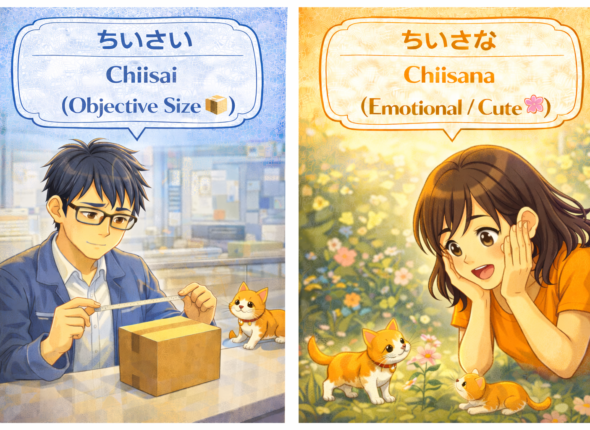
“Chiisai” vs. “Chiisana”: Learning Japanese Word Nuances
(Ken measuring a box [Chiisai] vs. Joy looking at a cute kitten [Chiisana]) “A small box.” -> Chiisai hako OR Chiisana hako “This box is small.” -> Kono hako wa chiisai desu....
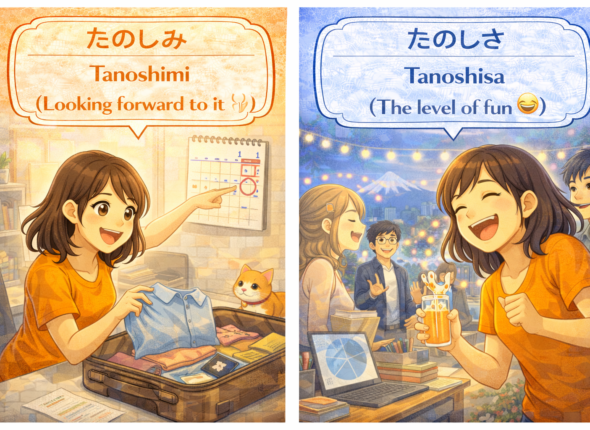
Tanoshimi vs Tanoshisa: Understanding their Differences
Joy packing her bags for a trip [Tanoshimi] vs. Joy laughing at a party right now [Tanoshisa]) “I’m looking forward to the trip.” -> Ryokou ga Tanoshimi desu. “I understand the fun...