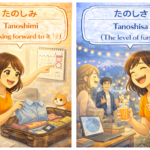
 (Joy hesitantly saying “Ano…” to politely interrupt Ken who is reading in a bookstore/cafe, with Raya browsing nearby and an orange cat sleeping)
Welcome to “Japanese You Keep Seeing”!
Have you ever noticed how often Japanese speakers start a sentence with a hesitant, drawn-out sound? It’s not “um,” “uh,” or “like” exactly, but it serves a very important social function. Today, we decode the politely powerful prefatory phrase: あの… (Ano…). You will see this everywhere—from anime to business meetings. Let’s see what happens when Joy wanpts to politely grab Ken’s attention in a cozy bookstore/cafe.
🗣 Conversation Scene
Joy and Ken are taking a break at a hybrid bookstore/cafe. Ken is engrossed in a new book about Japanese architecture. Joy has found a fascinating book on the history of visual communication design and wants to show it to him without being too abrupt.💡 Explanation: The Polite Prefecture
“Ano…” is a multifunctional linguistic tool that acts as both a filler word and a powerful prefatory phrase. Its closest English equivalents are “Um…”, “Well…”, “Say…”, or “Excuse me…”. Why do Japanese people use it so often?1. Softening the Approach 🌸
In Japanese culture, directness can often be perceived as blunt or aggressive. Starting a conversation, especially with a request or question, with a direct “Hello!” can be jarring. “Ano…” acts as a buffer, signaling to the listener, “I am about to ask something, but I am being careful of your time and space.” It is essential for politeness when interrupting someone, like Joy did to Ken.2. A HESITATION Device (Filler Word) 💭
Just like English speakers use “um,” “ano…” is used when you are thinking of the next word. It allows the speaker to hold their turn in conversation while they process their thoughts. Dragging the sound out (A-noooo…) indicates deep thought or careful consideration.3. Asking Polely for Attention (The Polite “Excuse me…”) 🙋♀️
When you need to politely grab someone’s attention without apologizing (unlike *Sumimasen*), “Ano…” is perfect. For example, if you see someone drop a coin and want to alert them, you might start with a drawn-out “Anooooo… sumimasen.”💎 Pro Tip: “Ano” vs “Sumimasen”
“Sumimasen” (Excuse me) is usually more apologetic, often used when you are causing a direct inconvenience (e.g., stopping a busy staff member). “Ano…” is purely prefatory and attentional; it says “I’m starting a conversation/thought gently.” You can even use both! **「あの… すみません」 (Ano… Sumimasen)** means “Um… excuse me…”
🔥 Practice Quiz
Ready to master the Ko-So-A-Do system?
Want to dive deeper? Check out our official Beginner’s Grammar Book for more examples, detailed explanations, and practice exercises to perfect your Japanese pointing skills!
📖 Read more in the Grammar Book: これ/それ/あれ/どれ