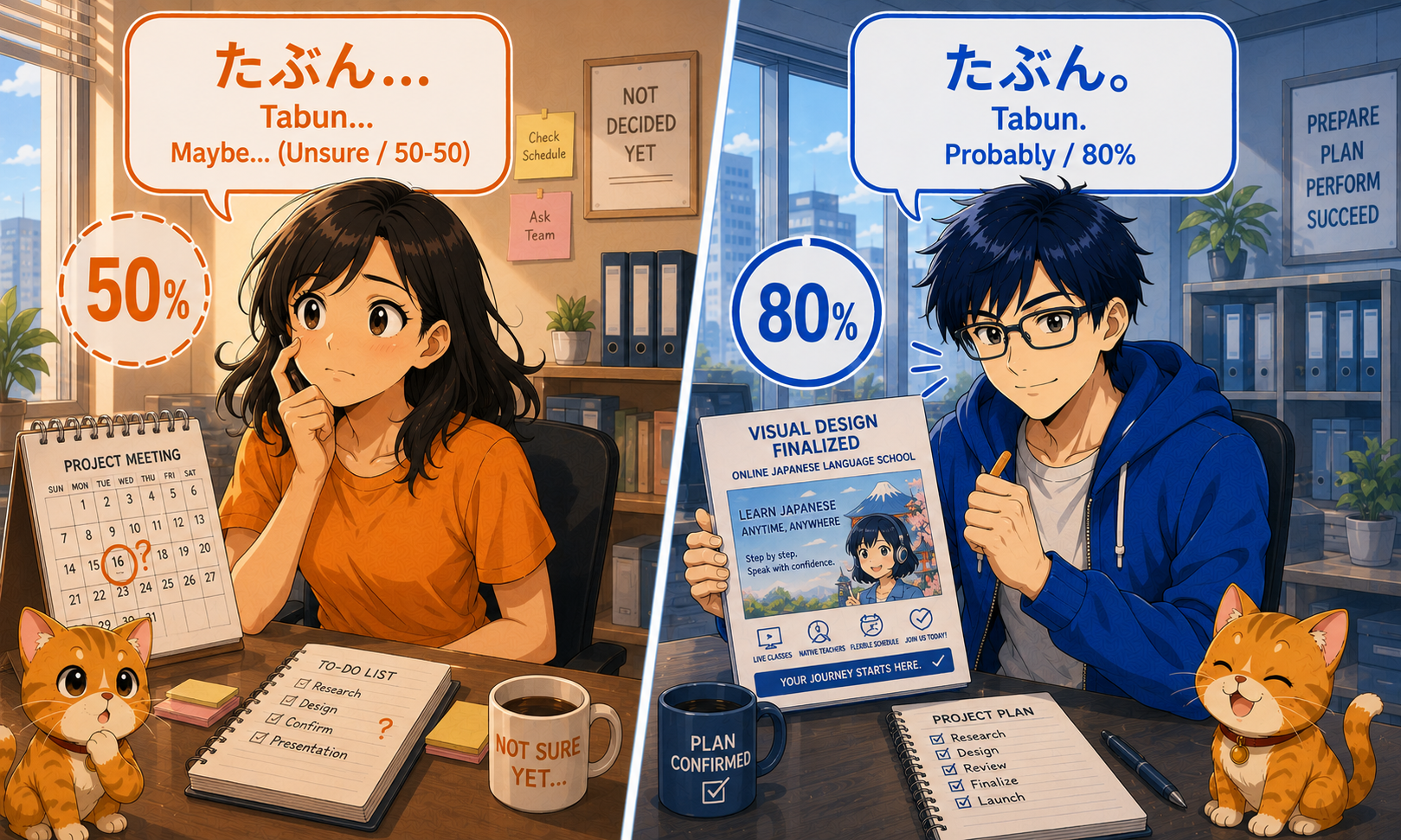
(Joy looking unsure with a 50% sign [Maybe] vs. Ken looking confident with an 80% sign [Tabun])
“There’s a 50/50 chance.” -> かもしれません (Kamoshiremasen) / Maybe
“I am 80% to 90% sure.” -> たぶん (Tabun) / Probably
If you look up “Maybe” in an English-Japanese dictionary, the first word you see is たぶん (Tabun). However, this translation causes massive communication breakdowns in the workplace! In English, “Maybe” means there is a 50% chance. But to a Japanese person, “Tabun” means there is an 80% or 90% chance. Let’s see what happens when Joy tries to use “Tabun” to talk about her visual design deadline.
🗣 Conversation Scene
Director Tanaka asks Joy if the new visual designs for Friday’s social media campaign will be finished in time.
(Joy, will the visual designs for Friday’s campaign be ready by tomorrow evening?)
(Hmm, “Tabun” [Joy thinks: 50% chance] it will be in time!)
(Is that so, great! Then I will send a confirmation email to the client that we can show them the designs tomorrow.)
[ Joy panics because she isn’t sure she can finish it. Ken pulls her aside. ]
(Joy! In Japanese, “Tabun” means an 80-90% probability [Probably]! If you meant 50%, you have to say “It might not be in time”, or it will cause trouble later!)
💡 Explanation
Probability and Politeness
Japanese people use たぶん (Tabun) to soften their statements and sound polite, even when they are almost 100% sure. To express a true 50/50 “Maybe”, you must use 〜かもしれません (~kamoshiremasen).
1. たぶん (Tabun) = Probably / Most likely (80% – 90%) 📈
The kanji for Tabun is 多分. “多” means many/much, and “分” means part. Literally, it means “in large part.” When a Japanese person says “Tabun,” they usually already know the answer. They use it because stating an absolute fact (100%) sounds too aggressive, arrogant, or direct in Japanese culture.
- あのレストラン、たぶん美味しいですよ。
(That restaurant is probably delicious. *They are highly confident based on reviews*) - たぶん、彼が担当者です。
(Most likely, he is the person in charge. *They are 95% sure*)
2. もしかしたら〜かもしれません (Moshikashitara ~kamoshiremasen) = Maybe / Perhaps (50%) ⚖️
If you truly do not know if you can meet a deadline, or if you are completely guessing, you must use 〜かもしれません (kamoshiremasen). It literally translates to “it cannot be known.” To make it even clearer, you can add もしかしたら (Moshikashitara – by any chance) to the beginning of the sentence.
- もしかしたら、明日は雨かもしれません。
(Maybe it will rain tomorrow. *50/50 chance*) - デザインの修正に、もっと時間がかかるかもしれません。
(It might take more time to revise the designs. *Warning the boss of a 50% risk*)
📊 The Certainty Scale
🔥 Practice Quiz
Tap to check the answer!