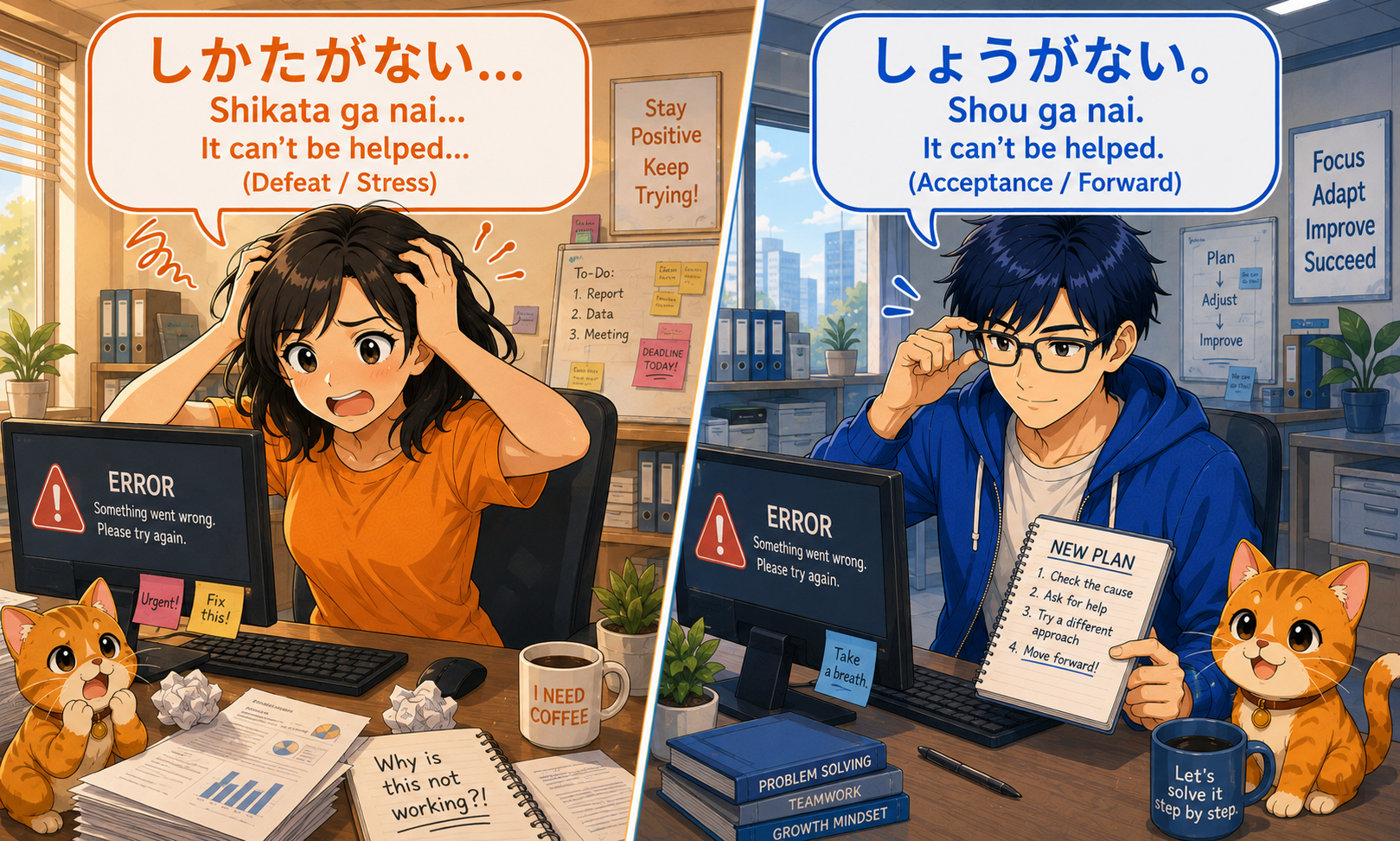
(Joy stressing over a computer error [Defeat] vs. Ken calmly making a new plan saying Shou ga nai [Acceptance])
“We lost. I give up.” -> It can’t be helped (Western view: Defeat & Frustration)
“It’s out of our control. Let’s focus on the next step.” -> しょうがない (Shou ga nai) (Japanese view: Acceptance & Peace)
If you translate しょうがない (Shou ga nai) or its more formal version 仕方がない (Shikata ga nai) into English, you get “It can’t be helped.” For many English speakers, this sounds pessimistic, lazy, or like you are giving up. But in Japan, it is a deeply positive survival mechanism. It is the art of letting go of stress over things you cannot control. Let’s see what happens when the internet goes down at the office.
🗣 Conversation Scene
Joy is working on a strict deadline for some visual designs, but suddenly, the office internet connection goes down.
(What should I do! The internet is down! I can’t upload the designs! Ah, I’m so stressed!)
(Joy, we can’t fix a system error ourselves. It’s “Shou ga nai”. Let’s do the offline tasks until the internet comes back.)
[ Director Tanaka walks by and nods in agreement with Ken’s mindset. ]
(Exactly. There’s no use getting frustrated [Shikata ga nai]. Let’s wait and have a coffee.)
💡 Explanation
Defeat vs. Mindful Acceptance
In many cultures, fighting against obstacles is seen as a virtue, so saying “it can’t be helped” feels like a negative defeat. In Japan, fighting against things you cannot change (like weather or train delays) is seen as a waste of energy. しょうがない (Shou ga nai) is the wisdom to accept reality so you can move forward.
1. It can’t be helped (Western Feeling) 😫
Focus: Frustration and Surrender.
When you say “it can’t be helped” in English, it often comes with a heavy sigh. It implies you *wanted* to fix it, but you failed, and now you must reluctantly give up. The feeling lingering in the air is often negative or stressful.
2. しょうがない (Shou ga nai) = The Reset Button 🧘
Focus: Acceptance and Peace of Mind.
“Shou ga nai” acts as an emotional reset button. Japan has historically dealt with many natural disasters (typhoons, earthquakes). The culture developed a mindset: “We cannot control nature. Complaining won’t fix it. Accept it quickly, and let’s rebuild.” By saying “Shou ga nai,” you release your stress and immediately pivot your brain to ask: “Okay, what CAN we do right now?”
- [Train is delayed by 30 mins] しょうがない。本でも読もう。
(Nothing I can do about the train. I’ll just read a book.) - [It rains on a holiday] 仕方がないね。家で映画を見よう。
(Shikata ga nai – slightly more polite. Let’s watch a movie at home.)
📊 Comparison Table
🚧 The Dangerous Trap of Shou ga nai
While Shou ga nai is great for external problems, never use it for your own mistakes! If you miss a deadline because you slept in, and you tell the boss “Shou ga nai,” you are basically saying “Not my fault, whatever.” The boss will be furious. Only use it for things truly outside human control!
🔥 Practice Quiz
Tap to check the answer!