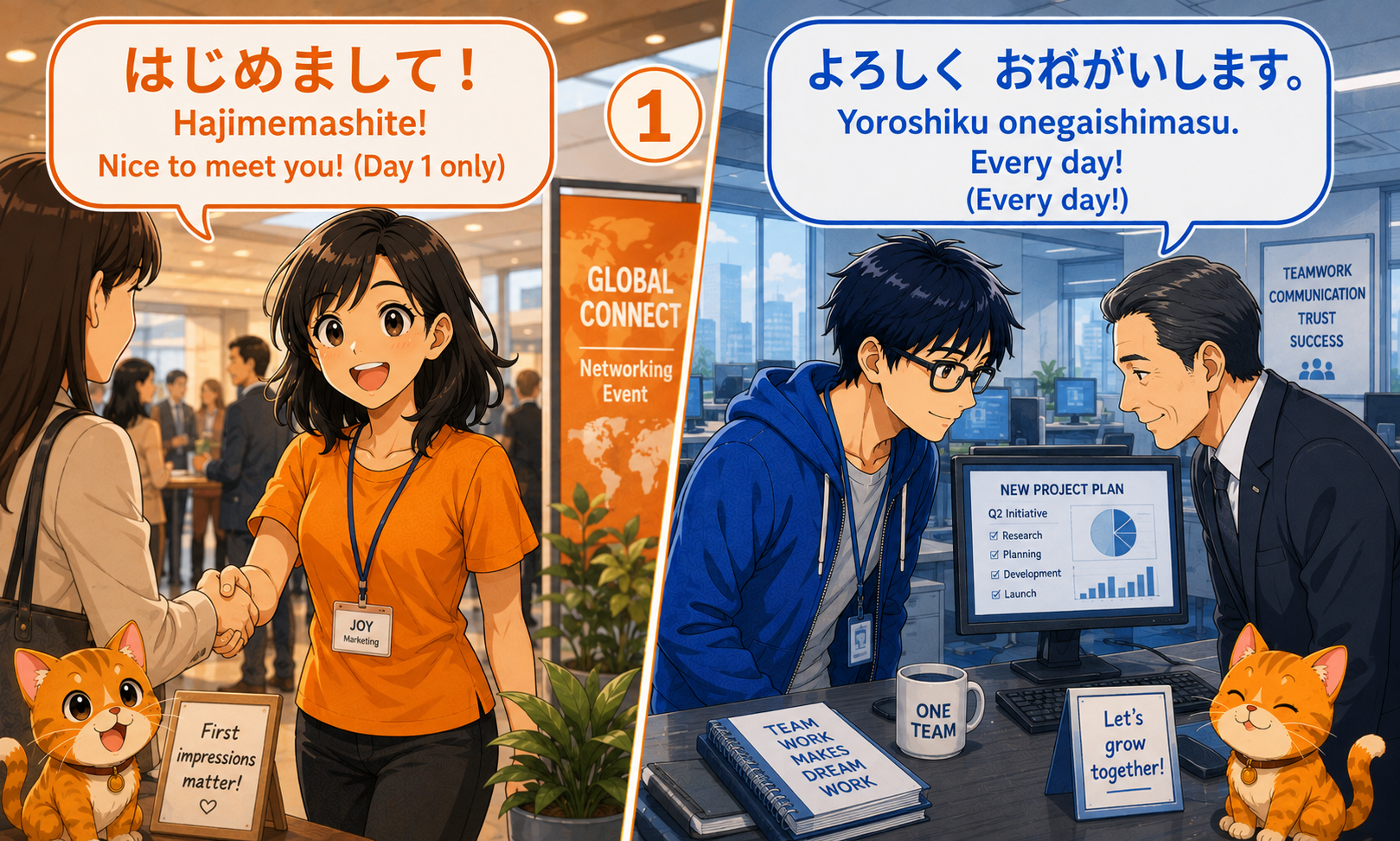
 (Joy shaking hands saying Nice to meet you [Day 1] vs. Ken and his boss starting a project saying Yoroshiku onegaishimasu [Every day])
“First time meeting you.” -> はじめまして (Hajimemashite) (Day 1 Only)
“Let’s work well together.” -> よろしくお願いします (Yoroshiku onegaishimasu) (Every Single Day)
If you check an English-Japanese dictionary, よろしくお願いします (Yoroshiku onegaishimasu) is often translated as “Nice to meet you.” Because of this, many beginners use it once on their first day of work and then never say it again! This is a massive cultural trap. In Japanese business, this phrase is the glue that holds teams together. Let’s see what happens when Director Tanaka starts a new design project with Joy.
🗣 Conversation Scene
Joy and Director Tanaka have known each other for months. Today, they are kicking off a new social media campaign.
(Joy, today we start creating the designs for the new SNS campaign. “Yoroshiku onegaishimasu”.)
(Eh? Director, “Nice to meet you”? But we have been working together for a long time?)
[ Tanaka is confused by her English translation. Ken jumps in to explain the magic word. ]
(Joy! “Yoroshiku onegaishimasu” doesn’t just mean “Nice to meet you”! It’s a signal meaning “Let’s do our best together” when starting a new task!)
💡 Explanation
The First Meeting vs. The Ongoing Relationship
In English, “Nice to meet you” has an expiration date (you can only say it once). In Japanese, よろしくお願いします (Yoroshiku onegaishimasu) is a promise of good relations for the future. It never expires!
1. はじめまして (Hajimemashite) = Nice to meet you 🤝
Focus: Day 1 Only.
If you want the literal translation of “Nice to meet you / This is our first time meeting,” use はじめまして (Hajimemashite). You say this exactly one time in your entire life to a person. It is always the very first word out of your mouth when introducing yourself.
- はじめまして、Joyです。
(Nice to meet you, I am Joy. *Standard self-intro*)
2. よろしくお願いします (Yoroshiku onegaishimasu) = The Magic Word ✨
Focus: Please treat me well / I’m counting on you / Let’s do this.
“Yoroshiku” means “well/appropriately,” and “onegaishimasu” means “I humbly request.” So you are literally saying, “I humbly request that you treat me (or this task) well.” Because it is so versatile, you use it in almost every business scenario:
- [At the end of a self-intro] はじめまして、Joyです。よろしくお願いします。
(Nice to meet you… Please treat me well in the future.) - [When kicking off a new project] 今日から新しいプロジェクトですね。よろしくお願いします!
(New project starts today. Let’s do our best together!) - [At the end of every business email] 引き続き、よろしくお願いいたします。
(I look forward to our continued good relationship / Best regards.)
📊 Comparison Table
💎 The “Asking a Favor” Trap
In English, if you ask someone to do a task, you say “Thank you” in advance. In Japanese, saying “Arigatou gozaimasu” before they actually do the work feels strange! Instead, you hand them the task and say: 「このタスク、よろしくお願いします」 (I’m counting on you for this task). You only say “Thank you” after they finish it!
🔥 Practice Quiz
Tap to check the answer!