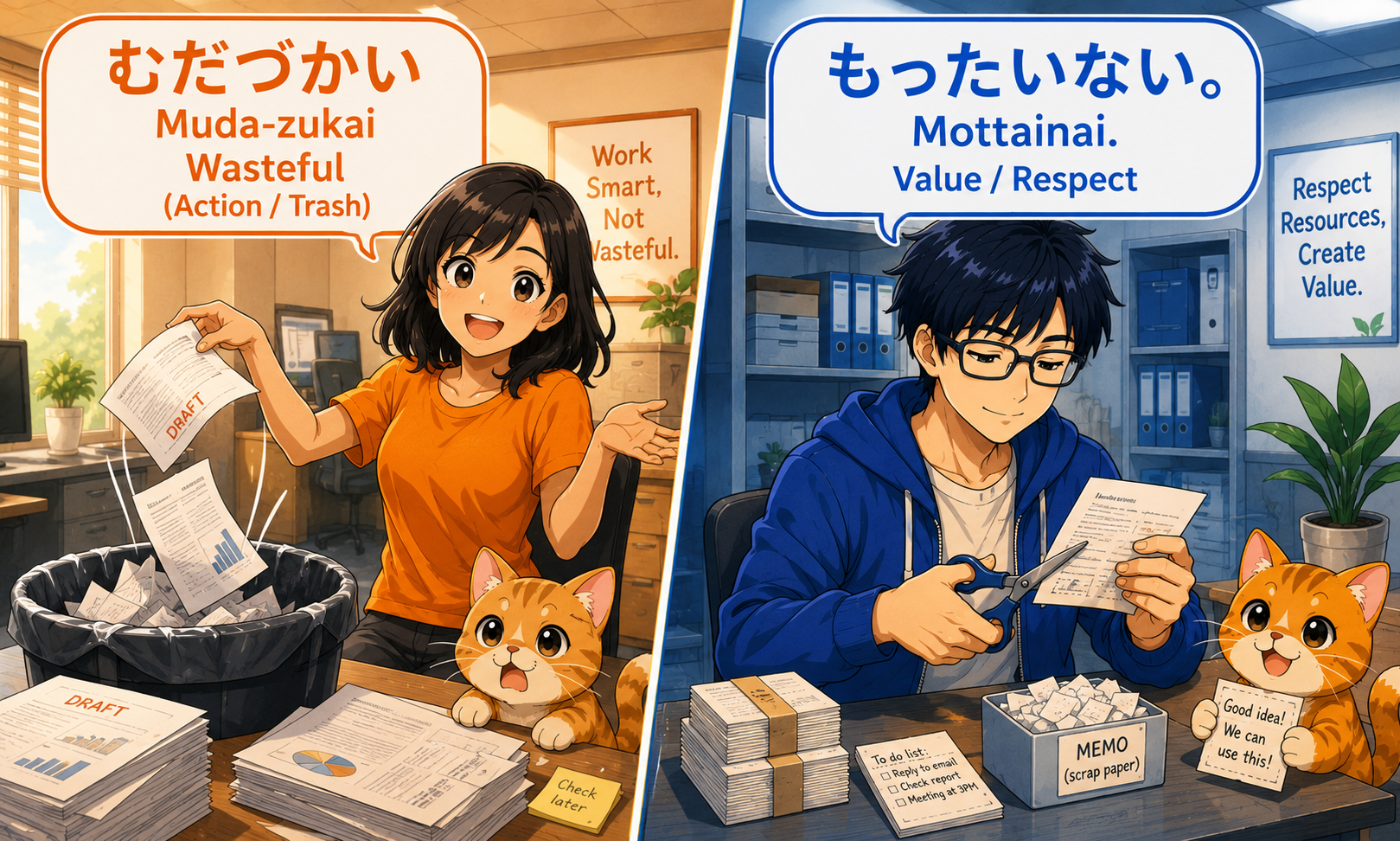
 (Joy throwing away paper [Wasteful Action] vs. Ken making scrap memo pads out of misprints [Mottainai Respect])
“Throwing this away is bad.” -> Wasteful (Focus on the negative action) “This object still has value to give!” -> もったいない (Mottainai) (Focus on gratitude/value) If you throw away half a bowl of rice, an English speaker might say, “That’s so wasteful!” A Japanese speaker will say, 「もったいない!」(Mottainai!). While both sentences happen in the same situation, the emotion behind them is completely different. Understanding “Mottainai” is the key to understanding the Japanese heart. Let’s see what happens when Joy makes a printing mistake at the office.
🗣 Conversation Scene
Joy accidentally printed 100 copies of a document with a typo. She is about to throw them in the trash.Joy
あーあ、文字を間違えちゃった。ゴミ箱に捨てよう。
(Ah man, I made a typo. I’ll throw these in the trash can.)
Tanaka
Joyさん、待って!捨てるのはもったいないですよ!裏面(うらめん)をメモ用紙として使いましょう。
(Joy, wait! Throwing that away is “Mottainai”! Let’s use the back side as scrap memo paper.)
[ Joy is confused because paper is very cheap. Ken explains the cultural mindset. ]
Ken
Joyさん、「もったいない」はお金の問題ではありません。その紙を作るために使われた資源(しげん)や命に対するリスペクト(敬意)の言葉なんです。
(Joy, “Mottainai” isn’t about money. It’s a word of respect for the resources and lives that were used to make that paper.)
💡 Explanation
The Action vs. The Spirit⚠️ The Core Difference:
“Wasteful” judges the action of the person throwing it away. もったいない (Mottainai) mourns the lost potential of the object itself.
1. Wasteful (Action-Focused) 🗑️
Focus: Guilt, Money, or Efficiency. In Western culture, calling something “wasteful” often implies a moral or financial judgment on the person doing it. (“You are throwing away money,” or “You are creating too much trash”). It focuses on the negative result of the action.2. もったいない (Mottainai) = Respecting Intrinsic Value 🌿
Focus: Gratitude and Potential. “Mottainai” comes from an ancient Buddhist concept that everything in the physical world has a spirit and a purpose. When you say “Mottainai,” you are essentially saying, “What a shame! This object has not yet fulfilled its purpose. It still has value to give to the world.” It is a feeling of deep respect for the object, the nature it came from, and the people who made it.3. Beyond Physical Trash (Time & Talent) ⏳
Because “Mottainai” is about unfulfilled potential, Japanese people use it for things that have nothing to do with garbage!- [A talented singer decides to quit] 歌をやめるの?もったいない! (You’re quitting singing? What a waste of talent/Mottainai!)
- [A beautiful sunny day, but you sleep until 3 PM] いい天気なのに、もったいない。 (It’s such a beautiful day, what a waste of time/Mottainai.)