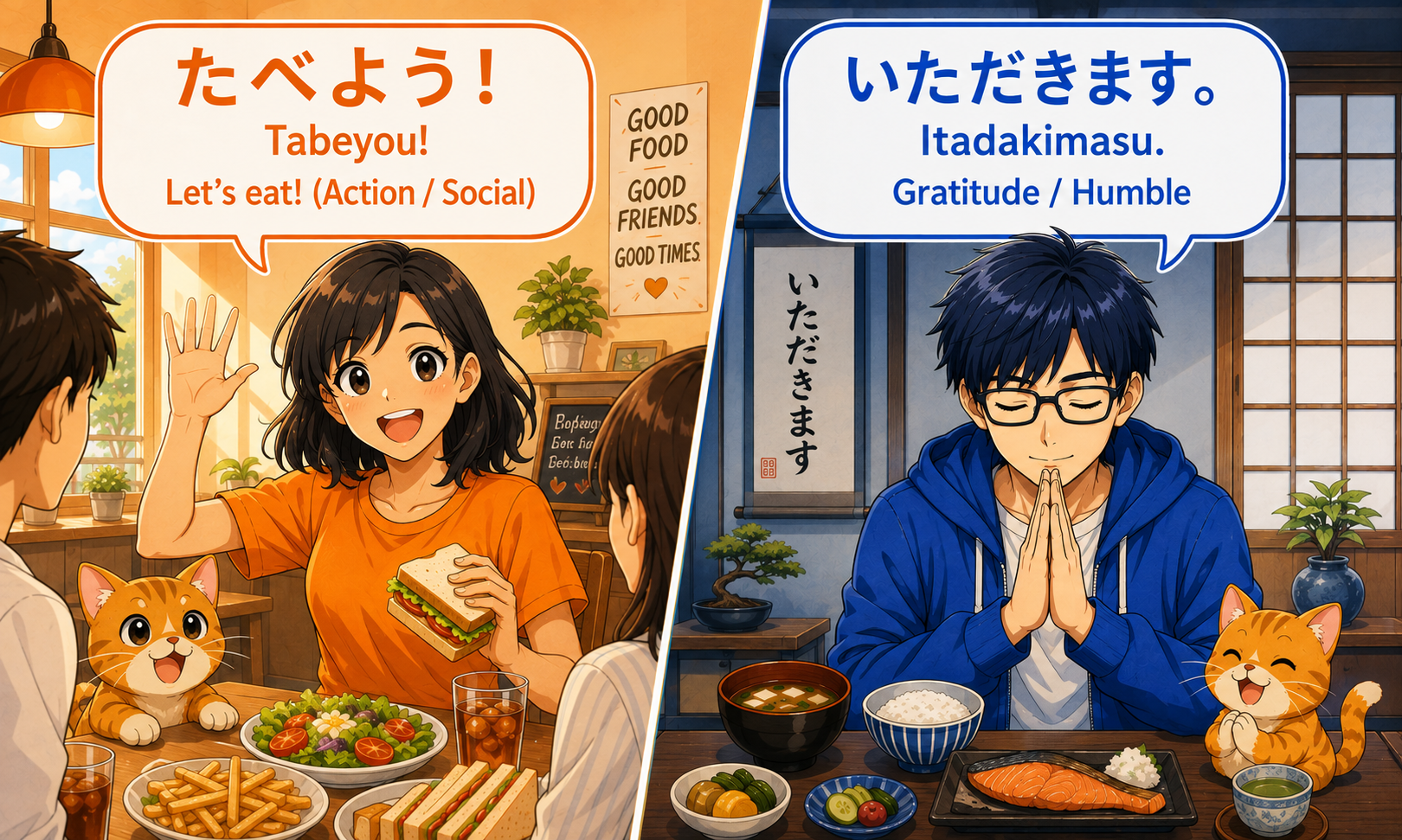
(Joy cheerfully saying Let’s eat [Social Action] vs. Ken pressing his hands together saying Itadakimasu [Humble Gratitude])
“Okay everyone, time to eat!” -> Let’s eat / 食べましょう (Tabemashou) (Social Action)
“Thank you for this meal.” -> いただきます (Itadakimasu) (Humble Gratitude)
If you watch anime or Japanese dramas, you know that everyone says いただきます (Itadakimasu) before eating. English subtitles almost always translate this as “Let’s eat!” or “Thanks for the food.” However, the true meaning goes much deeper than a simple dinner bell. Let’s see what happens when Director Tanaka treats Joy and Ken to a nice sushi lunch.
🗣 Conversation Scene
Director Tanaka has brought the team to a sushi restaurant to celebrate a successful project.
Tanaka
お疲れ様。さあ、新鮮なうちに食べましょう。
(Good work, everyone. Well then, let’s eat while it’s fresh.)
Joy
わーい!お腹ペコペコです。食べましょう!
(Yay! I’m starving. “Tabemashou!” [Let’s eat!])
[ Joy grabs her chopsticks immediately. Ken stops her to share a cultural rule. ]
Ken
Joyさん、日本では食べる前に手を合わせて「いただきます」と言います。命と、作ってくれた人に感謝するためですよ。
(Joy, in Japan, we press our hands together and say “Itadakimasu” before eating. It is to show gratitude to the lives given and the people who made it.)
💡 Explanation
Social Action vs. Humble Gratitude
⚠️ The Core Difference:
“Let’s eat” is directed at the people at the table (a call to action). いただきます (Itadakimasu) is directed at the food and nature (a humble prayer of thanks).
1. Let’s eat = 食べましょう (Tabemashou) 🍽️
Focus: The Event and the People.
In English, “Let’s eat” or “Dig in” simply means the food is ready and the social event of eating can begin. You wouldn’t say “Let’s eat” if you were sitting alone in your room eating a sandwich, because there is no one to talk to. In Japanese,
食べましょう (Tabemashou) has this exact same social meaning.
2. いただきます (Itadakimasu) = I humbly receive 🌾
Focus: Sacrifice and Gratitude.
Grammatically, “Itadakimasu” is the Humble Language (Kenjougo) form of the verb
morau (to receive). It literally means “I humbly receive.” When you say this, you are lowering yourself to show respect to two things:
1.
The lives given: The animals, fish, and plants that sacrificed their lives to become your meal.
2.
The hard work: The farmers, fishermen, truck drivers, and chefs who brought the food to your plate.
Because you are thanking nature and the food itself,
Japanese people say Itadakimasu even when they are eating completely alone!
📊 Comparison Table
| Phrase |
Literal Meaning |
Do you say it when alone? |
| Let’s eat
(Tabemashou) |
“Let us begin eating.” (Social Action) |
No. You need other people to say “let us.” |
| いただきます
(Itadakimasu) |
“I humbly receive.” (Humble Gratitude) |
Yes! Because you are thanking the food. |
💎 The Etiquette of the Hands
While saying Itadakimasu, the proper etiquette is to press your palms together in front of your chest (like a prayer) and bow your head slightly. However, in busy business lunches, a polite nod of the head while quietly saying “Itadakimasu” is perfectly acceptable.
🔥 Practice Quiz
Tap to check the answer!
Q1. You are working late at the office. Everyone else has gone home. You open a bento box from the convenience store. What should you say?
A. Nothing, because I am alone.
B. Itadakimasu.
Answer: B (Itadakimasu)
Even when alone, Japanese people say Itadakimasu to show respect to the food and the people who made the bento.
Q2. Grammatically, what type of word is “Itadakimasu”?
A. Casual slang.
B. Humble Language (Kenjougo).
Answer: B (Humble Language)
It is the humble form of “to receive.” You lower your own status to elevate the nature that provided the meal.