N4-G-063
もしかしたら (Adverb: Perhaps / Possibly / Maybe)
Supporting / Low Probability & Speculation
👀 Layer A: Visual Guide
📝 Quick Summary
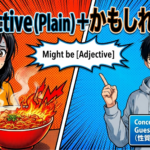
もしかしたら (moshikashitara) is an adverb used to express a slight possibility or hunch (“perhaps”, “possibly”, “maybe”). It indicates a lower level of probability (~20–50%) and almost always pairs with the sentence-ending pattern 〜かもしれません (might / may).
Structure: もしかしたら + [Sentence Clause] + 〜かもしれません
Example 1: もしかしたら あした あめが ふる かもしれません (It might possibly rain tomorrow).
Example 2: もしかしたら かれは こない かもしれません (He might possibly not come).
🔍 Layer B: Deepening
💡 Raya’s Hack
The Golden Pair: もしかしたら … かもしれません!
Always align your starting adverb with the matching sentence ending:
– きっと (kitto): ~90%+ certainty ➡️ Pairs with はずです / でしょう
– たぶん (tabun): ~50-70% certainty ➡️ Pairs with でしょう / とおもいます
– もしかしたら (moshikashitara): ~20-50% certainty ➡️ Almost ALWAYS pairs with 〜かもしれません!
When you hear someone start a sentence with moshikashitara, your brain should immediately expect kamo shiremasen at the end!
🚧 Joy’s Mistake
Scene: Joy is guessing about Tanaka-san’s arrival.
Joy: 「たなかさんは もしかしたら くる でしょう。」
(Tanaka-san wa moshikashitara kuru deshou.)
❌ Paired “moshikashitara” with “deshou”!
Why?
Deshou indicates a higher level of expectation (~70%). Because moshikashitara represents a lower, uncertain possibility (~20-50%), it must pair with 〜かもしれません.
Correct: 「たなかさんは もしかしたら くる かもしれません。」 (Tanaka-san might possibly come.)
🔥 Layer C: Retrieval Practice Loop
Retrieve and apply! Express low probability and possibilities. (Hiragana and English only)
Level 1: Structure Building (もしかしたら + Sentence + かもしれません)
Q1. Might possibly rain (あめが ふる)
Q2. Might possibly be late (おくれる)
Q3. Might possibly not come (こない)
Q4. Might possibly be a mistake (まちがい)
Q5. Might possibly be true/real (ほんとう)
Level 2: Full Sentences
Q6. It might possibly rain tomorrow. (あしたは / あめが ふる)
Q7. Tanaka-san might possibly be late. (たなかさんは / おくれる)
Q8. He might possibly not come today. (かれは きょう / こない)
Q9. This information might possibly be a mistake. (この じょうほうは / まちがい)
Q10. That story might possibly be true. (あの はなしは / ほんとう)