
![[Excuse me] vs. Ken bowing and apologizing for dropping papers [I’m sorry]](https://jplt-dialogplus.com/wp-content/uploads/2026/04/Excuse-me-vs.-Ken-bowing-and-apologizing-for-dropping-papers-Im-sorry-590x430.png)
The Difference Between「すみません」は謝罪?呼びかけ?正しい使い分け の違い |Japanese Grammar (N5–N3)
(Joy raising her hand to call a waiter [Excuse me] vs. Ken bowing and apologizing for dropping papers [I’m sorry]) “Excuse me, order please!” -> Sumimasen! “I am sorry I am late.”...
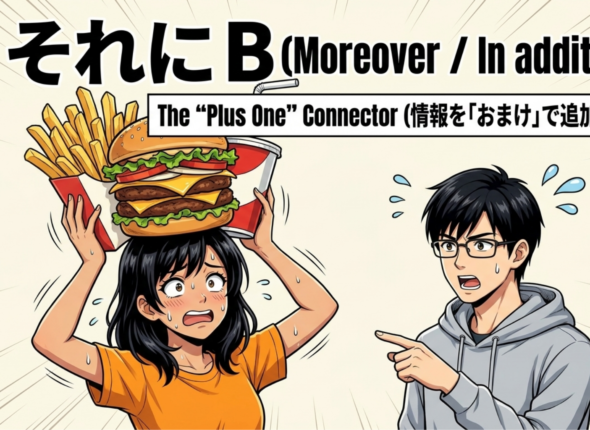
GrammarBook N4 : A それに B (Moreover / In addition)
N4-G-011 A それに B (Moreover / In addition) Supporting / Information addition 👀 Layer A: Visual Guide (直感理解) 📝 Quick Summary (まとめ) 「Aです。それに、Bです」のように、前(まえ)に言ったことに「さらに別(べつ)の情報(じょうほう)をプラスする」ときに使う言葉です。「おまけにもう一つ」というニュアンスがあります。 “Soreni” means “moreover”, “besides”, or “in addition”. It is...
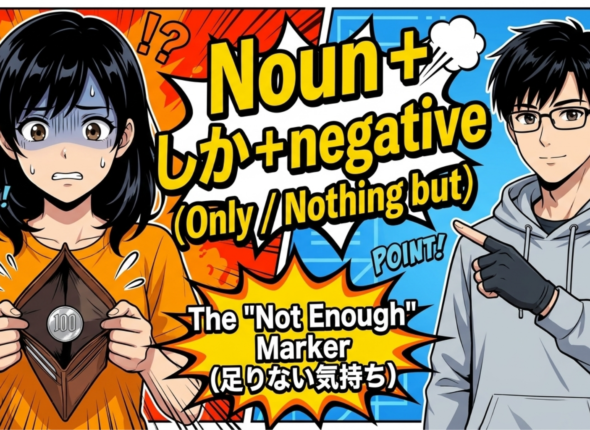
GrammarBook N4 : Noun+ しか+negative (Only)
N4-G-010 Noun+ しか+negative (Only) Supporting / Limitation & Emotion 👀 Layer A: Visual Guide (直感理解) 📝 Quick Summary (まとめ) 「~以外(いがい)はない」という強い制限(せいげん)を表します。「~だけ」と似ていますが、「しか」は「それっぽっちしかない(少なくて残念だ)」というネガティブな感情(かんじょう)を含みます。必ず否定形(ひていけい)(Negative form)の動詞と一緒に使います。 “Shika” means “only” or “nothing but”. Unlike “dake”, it carries a...
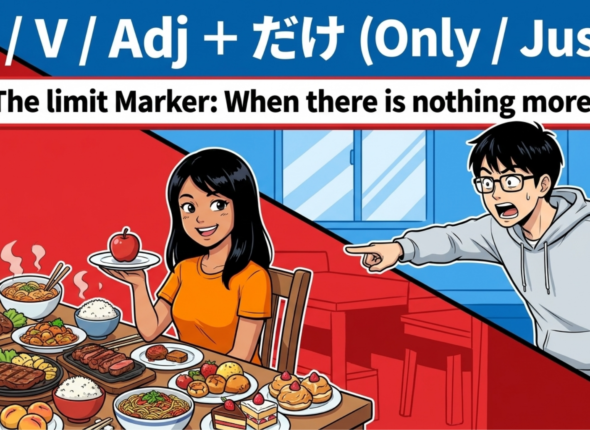
GrammarBook N4 : Noun/Verb/Adjective+だけ (Only / Just)
N4-G-009 N/V/Adjective+だけ (Only / Just) Core / Limitation base 👀 Layer A: Visual Guide (直感理解) 📝 Quick Summary (まとめ) 「それ以外(いがい)はない」という制限(せいげん)(Limitation)を表します。N4では名詞(めいし)だけでなく、動詞(どうし)や形容詞(けいようし)にも「だけ」をつけて、「~するだけ(Just doing)」と言うことができます。 “Dake” means “only” or “just”. In N4, you learn to attach...
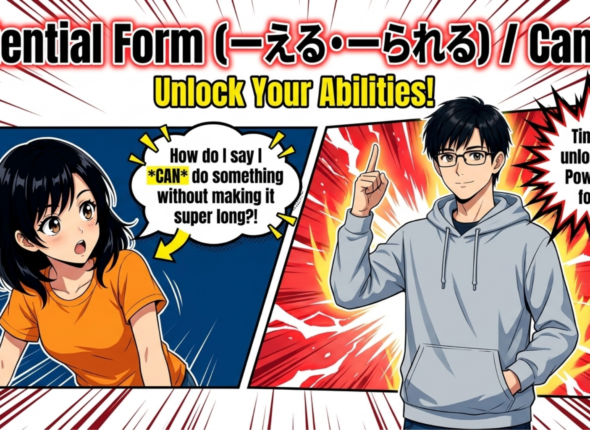
GrammarBook N4 : Potential verb(-える・ーられる)
N4-G-008 Potential verb(-える・ーられる) Core / Ability base 👀 Layer A: Visual Guide (直感理解) 📝 Quick Summary (まとめ) 「〜できる(Can do)」という能力(のうりょく)や可能性(かのうせい)を表す動詞の形です。「〜ことができる」と同じ意味ですが、より短く自然な表現になります。 The Potential Form transforms a verb to mean “can do [action]”. It is...
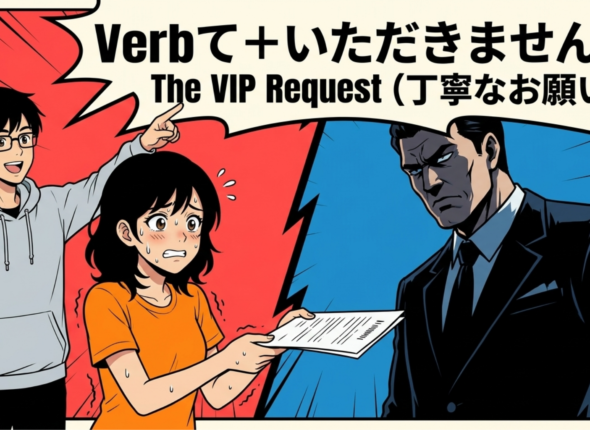
GrammarBook N4 : Verbて+いただきませんか (Would you kindly)
N4-G-007 Verbて+いただきませんか (Would you kindly) Peripheral / Polite Expansion 👀 Layer A: Visual Guide (直感理解) 📝 Quick Summary (まとめ) 目上の人(上司や先生、お客様など)に、何かをお願いするときに使う「とても丁寧(ていねい)な表現(ひょうげん)」です。「〜てください」よりも柔らかく、相手を尊敬する気持ちが伝わります。 Use “Verb te-form + itadakimasen ka” to make a very polite request...
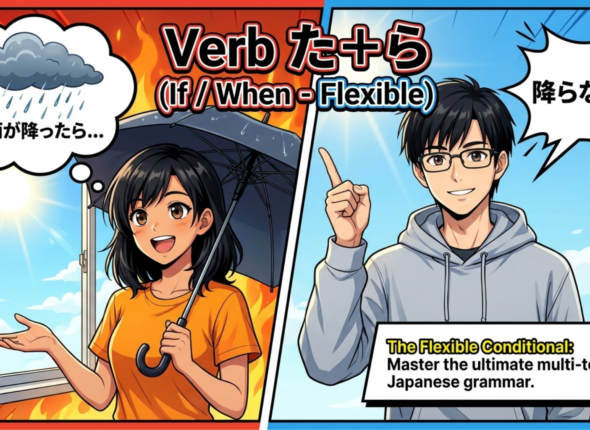
GrammarBook N4 : Verb た+ら (If / When)
N4-G-006 Verb た+ら (If / When) Core / Flexible Conditional 👀 Layer A: Visual Guide (直感理解) 📝 Quick Summary (まとめ) 「もし~なら(If)」と「~したあとで(When/After)」の、2つの意味を持つとても便利(べんり)な文法です。動詞(どうし)の「た形」に「ら」をつけます。 Use “Verb ta-form + ra” to express a condition (“If”) or...
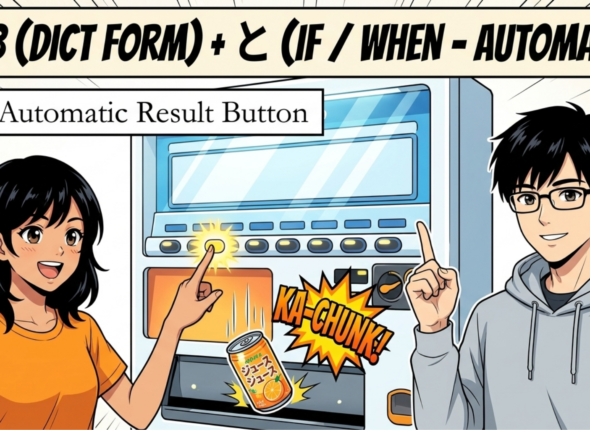
GrammarBook N4 : Verb(dict) + と (If/When – Automatic)
N4-G-005 Verb(dict) + と (If/When – Automatic) Core / Cause-effect base 👀 Layer A: Visual Guide (直感理解) 📝 Quick Summary (まとめ) 「Aをすると、必ずBになる」という、自動的(じどうてき)な結果(けっか)や自然(しぜん)のルールを表します。機械(きかい)の使い方や、道案内(みちあんない)でよく使われます。 Use “Verb(dict) + to” to express a natural, automatic, or...
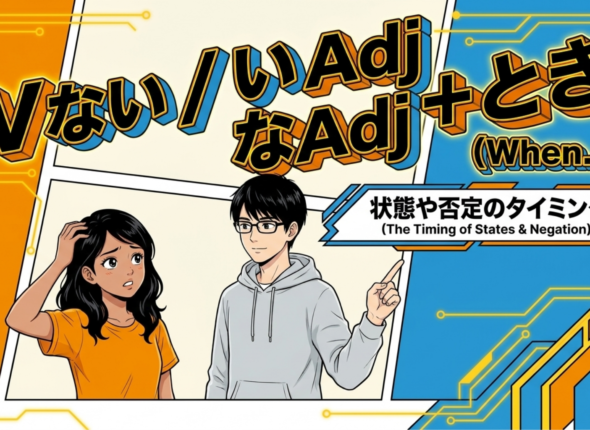
GrammarBook N4 : Noun + のとき (When)
N4-G-004 Noun + のとき (When) Core / Life stage & Situations 👀 Layer A: Visual Guide (直感理解) 📝 Quick Summary (まとめ) 「こどものとき」や「びょうきのとき」のように、名詞(めいし)を使って特定の時間(じかん)や状況(じょうきょう)を表します。名詞(めいし)と「とき」の間(あいだ)には、必(かなら)ず「の」を入れます。 Use this to refer to specific periods or states using...
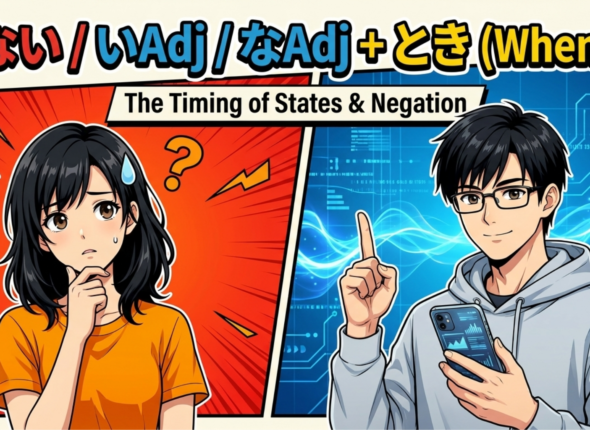
GrammarBook N4 : Vない / いAdj / なAdj + とき
N4-G-003 Vない / いAdj / なAdj + とき Supporting / Negative timing & Problem solving 👀 Layer A: Visual Guide (直感理解) 📝 Quick Summary (まとめ) 「~の状態(じょうたい)のとき」や「~していないとき」に何をするかを説明します。形容詞(けいようし)や動詞(どうし)のない形(かたち)に「とき」をつなげます。 Use this to describe what you...
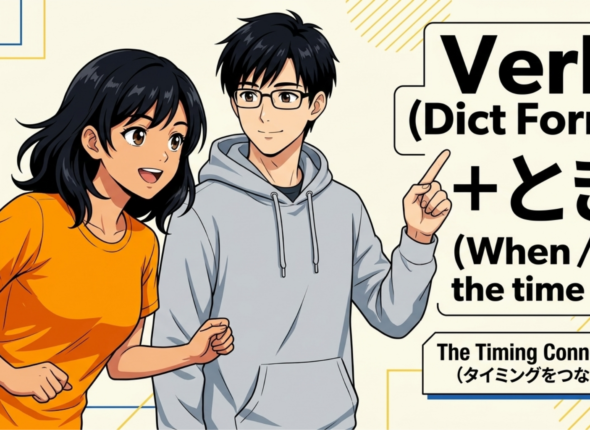
GrammarBook N4 : Verb(dict form)+とき (When)
N4-G-002 Verb(dict form)+とき (When) Core / Story Timing 👀 Layer A: Visual Guide (直感理解) 📝 Quick Summary (まとめ) 「Aするとき、Bする」というように、2つの動作のタイミングをつなぐ文法です。辞書形(〜る)を使うと、「Aの動作が終わる前(または途中)」にBをすることを表します。 Use “Verb(dict form) + toki” to say “When I do X, I do...

GrammarBook N4 : いくらですか (How much?)
N4-G-001 いくらですか (How much?) Core / Transaction & Shopping 👀 Layer A: Visual Guide (直感理解) 📝 Quick Summary (まとめ) 買い物をするときに、値段(Price)を聞くための最も大切なフレーズです。「ぜんぶで」や「〜つで」をつけると、さらに詳しく値段を聞くことができます。 Use “Ikura desu ka” to ask for the price. You can combine...
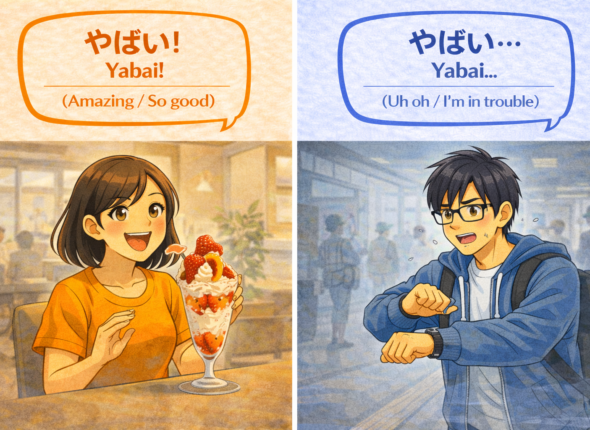
The Difference Between 「やばい」は褒め?それとも危険?ニュアンスの違い |Japanese Grammar (N5–N3)
(Joy eating a delicious parfait [Amazing] vs. Ken looking panicked because he is late [In trouble]) “This cake is amazing!” -> Kono keeki, yabai! “Uh oh, I lost my wallet!” -> Yabai!...
【使い分け】「別に」は本当に“別に”?肯定と否定の違い [日本語学習]
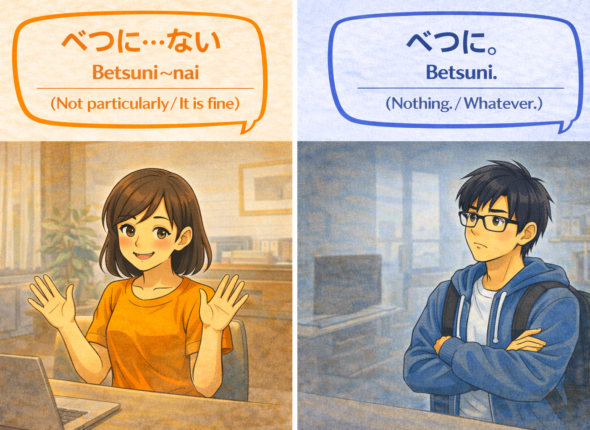
(笑顔で手を振って「特にないです」と伝えるJoy [安全] vs. 腕を組んで不機嫌そうに「別に。」と言うKen [冷たい・怒り]) 「特にほしくないです。」→ 別にほしくないです。 「どうしたの?」「何でもない(ほっといて)。」→ 別に。 「別に(Betsuni)」は日常会話で頻繁に使われる言葉です。教科書では「否定形と一緒に使って『特に〜ない(not particularly)』という意味になる」と習います。しかし、現実の日本社会において、「別に」は怒りや不満を隠し持った「思春期の反抗」や「受動的攻撃(パッシブ・アグレッシブ)」を表現する最強の言葉でもあります!使い方を間違えると、会話が一瞬で凍りついてしまいます。Kenの失敗を見てみましょう。 🗣 会話シーン (Conversation Scene) Kenは朝からずっと無口で、機嫌が悪そうです。Joyが心配して声をかけます。 Joy ケンさん、どうしたんですか?怒って(おこって)いますか? (Ken, what’s wrong? Are you mad?) Ken …いや、別に。 (不機嫌そうな声で単独の「別に」を使い、会話を拒絶している) Joy えっ、絶対に怒ってますよね!?その「別に」は怖いです! (Eh, you...
The Difference Between 「別に」は本当に“別に”?肯定と否定の違い |Japanese Grammar (N5–N3)
(Joy waving her hands politely to say ‘Not particularly’ [Safe] vs. Ken crossing his arms and looking annoyed saying ‘Nothing’ [Cold]) “I don’t particularly want it.” -> Betsuni hoshiku nai desu....
使い分け】「いいです」は許可?拒否?ネイティブ感覚との違い [日本語学習]
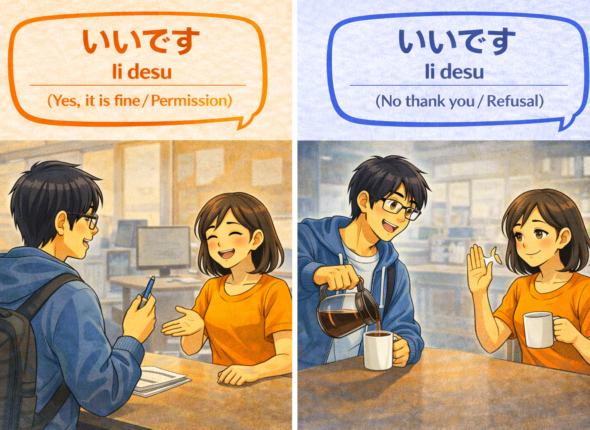
(笑顔でペンを貸す許可を出すJoy [YES] vs. 手を振ってコーヒーのおかわりを断るJoy [NO]) 「これを使ってもいいですか?」→ はい、いいですよ。(許可・YES) 「袋はいりますか?」→ いいえ、いいです。(拒否・NO) 日本に来た初心者が最も混乱する瞬間の一つは、誰かに物を勧めて「いいです(Good)」と言われたのに、相手がそのまま立ち去ってしまった時です!英語の「I’m good」と全く同じように、日本語の「いいです」は賛成(YES)と拒否(NO)の両方を意味します。ネイティブの意図を理解する秘密は、言葉にくっついている「ヒント」に注目することです。Joyが両方の状況にどう対応するか見てみましょう! 🗣 会話シーン (Conversation Scene) JoyとKenがオフィスで働いています。KenはJoyにお願いごとをし、その後飲み物を勧めます。 シーンA:許可を求める時(YES) Ken Joyさん、このペンを使ってもいいですか? (Joy, is it okay if I use this pen?) Joy はい、いいですよ。どうぞ。 (ポジティブな「はい」と「よ」をつけて、明確に許可を与えている) シーンB:何かを勧める時(NO)...
The Difference Between 「いいです」は許可?拒否?ネイティブ感覚との違い |Japanese Grammar (N5–N3)
(Joy smiling and giving permission to use a pen [YES] vs. Joy waving her hand to decline more coffee [NO]) “Can I use this?” -> Hai, ii desu yo. (Yes, that is...
【使い分け】「今度」は未来?それとも近い未来?初心者が迷う違い の違い [日本語学習]
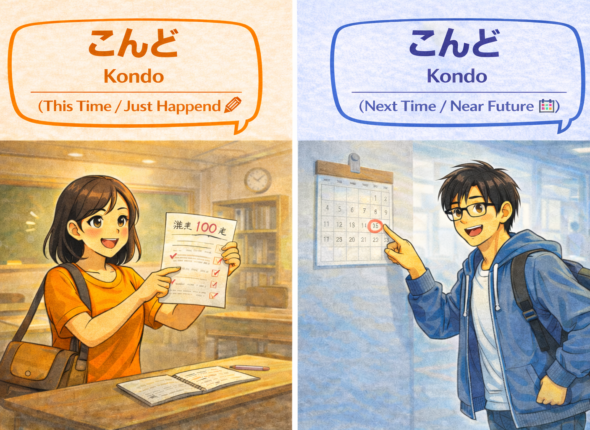
(終わったばかりのテスト用紙を持ってホッとするJoy [今回] vs. カレンダーの未来の日付を指差して笑うKen [次回]) 「今回のテストは難しかった。」→ 今度のテストは難しかったです。 「次回、一緒に行きましょう。」→ 今度一緒に行きましょう。 日本語学習者にとって、「今度(Kondo)」は大きな謎の一つです。1つの言葉が、なぜ「直近の過去」と「近い未来」の両方を意味するのでしょうか?「今度」の本当の意味を解き明かす鍵は、単語そのものではなく、文末の「動詞の時制(過去か未来か)」にあります。JoyとKenと一緒に、この見分け方のトリックをマスターしましょう! 🗣 会話シーン (Conversation Scene) JoyとKenが日本語の試験を終えて教室から出てきました。 Joy ああ、疲れました。今度のテストは難しかったですね。 (過去形の「難しかった」と結びつき、終わったばかりの「今回」のテストを指している) Ken そうですね。漢字が多かったです。 (It really was. There were a lot of Kanji.) Ken 今度、一緒に勉強しましょう! (提案の「〜ましょう」と結びつき、近い未来の「次回」を指している)...
The Difference Between「今度」は未来?それとも近い未来?初心者が迷う違い の違い |Japanese Grammar (N5–N3)
(Joy holding a recently finished test [This Time] vs. Ken pointing to a future calendar date [Next Time]) “This time, the test was hard.” -> Kondo no tesuto wa muzukashikatta desu. “Let’s...
【使い分け】「今度」は未来?それとも近い未来?初心者が迷う違い の違い [日本語学習]
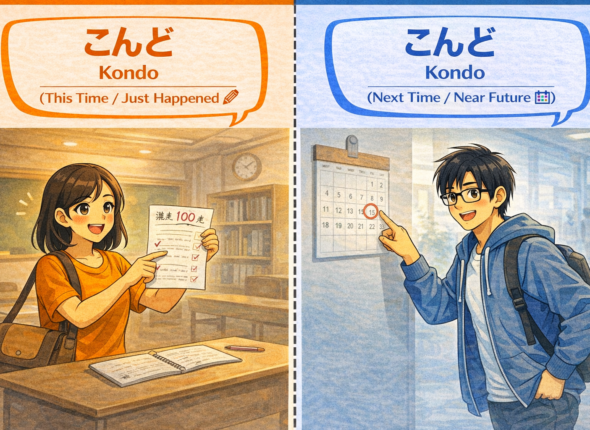
(終わったばかりのテスト用紙を持ってホッとするJoy [今回] vs. カレンダーの未来の日付を指差して笑うKen [次回]) 「今回のテストは難しかった。」→ 今度のテストは難しかったです。 「次回、一緒に行きましょう。」→ 今度一緒に行きましょう。 日本語学習者にとって、「今度(Kondo)」は大きな謎の一つです。1つの言葉が、なぜ「直近の過去」と「近い未来」の両方を意味するのでしょうか?「今度」の本当の意味を解き明かす鍵は、単語そのものではなく、文の最後にあるのです。JoyとKenと一緒に、この見分け方のトリックをマスターしましょう! 🗣 会話シーン (Conversation Scene) JoyとKenが日本語の試験を終えて教室から出てきました。 Joy ああ、疲れました。今度のテストは難しかったですね。 (過去形の「難しかった」と結びつき、終わったばかりの「今回」のテストを指している) Ken そうですね。漢字が多かったです。 (It really was. There were a lot of Kanji.) Ken 今度、一緒に勉強しましょう! (提案の「〜ましょう」と結びつき、近い未来の「次回」を指している)...