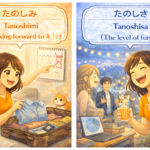
 (A cafe clerk holding a tray and a paper bag asking Joy “Tennai desu ka?”, as Joy points to a table, Ken and Raya chat, and an orange cat hides in a takeout bag)
Welcome to “Japanese You Keep Seeing”!
You survived the menu, successfully ordered your food, and have your wallet ready. You think you are safe, but then the cashier asks you one final, rapid-fire question: 店内ですか? (Tennai desu ka?). If you go to any cafe, fast food restaurant, or bakery in Japan, this question is mandatory. It determines whether you get a tray or a paper bag, and it even changes how much tax you pay! Let’s master the “For here or to go” response.
🗣 Conversation Scene
Joy, Ken, and Raya are grabbing a quick lunch at a popular cafe. Joy orders a sandwich and an iced coffee. The clerk needs to know how to prepare her order.💡 Explanation: Dine In or Take Out?
Because space is limited in Japan, and packaging is an art form, stores need to know immediately if they should arrange your food beautifully on a washable tray or pack it securely for travel.1. Tennai (店内) – For Here 🍽️
The word 店内 (Tennai) is made of two kanji: 店 (Ten – Shop) and 内 (Nai – Inside). When the clerk asks “Tennai desu ka?”, they are asking, “Will you be eating inside the shop?” How to answer: “Tennai desu” (Inside the shop) or “Koko de tabemasu” (I will eat here).2. Mochikaeri (お持ち帰り) – To Go 🛍️
If you want to take your food home, you need to use the word お持ち帰り (O-mochikaeri). This translates literally to “carry and return (home).” How to answer: “Mochikaeri de onegaishimasu” (To go, please). *Note: You can also use the English loanword テイクアウト (Teiku-auto – Takeout), which is widely understood!3. The Polite Version: “Omeshiagari” 👑
Sometimes, cashiers at fancy cafes or bakeries will use highly polite Japanese (Keigo). Instead of “Tennai desu ka?”, they might ask: 「店内でお召し上がりですか?」 (Tennai de omeshiagari desu ka?) “Omeshiagari” is the respectful way to say “eat/drink.” Don’t panic if you hear this longer phrase; they are still just asking “Is it for here?”!💎 Pro Tip: The Consumption Tax Difference
Did you know that your answer changes the price? In Japan, the consumption tax is 8% for takeout food, but it jumps to 10% if you dine in! Because of this strict tax law, cashiers must confirm your choice before they press the final button on the cash register.
🔥 Practice Quiz
Ready to master the Ko-So-A-Do system?
Want to dive deeper? Check out our official Beginner’s Grammar Book for more examples, detailed explanations, and practice exercises to perfect your Japanese pointing skills!
📖 Read more in the Grammar Book: これ/それ/あれ/どれ