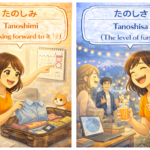
 (Joy holding a coffee cup in the office breakroom, asking a nervous Ken “Nansai desu ka?”, while Raya smiles and an orange cat peeks from a cabinet drawer)
Welcome to “Japanese You Keep Seeing”!
In many cultures, asking someone’s age is a standard way to get to know them. Since Japanese society relies heavily on age and seniority to determine levels of politeness (Keigo), you might think asking 何歳ですか? (Nansai desu ka?) is perfectly normal. However, directly asking for someone’s age can actually be a major social faux pas! Let’s find out why.
🗣 Conversation Scene
Joy, Ken, and Raya are taking a coffee break in the office pantry. They are chatting about classic anime, and Joy wants to know exactly which generation Ken belongs to.Joy
Line 1: 何歳ですか?
Line 2: Nansai desu ka?
Line 3: (How old are you?)
Kenさん、90年代のレトロアニメにすごく詳しいですね。何歳ですか? (Ken-san, you know a lot about 90s retro anime! How old are you?)
Ken
えっと…「永遠の二十歳」ということにしておきましょう!(笑) (Umm… let’s just say I am “forever 20”! *laughs*)
Raya
Joy, asking a Japanese coworker their age directly can make them panic!
💡 Explanation: The Age Dilemma
Age is a very private matter in Japan. While the social hierarchy (Senpai/Kouhai) heavily depends on age, bringing it up bluntly is considered intrusive.1. Why is it sensitive? 🤐
In a business or social setting, knowing someone’s age immediately forces both people to figure out who is older and who must use polite speech (Keigo). By avoiding the age question, people can maintain a smooth, equally polite distance without worrying about hierarchy. Furthermore, many adults simply consider it personal information that is rude to ask, especially for women or older individuals.2. The Polite Alternative: Oikutsu desu ka? 🎩
If you absolutely *must* ask someone’s age (for example, if you are filling out an official form, or if the conversation naturally leads to it), you should never use “Nansai desu ka?”. That phrase is for children! Instead, use the respectful, formal version: おいくつですか? (Oikutsu desu ka?). It literally translates to “How many (years) are you?” and sounds much softer and more elegant.3. The “Indirect” Questioning Strategy 🕵️♀️
Instead of asking age directly, Japanese people often use clever, indirect questions to guess how old someone is:- 干支は何ですか? (Eto wa nan desu ka?): “What is your Chinese Zodiac sign?” (Because the zodiac repeats every 12 years, they can easily guess your exact age based on how you look!)
- 学生時代、何が流行っていましたか? (Gakusei jidai, nani ga hayatte imashita ka?): “What was popular when you were a student?” (Just like Joy tried to do with Ken’s retro anime!)
💎 Pro Tip: The “Hatachi” Rule
There is one age everyone talks about openly: 20 years old! In Japan, 20 is the traditional age of adulthood. When you turn 20, you do not say “Nijuu-sai”. You must use the special word 二十歳 (Hatachi)!
🔥 Practice Quiz
Ready to master the Ko-So-A-Do system?
Want to dive deeper? Check out our official Beginner’s Grammar Book for more examples, detailed explanations, and practice exercises to perfect your Japanese pointing skills!
📖 Read more in the Grammar Book: これ/それ/あれ/どれ