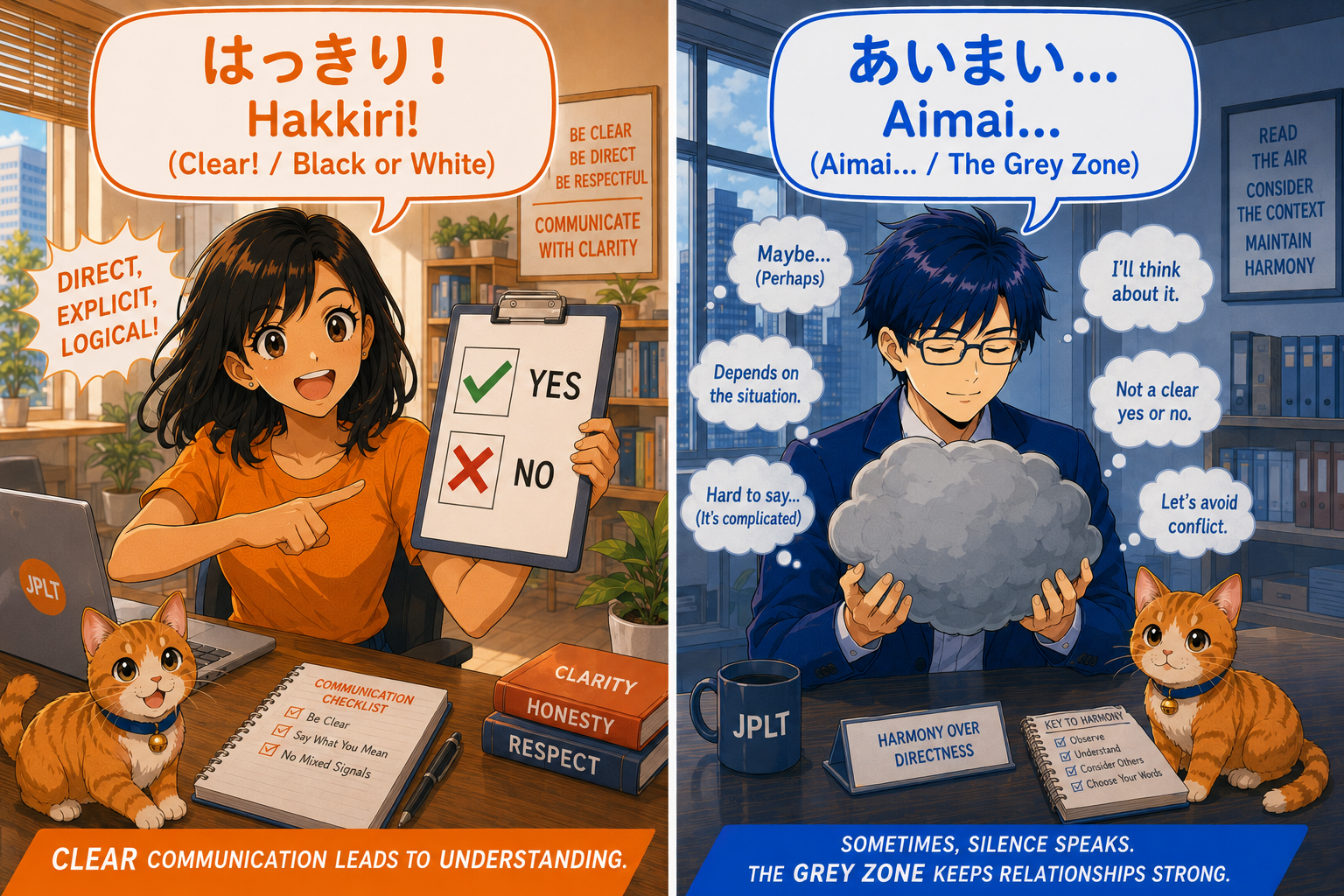
(Joy holding a clear YES/NO clipboard [Black or White] vs. Ken holding a vague grey cloud [Aimai / The Grey Zone])
“This idea is bad. Let’s not do it.” -> 明確表現 (Meikaku – Clear / Black & White)
“We will consider it in a forward-looking manner.” -> あいまい表現 (Aimai – Ambiguous / Grey Zone)
In English-speaking cultures, ambiguity is the enemy of business. Being clear, precise, and “black or white” is a sign of intelligence and respect. In Japan, however, forcing things into “black or white” creates winners and losers, which destroys harmony. To survive, Japanese people rely heavily on あいまい (Aimai – The Grey Zone). Let’s see what happens when Joy submits her new PR visual designs for a major marketing launch.
🗣 Conversation Scene
Joy has created the primary visual communication materials for an upcoming new program launch in Malaysia. She shows the draft to Director Tanaka.
(Director! The PR visual for the new Malaysia program launch is complete! How is it?)
(Hmm… this design is a little “Bimyou”…)
(“Subtle”? Thank you! I went for a delicate design this time!)
[ Tanaka is stunned by her happy reaction. Ken quickly intervenes. ]
(Joy! In Japanese business, “Bimyou” does not mean “subtle/delicate”! It is a classic “Aimai” [ambiguous] expression that means “Not good (NG)”! You have to remake it!)
💡 Explanation
The Power of “Aimai” (Ambiguity)
あいまい (Aimai) means vague or ambiguous. Instead of using clear, aggressive words like “Bad,” “Impossible,” or “Perfect,” Japanese people use “Aimai” words to soften the impact, protect feelings, and leave room for the situation to change.
1. 微妙 (Bimyou) = The Ultimate Grey Word 🌫️
The dictionary translates Bimyou as “subtle” or “delicate.” However, in modern Japanese, it almost always means “Not great,” “I don’t really like it,” or “It’s questionable.” Because it literally means “delicate,” it allows the speaker to express a negative opinion without directly saying “It’s bad” (Warui). If your design is called “Bimyou,” it means you need to rethink it.
2. 一応 (Ichiou) = The Modesty Shield 🛡️
Another classic Aimai word is 一応 (Ichiou), which roughly translates to “for the time being” or “more or less.” In English, if a task is done, you say “It is finished!” In Japan, to avoid sounding arrogant or to protect yourself in case there is a mistake, you add “Ichiou.”
“Ichiou, kansei shimashita” (It is more or less finished). It doesn’t mean it’s half-done; it’s just an Aimai way to lower expectations and show humility.
3. 前向きに検討します (Maemuki ni kentou shimasu) = The Black Hole 🕳️
This is the most famous Aimai phrase in Japanese business. It translates to “We will consider it in a forward-looking manner.” In Western culture, this sounds like a 90% “YES.” In Japan, it is often a polite “NO.” It allows the meeting to end on a positive, harmonious note without anyone losing face, but the proposal will quietly disappear into the grey zone.
📊 Aimai Dictionary
🔥 Practice Quiz
Tap to check the answer!