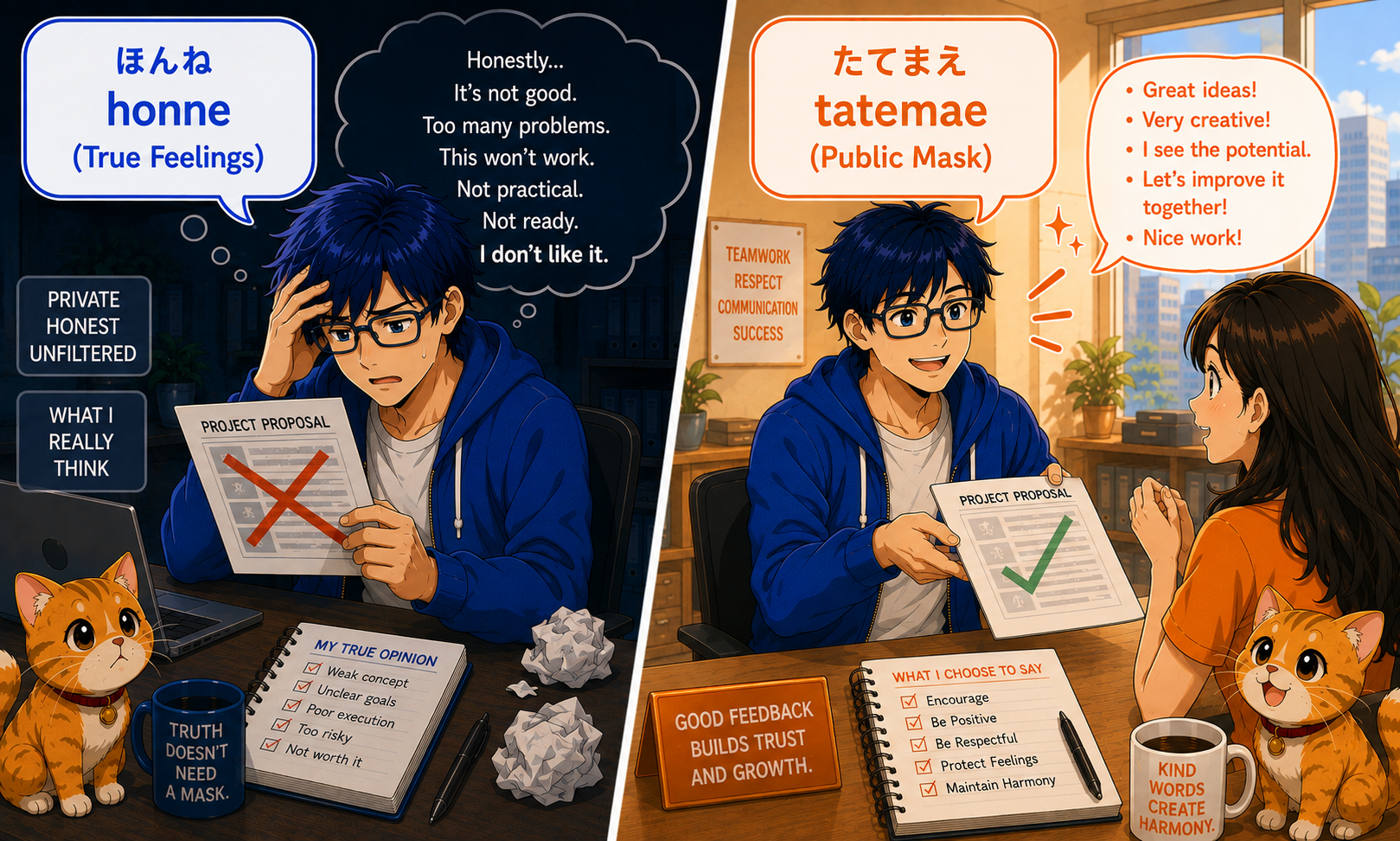
(Ken showing his raw negative feelings in a thought bubble [Honne] vs. Ken showing a polite, supportive smile in public [Tatemae])
“This design is terrible.” -> 本音 (Honne – True Feelings)
“This design is very unique!” -> 建前 (Tatemae – Public Facade)
In many Western cultures, “honesty is the best policy.” People who hide their true opinions are often viewed as fake or untrustworthy. In Japan, however, prioritizing your raw feelings over the group’s comfort is considered selfish and childish. Japanese society runs smoothly because of the balance between 本音 (Honne) and 建前 (Tatemae). Let’s see what happens when Joy submits her visual communication designs for the active season’s social media campaign.
🗣 Conversation Scene
Joy has spent hours creating bold, neon visual materials for the school’s social media. She shows them to Director Tanaka for final approval.
(Director, the visual designs for this active season’s SNS campaign are finished! How are they?)
(Oh… this is a very “unique” design. You worked really hard on this, Joy.)
(Thank you! I’m glad you praised it. I’ll post it right away!)
[ Tanaka’s smile freezes. Ken intercepts Joy before she hits the publish button. ]
(Joy, wait! That was “Tatemae” [Public Facade]! When a Japanese boss says “unique,” their “Honne” [True Feelings] is “It doesn’t match the brand image, please fix it”!)
💡 Explanation
The Mask and the Mind
本音 (Honne) is what you truly think. 建前 (Tatemae) is the socially acceptable response you give to protect harmony. Tatemae is not considered lying; it is a sign of emotional intelligence and respect for others’ feelings.
1. 建前 (Tatemae) = The Public Shield 🛡️
The word *Tatemae* literally means “built in front.” It is the facade you put up in public. In the workplace, giving negative feedback directly can cause a loss of face (shame) for the employee. By saying “It’s very unique” or “You worked hard,” the boss uses Tatemae to acknowledge your effort without endorsing the final product. It is up to you to read between the lines.
2. 本音 (Honne) = The Inner Truth 🧠
The word *Honne* literally means “true sound.” In Japanese society, revealing your Honne in a professional or public setting is dangerous because it can spark conflict. So, when do Japanese people actually reveal their Honne?
* With very close friends and family.
* During 飲み会 (Nomikai – drinking parties). Alcohol provides a socially accepted excuse to drop the Tatemae and speak honestly with coworkers without ruining the daytime office harmony.
3. Decoding Tatemae 🕵️♀️
How do you know if someone is using Tatemae? Look out for praise that focuses on effort rather than the result, or words that are overly vague.
- “面白いアイデアですね” (That’s an interesting idea.)
Honne: That idea is crazy/unrealistic. We won’t do it. - “行けたら行きます” (I’ll go if I can.)
Honne: I have zero intention of going to your party.
📊 Cultural Mindset Table
💎 Pro Tip: The “Iketara Ikimasu” Rule
If you invite a Japanese coworker to dinner and they say 行けたら行きます (Iketara ikimasu – I will go if I can), do not wait for them! This is the ultimate Tatemae phrase for “No.” They are trying to reject your invitation without hurting your feelings.
🔥 Practice Quiz
Tap to check the answer!