Skip to content
JPLT Online Japanese Language Training SchoolJPLT Online Japanese Language Training School
  • Courses
  • Plans
  • Get Started
    • What is JPLT Metaverse Campus
    • How to Enroll
  • JPLT LEARNING GYM
    • What is JPLT LEARNING GYM?
    • BootCamp
    • Studio
    • Season
    • Grammar Book
    • Optional Classes and AOTD
  • Schedule
  • Blog
  • About Us
    • What Is Dialog+ JPLT
    • Teachers
    • Company Profile
    • Contact Us
    • FAQs
  • Login
  • For Business
JPLT Online Japanese Language Training SchoolJPLT Online Japanese Language Training School
  • Courses
  • Plans
  • Get Started
    • What is JPLT Metaverse Campus
    • How to Enroll
  • JPLT LEARNING GYM
    • What is JPLT LEARNING GYM?
    • BootCamp
    • Studio
    • Season
    • Grammar Book
    • Optional Classes and AOTD
  • Schedule
  • Blog
  • About Us
    • What Is Dialog+ JPLT
    • Teachers
    • Company Profile
    • Contact Us
    • FAQs
  • Login
  • For Business
JPLT Blog

The Difference Between「空気を読む」と英語文化の違いの違い |Japanese Grammar (N5–N3)

  • 19 Aug, 2026
  • Com 0
「空気を読む」と英語文化の違い
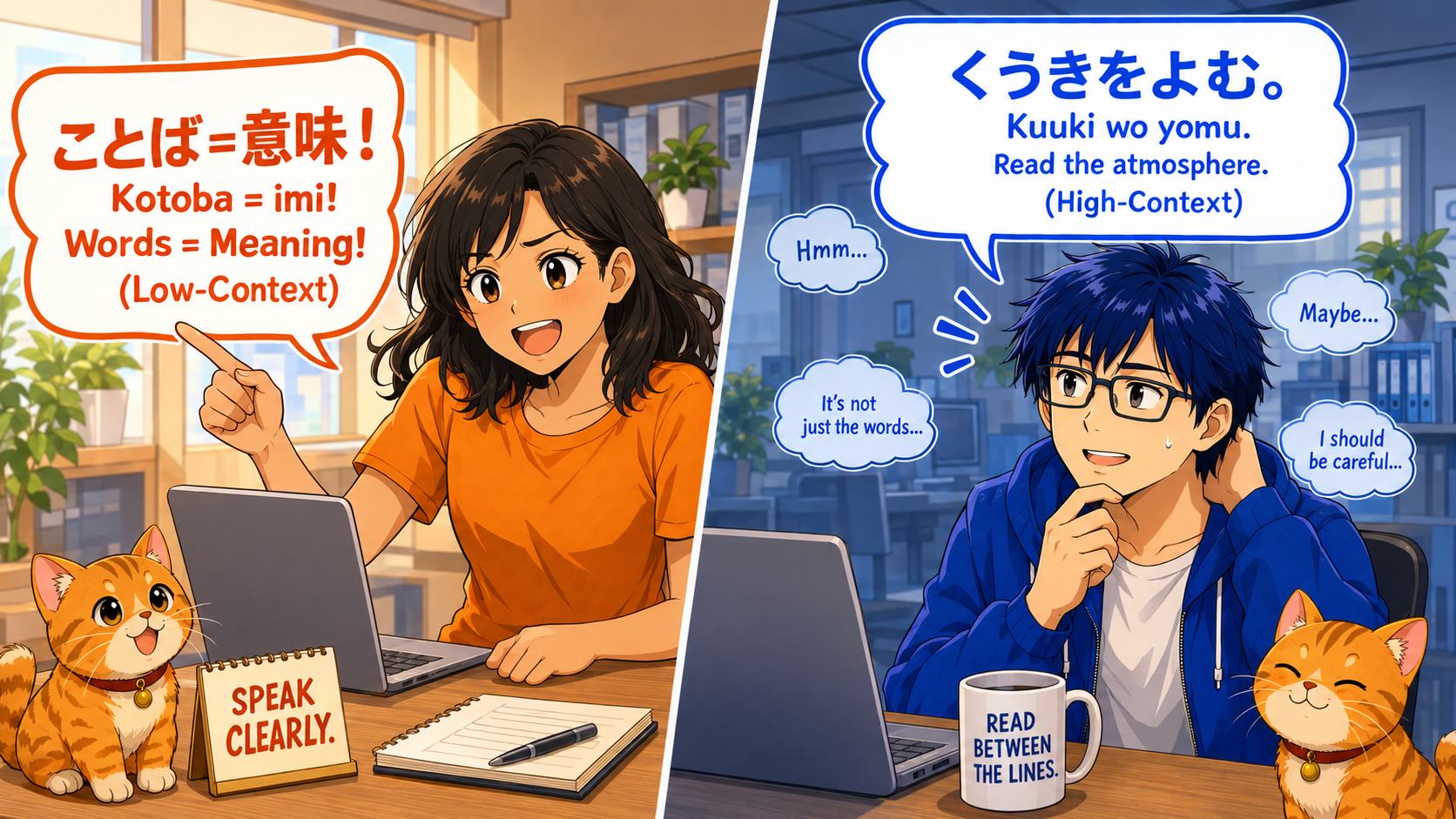
(Joy relying purely on spoken words [Low-Context] vs. Ken observing the atmosphere and unspoken cues [High-Context])

“Say exactly what you mean.” -> Low-Context Culture (English)
“Understand what is left unsaid.” -> High-Context Culture (Japanese)
Have you ever heard the phrase 空気を読む (Kuuki wo yomu – Reading the air)? If someone lacks this skill in Japan, they are called “KY” (Kuuki ga Yomenai). In English-speaking cultures, communication is like a written contract: if it isn’t spoken, it doesn’t exist. In Japan, communication is like a puzzle: the speaker gives you pieces, and you must put them together. Let’s see what happens when Joy tries to organize a teaching schedule with Director Tanaka.

🗣 Conversation Scene

Joy is coordinating the schedule for an upcoming three-hour instruction review and mock test session. She plans to co-conduct it with her colleague, Shannon-san.

Joy
ディレクター、来週の3時間の模擬テストですが、Shannonさんと私で、担当時間を半分ずつ(50/50)に分けようと思います!
(Director, for next week’s three-hour mock test, I am thinking Shannon-san and I will divide the instruction hours in half [50/50]!)
Tanaka
うーん……Shannonさんは今週、通常のシフト時間内で生徒の評価アセスメントをたくさん抱えているんですよね……。
(Hmm… Shannon-san has a lot of student assessment evaluations to do during her regular shift hours this week…) [Trails off into silence]
Joy
ああ、通常シフトに入っているんですね!よかったです。それなら50/50で問題ないですね!
(Oh, she is on her regular shift! That’s good. Then 50/50 is no problem!)

[ Tanaka gives a troubled smile. Ken pulls Joy aside. ]

Ken
Joyさん!空気を読んで!ディレクターは「Shannonさんは忙しすぎるから、Joyさんがもっと多く時間を担当してあげて」と暗に言っているんですよ!
(Joy! Read the air! The Director is implicitly saying, “Shannon-san is too busy, so Joy, please take on more of the hours”!)

💡 Explanation

Low-Context vs. High-Context Communication

⚠️ The Core Concept:
In English (Low-Context), the speaker is 100% responsible for sending a clear message. In Japanese (High-Context), the listener is 50% responsible for decoding the unsaid message by reading the context.

1. The English Way (Low-Context) 🗣️

In a low-context culture, if you want Joy to take more hours, you say it directly: “Shannon is busy, so please take 2 hours and let her do 1 hour.” If you don’t say it clearly, the resulting mistake is the speaker’s fault. Words are treated as absolute facts.

2. The Japanese Way (High-Context / Kuuki wo Yomu) 🌫️

Japan is an island nation with a long history of shared culture. Because people share the same background, they don’t need to explain everything from zero. 空気を読む (Kuuki wo yomu) is not telepathy; it is the skill of picking up context clues.

  • The Unfinished Sentence: When Tanaka said, “Shannon has a lot of evaluations…”, he left the end of the sentence blank. This blank space is where the listener is supposed to read the air and say, “Ah, should I take on more hours?”
  • Protecting Harmony: Why doesn’t Tanaka just order Joy to do it? Because forcing a command creates friction. By letting Joy “realize” it herself, he preserves the illusion of harmony and teamwork.

📊 Cultural Communication Table

Aspect Low-Context (English) High-Context (Japanese)
Where is the meaning? In the words. In the air (tone, hesitation, omissions).
Good Communication is… Direct, explicit, and easy to understand. Nuanced, polite, and protective of feelings.
When a mistake happens… “You didn’t explain it clearly.” “You didn’t read the situation properly.”

💎 How to tell if you missed the air

If you make a direct statement and your Japanese counterpart inhales sharply, tilts their head, says “Sou desu ne…” (Well…), and falls silent, you have missed the air. They are waiting for you to reconsider your statement.

🔥 Practice Quiz

Tap to check the answer!

Q1. You propose a Friday deadline. The client says, “Friday… the weekend is right after that…” and trails off. What do you do?
A. Say, “Yes, so you can relax on the weekend!”
B. Say, “Would Monday be better for you?”
Answer: B (Offer an alternative)
By trailing off, the client is indirectly telling you that Friday is bad for them. “Reading the air” means offering the solution so they don’t have to say “No” to your face.
Q2. True or False: “Kuuki wo yomu” means you must blindly follow whatever the group wants, even if it’s a bad idea.
A. True.
B. False.
Answer: B (False)
Reading the air just means understanding the unspoken context. You can still politely disagree or negotiate, but you must do it softly and respectfully based on the “air” of the room.

Related posts:

Challenges of Learning Japanese: 10 Solutions & Key Points Understanding Gakusei ja nai~n desu and Gakusei ja nai desu Tanoshimi vs Tanoshisa: Understanding their Differences The Difference Between 沈黙の意味が違う?日本語と英語の会話文化の違い |Japanese Grammar (N5–N3)
Share on:
【使い分け】沈黙の意味が違う?日本語と英語の会話文化の違い [日本語学習]
【使い分け】「空気を読む」と英語文化の違いの違い [日本語学習]
JPLT Malaysia

Japanese Learning Resources:

Tips for Learning Japanese Learn Japanese with Mastery Tips Japanese Grammar Book Japanese Learning Hacks Japanese Learning FAQ (日本語) Japanese Learning FAQ (English)

Connect with us!

Inquire Now!
Send us a message to know the latest class schedules. Lessons are conducted in English and Taglish (Tagalog-English).
Please enable JavaScript in your browser to complete this form.
Name *
Loading

Latest Post

Thumb
The Difference Between 直接褒める英語と控えめに褒める日本語の違い の違い |Japanese Grammar
19 Aug, 2026
Thumb
【使い分け】直接褒める英語と控えめに褒める日本語の違い の違い [日本語学習]
19 Aug, 2026
Thumb
【使い分け】建前と本音の違いで失敗しない日本語 の違い [日本語学習]
19 Aug, 2026

Categories

  • Courses (13)
  • Grammar Book (140)
  • JAPANESE LEARNING FAQ (23)
  • Japanese Learning Hacks (9)
  • Japanese Learning TIPS (203)
  • JPLT Blog (258)
  • JPLT NEWS (12)
  • List of media productions (5)
  • にほんごをまなぶTips (199)
  • 日本語学習ハック (9)
JPLT_logo (2)

JPLT (Japanese language training) online school by Dialogplus 

Icon-facebook Icon-instagram Youtube

株式会社ダイアログプラス(Dialog+ Co., Ltd.) 
神奈川県横浜市都筑区南山田二丁目1番1-206号 
Address: 2-1-1-206 Minamiyamada, Tsuzuki-ku, Yokohama Japan 
Website: https://www.dialogplus.co.jp/ 

Dialog+ Philippines
Philippine Address: Unit 7 2/F, Seung Lee Building, Lot 1 Greenwoods Park Rizal Highway, CBD Area, Subic Bay Freeport Zone, Philippines
Website: https://dialogplus.ph/
Email: info@jplt-dialogplus.com

  • Specified Commercial Transaction Law
  • Privacy Policy
  • Terms & Condition
  • Refund Policy
  • JPLT Calendar
  • Admin
JPLT Online Japanese Language Training SchoolJPLT Online Japanese Language Training School