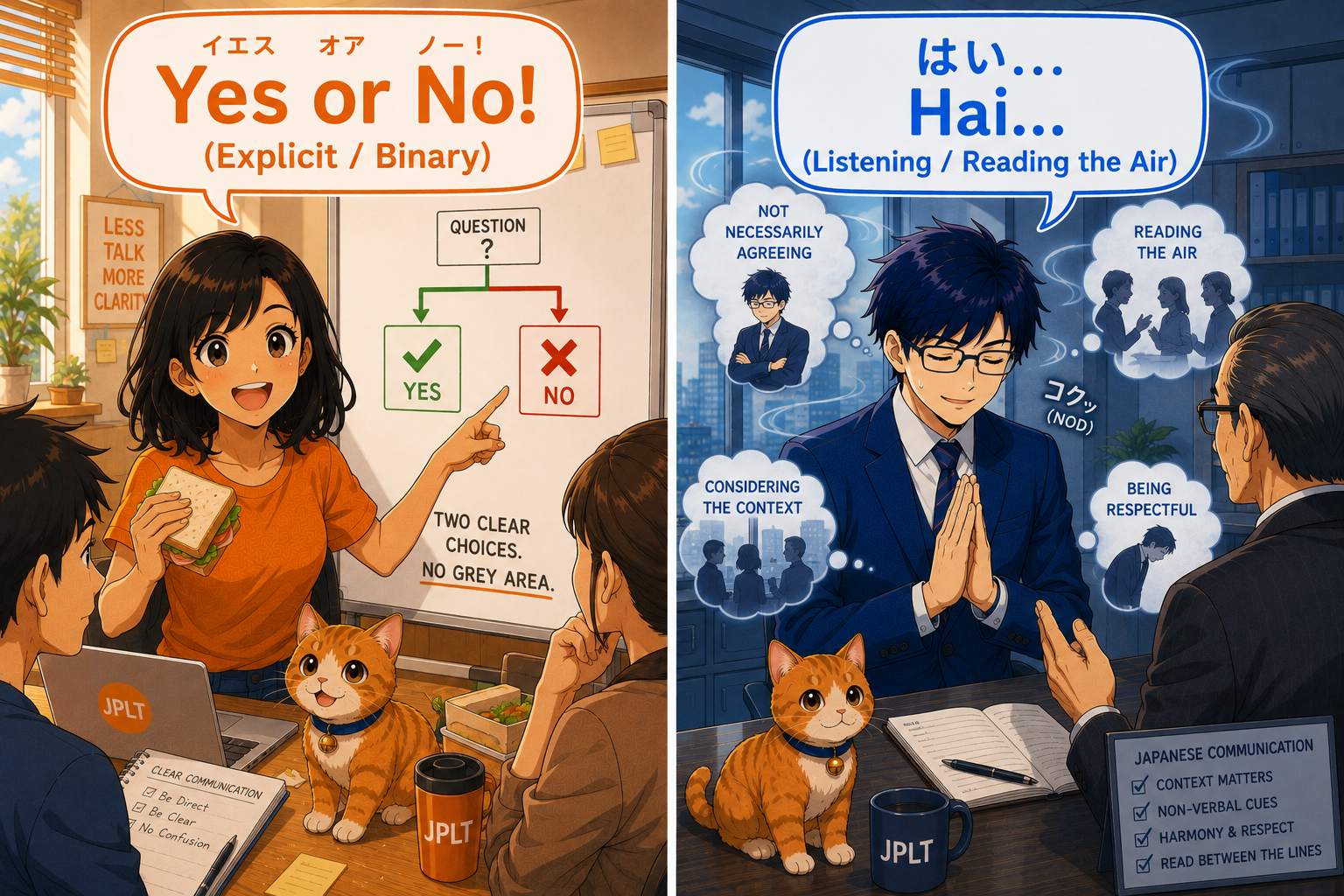
(Joy pointing to a clear Yes/No flowchart [Explicit] vs. Ken nodding while looking hesitant [Reading the Air / Aizuchi])
“Yes, I agree.” -> YES (Binary & Explicit)
“Yes, I hear the words coming out of your mouth.” -> はい (Hai / Aizuchi)
In English, words carry 90% of the meaning. If someone says “Yes,” you have a green light to proceed. In Japan, words only carry about 30% of the meaning. The other 70% is hidden in the 空気 (Kuuki – The Air / Atmosphere). The biggest mistake foreigners make is assuming that the Japanese word はい (Hai) means agreement. Let’s see what happens when Joy proposes a change to the school’s billing system to Director Tanaka.
🗣 Conversation Scene
Joy is suggesting an operational change to the online language school’s subscription plans.
Joy
ディレクター、生徒のサブスクリプションですが、Shopifyの自動請求(Auto-billing)を月額から週額に変更するのはどうでしょうか?
(Director, regarding the student subscriptions, what if we change the Shopify auto-billing from monthly to weekly?)
Tanaka
はい……。そうですね……。(腕を組み、視線を下に落とす)
(“Hai… I see…” [Crosses his arms and looks down at the desk])
Joy
やった!「はい」と言ってくれた!では、すぐにShopifyのシステム設定を変更しますね!
(Yay! He said “Hai/Yes”! Then I will change the Shopify system settings immediately!)
[ Tanaka’s eyes widen in panic. Ken runs over to stop Joy before she changes the billing system! ]
Ken
Joyさん、設定を変えないで!今の「はい」は同意のYESじゃありません!「あなたの言葉は聞こえましたよ」という相槌(Aizuchi)です!空気を読んで!
(Joy, don’t change the settings! Just now, his “Hai” was not an agreement YES! It was Aizuchi [backchanneling] meaning “I heard your words”! Read the air!)
💡 Explanation
Binary Words vs. Atmosphere
⚠️ The Core Concept:
To master Japanese business, you must separate the word はい (Hai) from the English word “Yes.” In Japan, listening attentively and showing you hear the other person is more important than giving an immediate, binary answer.
1. The Trap of Aizuchi (相槌) 🗣️
Japanese speakers constantly say “Hai,” “Ee,” and “Sou desu ne” while you are talking. This is called
相槌 (Aizuchi). It does
not mean they agree with your logic. It simply means, “I am paying attention to you.” If you pitch an idea and the client says “Hai… hai…”, they are just being polite listeners. Never assume the deal is closed until you receive an explicit, active confirmation.
2. 空気を読む (Kuuki wo yomu) – Reading the Air 🌫️
Because direct refusal is considered rude, you must “Read the Air.” You do this by looking at three things:
1. The Speed: A fast, bright “Hai!” usually means genuine agreement. A slow, trailing “Hai…” means doubt.
2. The Body Language: Nodding while smiling is good. Crossing arms, tilting the head, or inhaling sharply through the teeth means “Absolutely not.”
3. The Follow-up: If “Hai” is followed by silence, or “Sore wa chotto…” (That is a little bit…), the true answer is NO.
3. Answering Negative Questions 🤔
The English YES/NO system is logic-based. If someone asks, “You didn’t eat?” you say “No, I didn’t.”
The Japanese system is relationship-based. You are agreeing with the
speaker’s statement.
“You didn’t eat?” ->
はい、食べていません (Yes, what you said is correct. I didn’t eat.)
If you say “No” (Iie) in Japanese, you are telling the speaker they are wrong!
📊 How to decode “Hai”
| What they do |
What they say |
True Meaning (The Air) |
| Smile + Quick nod |
「はい!いいですね!」(Hai! Ii desu ne!) |
100% Agreement. Go ahead. |
| Nodding while you speak |
「はい。はい。」(Hai. Hai.) |
Aizuchi. “I am listening, keep talking.” |
| Look away + Crossed arms |
「はい……。そうですね……。」(Hai… sou desu ne…) |
Polite Disagreement. The answer is NO. |
💎 Pro Tip: Getting True Confirmation
Because “Hai” is so ambiguous, how do you know if your boss actually approved your idea? Never rely on “Hai.” Wait for an active command verb, such as: 「進めてください」 (Susumete kudasai – Please proceed) or 「それでいきましょう」 (Sore de ikimashou – Let’s go with that).
🔥 Practice Quiz
Tap to check the answer!
Q1. You present a new marketing strategy. The client inhales sharply, tilts their head, and says “Hai… omoshiroi desu ne…” (Yes… it is interesting…). What does this mean?
A. They love the idea and want to use it.
B. They don’t like the idea, but are trying to be polite.
Answer: B (They don’t like the idea)
The sharp inhale (sucking air through teeth) and head tilt are massive red flags in Japanese “air.” The “Hai” is just a polite filler.
Q2. A coworker asks you: “You haven’t finished the report yet?” You have NOT finished it. How do you reply in Japanese?
A. Iie, mada desu. (No, not yet.)
B. Hai, mada desu. (Yes, not yet.)
Answer: B (Hai, mada desu)
In Japanese, you say “Hai” (Yes) to confirm that the other person’s negative statement is correct.